AUTOMOTIVE: Tesla In Reverse

Tesla faces its gravest crisis yet with plummeting sales, legal battles, and brand toxicity. Can Musk’s desperate sales intervention save the company he built?
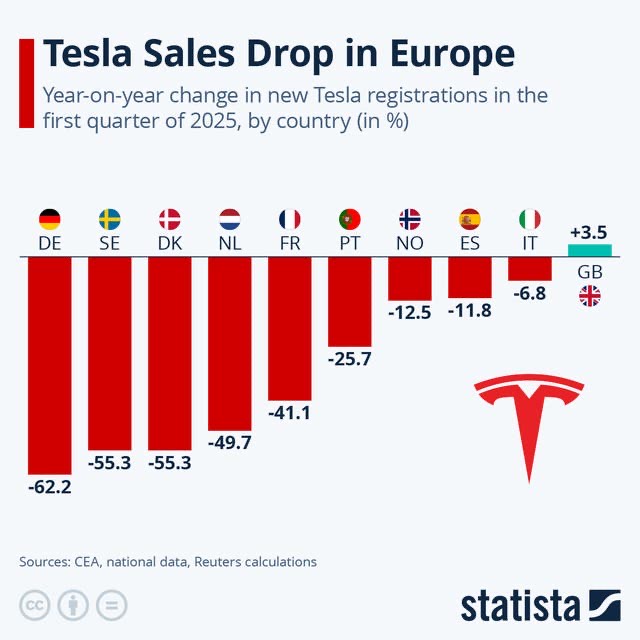
Tesla Sales Slump. A Company In Reverse.
The numbers tell a brutal story. Tesla’s second-quarter deliveries plummeted 13.5% year-on-year to just 384,000 vehicles, whilst European sales collapsed by as much as 45% in early 2025. Even in Tesla’s stronghold markets of China and the United States, rivals including BYD, Volkswagen, and Hyundai are systematically dismantling the company’s once-impregnable market position.

What began as isolated competitive pressure has metastasised into an existential crisis encompassing product stagnation, mounting legal challenges, and a brand toxicity that would have been unthinkable just two years ago. Elon Musk’s response – personally commandeering Tesla’s sales operations from the company’s headquarters – represents either inspired leadership or desperate theatre. The evidence suggests the latter.

Tesla’s troubles extend far beyond routine quarterly fluctuations. Industry analysts point to a fundamental product problem: the company has launched no genuinely new mainstream models since the divisive Cybertruck, leaving its core range looking increasingly antiquated. The Model S and Model X, now approaching their second decade, lack the technological edge that once justified premium pricing, whilst even the refreshed Model 3 and Model Y variants have failed to generate meaningful market excitement.

Manufacturing bottlenecks from Model Y production transitions have exacerbated inventory buildups, creating the paradox of falling sales alongside unsold stock. “Tesla is caught between worlds,” explains one former executive who departed the company last year. “They’re trying to maintain premium positioning whilst competing on volume, and it’s not working.”

The human cost of these missteps extends beyond shareholders. Recent months have witnessed an exodus of senior talent, including the head of North American sales and key battery engineering leaders, suggesting internal recognition that current strategies are failing.

Perhaps more damaging than operational setbacks is Tesla’s reputational crisis. Musk’s increasingly vocal political alignment, particularly his association with Donald Trump, has triggered what industry observers term a “consumer revolt” in traditionally progressive markets where Tesla once dominated.

The “Tesla Takedown” movement, documented across social media platforms, encompasses everything from organised boycotts to physical vandalism of vehicles. Resale values have declined accordingly, with specialist automotive data firms recording measurable drops in Tesla’s brand perception scores throughout 2025.

“We’re seeing something unprecedented,” notes Professor Sarah Davidson, who studies automotive consumer behaviour at Warwick Business School. “Political polarisation is directly impacting purchase decisions in ways we’ve never measured before. Tesla owners are reporting embarrassment about their vehicles.”

Tesla’s troubles extend into America’s courtrooms, where multiple high-stakes cases threaten both immediate operations and long-term viability. California’s Department of Motor Vehicles is pursuing a 30-day sales ban over allegedly misleading advertising of Autopilot and Full Self-Driving capabilities, a move that would devastate Tesla’s largest single market.

Simultaneously, a wrongful death trial in Miami centres on Autopilot’s role in a fatal 2019 crash, with potential punitive damages that could establish precedents for autonomous vehicle liability. Legal experts suggest the outcome could fundamentally reshape how self-driving technologies are marketed and deployed. Tesla’s very own Trolley Car Problem.

Beyond these headline cases, Tesla faces a growing constellation of “phantom braking” complaints, quality control lawsuits, and antitrust challenges to its repair monopoly. Each represents not merely financial exposure but further erosion of consumer confidence in Tesla’s core technologies.

Central to Tesla’s current predicament is a business model that once represented revolutionary thinking but now appears increasingly anachronistic. The company’s rejection of traditional franchise dealerships delivered early advantages in pricing control and customer experience, yet state-level dealership protection laws have created a patchwork of legal restrictions that limit Tesla’s expansion opportunities.

More problematically, Tesla’s insistence on controlling all aspects of vehicle servicing has created what consumer advocates term a “repair monopoly.” Owners face extended delays, higher costs, and limited alternatives when vehicles require maintenance, issues that traditional franchise networks handle through distributed infrastructure and competitive pricing.

“The direct-to-consumer model worked brilliantly when Tesla was a premium niche player with devoted customers,” observes automotive retail consultant James Morrison. “But mass-market consumers expect convenience and choice that Tesla’s current structure simply cannot deliver at scale.”

Industry data supports this assessment. Whilst traditional manufacturers leverage dealer networks to manage demand fluctuations and regional variations, Tesla must shoulder these burdens independently. The resulting bottlenecks in service capacity and inventory management become particularly acute during periods of market stress.

Reports from Tesla’s Fremont headquarters suggest Musk has resumed the hands-on approach that characterised the company’s early years, reportedly employing Musk’ peculiar trademark of sleeping at the facility whilst personally directing sales strategy. The company has rolled out aggressive incentive programmes including discounted financing, complimentary software trials, and targeted offers for military veterans and educators.

These measures represent classic demand stimulation tactics, designed to shore up quarterly numbers ahead of Tesla’s earnings announcement. However, automotive industry veterans express scepticism about their long-term effectiveness.

“Incentives are a sugar rush,” explains former General Motors executive Patricia Williams, now an independent consultant. “They can mask underlying problems temporarily, but they don’t address fundamental issues of product competitiveness or brand perception. Tesla’s challenges are structural, not tactical.”

Stock market analysts echo this assessment, noting that Tesla’s current crisis encompasses precisely the factors that discount-driven sales campaigns cannot address: ageing product lines, manufacturing inefficiencies, legal liabilities, and consumer sentiment.

Tesla’s recovery requires acknowledgement that its original advantages have largely evaporated. The company’s technological lead has narrowed considerably, with competitors matching or exceeding Tesla’s capabilities in areas from battery range to autonomous features. Meanwhile, manufacturing cost advantages have disappeared as established automakers achieve economies of scale in electric vehicle production.

Perhaps most critically, Tesla must confront the limitations of its direct-to-consumer model. Industry experts suggest hybrid approaches, incorporating elements of traditional franchise or agency partnerships, could address current bottlenecks whilst maintaining some operational control.

“Tesla needs to swallow its pride about the dealership model,” argues automotive strategist David Chen. “The best aspects of direct-to-consumer can be preserved whilst addressing the very real scalability and service issues that are alienating customers.”

Similarly, product renewal cannot wait for revolutionary technologies. Tesla requires incremental but meaningful updates to its existing range, coupled with genuinely new models that recapture market imagination.

Where is the Tesla equivalent ‘Dolphin Surf’ or WuLing Baojun’s funky “Yue Ye” a Suzuki Jimny impersonator, on price and desirability?

Tesla’s current predicament represents more than routine corporate turbulence. The company faces simultaneous challenges across every aspect of its operations, from product development to legal compliance to consumer perception. Musk’s personal intervention in sales operations, whilst symbolically significant, addresses none of these fundamental issues.

The electric vehicle market Tesla created has matured beyond recognition, populated by government funded capable competitors offering consumers genuine alternatives. Tesla’s survival depends not on charismatic leadership or promotional campaigns, but on systematic operational reform that acknowledges this new reality.

Whether Musk and his leadership team possess the humility to undertake such reform remains the critical question facing Tesla shareholders, employees, and customers. The company’s next chapter will be written not in boardrooms or Twitter feeds, but in the quotidian work of building better products and serving customers more effectively than increasingly capable rivals.

The Tesla revolution may be ending. What comes next depends entirely on the company’s willingness to evolve beyond the mythology that created it.

DIGITAL MARKETING: The 2025 Creator Content Premium

Why Creator Content is Outperforming Traditional Advertising

The marketing landscape has changed dramatically in recent years, with the rise of the creator economy at the heart of this transformation. New research confirms what many marketers have suspected: content made by creators doesn’t just match the impact of traditional advertising, it actually outperforms it. This is true for both long-term brand equity and short-term sales.

What the Research Tells Us

Several recent studies have compared creator content directly with standard industry advertising. The findings are compelling:

– Superior Performance: Creator content consistently beats traditional adverts on measures such as emotional resonance, memorability, and trustworthiness.
– Emotional Connection: Viewers are much more likely to feel an emotional response to content made by creators. In some cases, up to a third of people reported a genuine emotional reaction, which is invaluable for brands aiming to stay top of mind.
– Real Results: Brands aren’t just seeing warm feelings. Around 70% of brands say their most successful campaigns have involved creators, and most believe that creator-led content delivers a better return on investment than conventional adverts.
– Driving Action: Research shows that 80% of consumers have taken action after engaging with creator content, whether that’s looking up a brand, following them on social media, or making a purchase.

Why Are Creators So Effective?

There are a few key reasons why creators deliver such impressive results:

– Authenticity: People trust real voices more than polished adverts. Creators speak directly to their followers, often sharing personal stories and honest opinions. This authenticity is especially valued by younger audiences, who are increasingly sceptical of anything that feels too scripted.
– Emotional Engagement: Creators are skilled at building genuine connections with their communities. When a creator is enthusiastic about a product, that excitement rubs off on their audience, making a real difference to brand recall.
– Relevance: Creator content is often tailored to the interests and needs of a specific audience, making it far more relevant and effective than generic advertising.

The Power of Short-Form Video

Platforms like TikTok, Instagram Reels, and YouTube Shorts have amplified the impact of creator content. Short-form videos are quick, engaging, and perfectly suited to the way we consume media today. Nearly half of UK social shoppers say they’ve bought something after seeing it featured by a creator.

What Does This Mean for Brands?

The message is clear: if you want to make a real impact, it’s time to invest in creator partnerships. As the digital world becomes more crowded and AI-generated content becomes more common, the human touch offered by creators will only become more valuable.

Brands that embrace this shift and work with creators who genuinely align with their values are set to reap the rewards, both now and in the future.

–  “When creators grab and hold attention in social feeds, it generates an extended emotional reaction that fosters deep connections with the brand, driving brand memory and making it easier and faster for audiences to recall brands when making purchasing decisions.” Ben Jeffries, CEO of Influencer.

In summary, creator content isn’t just a passing trend. It’s the new gold standard for building brands and driving sales in the digital age.

DIGITAL MARKETING: Get An Upgrade

Get An Upgrade Website SEO Offer

Ready to transform your digital presence? Introducing a state-of-the-art website offer that’s designed to elevate your brand, engage your audience, and drive results.

Six great reasons to refresh your website and digital presence today:

– Instantly boost your credibility and authority with a modern, professional design.

– Enhance user experience and keep visitors engaged with seamless navigation and updated features.

– Improve security and reduce the risk of hacks by upgrading to the latest technology.

– Stay ahead of competitors by integrating the newest tools and functionalities your audience expects.

– Save time and improve customer service with easier site management and automation.

– Expand your reach and connect with a global audience 24/7 – your website never sleeps.

Don’t let an outdated site hold your business back. Ready for a digital upgrade? Let’s chat and unlock your brand’s full potential!

A website is for life, not just for Christmas. Take a look at the projects page for more details about Steve Coulter Creative, the team and our work to update and fine tune your digital marketing.

DIGITAL MARKETING: What Is Off Page SEO?

Understanding Off-Page SEO

Off Page SEO refers to all the activities you do outside of your own website to improve its search engine rankings. Think of it as building your site’s reputation and authority across the internet. While on-page SEO is like making your house beautiful on the inside, off-page SEO is like getting your neighbours to say great things about your house.

Key Components of Off-Page SEO

Backlinks:
The most important element of off-page SEO is earning quality backlinks i.e. when other websites link to yours. These act like votes of confidence in your content. However, not all backlinks are created equal:

– High Quality Backlinks: Links from reputable, relevant websites in your industry
– Natural Backlinks: Earned through great content rather than paid or manipulated
– Relevant Backlinks: Coming from sites related to your industry or topic

Brand Mentions:
When people talk about your brand online, even without linking to you, it helps build authority. These come in two forms:
– Linked mentions: When your brand name is mentioned with a link
– Unlinked mentions: When your brand is mentioned without a link

Social Signals:
While not direct ranking factors, social media activity can indirectly boost your SEO by:
– Increasing content visibility
– Driving traffic to your website
– Building brand awareness
– Creating opportunities for natural backlinks

Content Marketing:
Creating shareable content that naturally attracts backlinks and mentions:
– Industry research and studies
– Infographics
– Expert interviews
– Comprehensive guides
– Original data and statistics

Guest Posting:
Writing valuable content for other reputable websites in your industry:
– Sharing expertise with new audiences
– Building relationships with other sites
– Earning quality backlinks
– Establishing industry authority

Effective Off Page SEO Strategies

Building Real Relationships:
– Networking with industry influencers
– Participating in relevant online communities
– Engaging with your audience on social media
– Collaborating with other businesses

Creating Link-Worthy Content:
– Develop unique, valuable resources
– Conduct original research
– Create detailed guides and tutorials
– Share expert insights and analysis

Local SEO Activities:
– Managing Google Business Profile
– Getting listed in local directories
– Earning local reviews
– Participating in community events

Online Reputation Management:
– Monitoring brand mentions
– Responding to reviews
– Managing online presence
– Building positive relationships

Best Practices for Off-Page SEO

1. Focus on quality over quantity in backlinks
2. Build genuine relationships in your industry
3. Create content worth linking to
4. Engage authentically on social media
5. Monitor and manage your online reputation
6. Avoid techniques like buying links
7. Think long term rather than quick wins
8. Stay active in your industry community

What to Avoid

– Buying links
– Participating in link schemes
– Spamming comments on other sites
– Creating fake reviews
– Using automated link-building tools
– Engaging in link exchanges
– Creating low-quality guest posts

Remember, effective off-page SEO takes time and patience. Focus on building genuine relationships and creating valuable content that naturally attracts attention and links. Think of it as building your brand’s reputation, there are no shortcuts to earning real trust and authority in your industry.

Off-page SEO might be considered the Dark Arts of website optimisation, but with time and effort they have a disproportionate effect on your search results. Any website that ranks highly without sponsored Pay Per Click will have effective off-page SEO.

Please contact me if you would like to maximise your website’s effectiveness.

DIGITAL MARKETING: Why You Need A WordPress Website

Why Your Business Needs a WordPress Website: Here’s 10 Compelling Reasons to Invest. 

Are you running a small or medium-sized business without a proper website? Or indeed a dated or broken one? You’re leaving money on the table. WordPress powers over 43% of all websites on the internet, and there’s a good reason for that. Here’s why your business should invest in an affordable WordPress website from Team SCC today.

1. Cost-Effective Solution

WordPress from Team SCC offers professional-looking templates and themes at a very affordable cost. In addition to your website you only need to pay a nominal amount for hosting, a great domain name, and occasionally premium themes or plugins.

2. Easy to Update Without Technical Skills

Remember the days of calling your web developer for every small change? WordPress puts you in control. The user-friendly dashboard lets you update content, add images, and publish blog posts as easily as using Microsoft Word. Your team can handle it without any coding knowledge. Of course Team SCC are here in reserve!

3. Mobile-Ready Out of the Box

Your customers are on their phones – your website needs to be too. Modern WordPress themes automatically adjust to any screen size, whether it’s a smartphone, tablet, or desktop. No extra work needed on your part. Dynamic Websites R Us!

4. Built-In SEO Features

Getting found on Google is vital for business growth. WordPress comes with built-in SEO features and can be enhanced with powerful plugins. Better search rankings mean more customers finding your business naturally. So, it pays for itself.

5. Scalable as Your Business Grows

Starting small? Low budget? No problem. WordPress grows with you. Add new features, pages, or even an online store when you’re ready. Major brands like The Walt Disney Company and Sony Music use WordPress – it’s that scalable. We build great e-commerce websites using WP.

6. Extensive Plugin Marketplace

Need a contact form? Want to add social media feeds? Looking to start email marketing? There’s a plugin for everything. WordPress’s plugin directory has over 59,000 free options to extend your website’s functionality.

7. Security and Regular Updates

WordPress is actively maintained by thousands of developers worldwide. Regular security updates keep your website safe from cyber threats. With basic security plugins and good hosting, your site stays protected.

8. Built-In Blog Platform

Content marketing drives sales, and WordPress started as a blogging platform. I was there! Share your expertise, announce new products, or keep customers updated – all from the same dashboard you use to manage your website.

9. Support from Team SCC

Team SCC is ready to help if your site is malfunctioning or there is an upgrade you need, or an update you’re uncertain about.

10. Integration with Business Tools

Connect your website with the tools you already use. WordPress plays nice with everything from payment processors and CRM systems to social media platforms and email marketing services. We can help here too.

Take Action Today

Don’t let your competition get ahead. Setting up a WordPress website with Team SCC is easier than you think:

1. We can recommend a reliable and sustainable hosting provider

2. Select a great domain name and a professional theme that suits your brand

3. Install the essential plugins

4. Add SEO & CAI* optimised content

5. Press Go!

Your business deserves a strong online presence, and WordPress & Team SCC makes it possible without breaking the bank.

Your future customers are searching online right now. Make sure they find you with a professional website.

Call or message me to get started.

—-

Steve Coulter the principal at SCC is a Sales & Marketing expert, consultant & creative with 35+ years in senior leadership & entrepreneurship, primarily in automotive & e-commerce. A tech-savvy early adopter helping businesses evolve & grow.​​​​​​​​​​​​​​​​

*CAI is Conversational AI – the searchable content of the future. 

DIGITAL MARKETING: The New Kid On The Block.

I’m going to introduce you to an innovation around Internet search you have possibly not heard about, but will undoubtedly dominate the conversation (excuse the pun) in the near future.

Every now and then there’s a paradigm shift that alters the way we behave and that moves from something niche, to serious mainstream. Have you ever read Malcolm Gladwell’s The Tipping Point? I recommend it to anyone interested in human behaviour and especially where everyday technology applies.

If you are relying upon your website and its performance in search and in 2025 that means Google, you need to understand there is a new kid on the block who is not going away.

That’s ‘Conversational Search’ or CCAI to give it the correct acronym. The usurper of SEO?

Have you noticed how you might have started to use conversational language in the search field? Example a search ‘Rolex For Sale Near Me’ becomes ‘What are the most popular new luxury watches that hold their value?’.

If people are searching the latter and you’ve optimised your site only to rank on Google or with less relevancy or authoritative information you won’t do so well in CCAI, that could have profound effects on your business. As the investment guru Warren Buffet says ‘If you have all your eggs in one basket, you better keep an eye on the basket’. I’d put money on the majority of business owners being myopic about their Google ranking with little interest in alternatives. Let’s be honest, people like me exist because many businesses are not even strong on Google!

So, is CCAI the future of online information retrieval? In January 2025, the landscape of online search is rapidly evolving. CCAI is gaining traction and challenging the traditional search paradigm nowadays dominated by Google. But could it replace the search giant and undermine our SEO tactics? I’m old enough to remember the Nineties where ranking, even inclusion on Yahoo was vital to search success. Anyone remember Alta Vista?

Advantages of Conversational AI Search

  1. Natural Interactions: Users can ask questions in their own words, making the search process more intuitive and user-friendly.
  2. Direct Answers: Instead of a list of links, CCAI provides concise, contextually relevant responses, saving time and effort. Great for research.
  3. Personalisation: AI can tailor responses based on user preferences and previous interactions, offering a more personalised experience.

Challenges and Limitations

  1. Accuracy Concerns: While improving, we’re still at ‘Ford Model T’ stage, AI can still misinterpret queries or provide incomplete information.
  2. Data Recency: Traditional search engines often have more up-to-date information, crucial for current events and rapidly changing topics.
  3. Comprehensive Results: Google’s vast index and sophisticated algorithms still provide a broad range of sources and perspectives although have you noticed how dated many search results are nowadays?
  4. Self Referencing: A real issue with AI is self referencing, where results from AI are included in new website content, thus in time overemphasise importance.

My Verdict

While Conversational AI search is making significant strides, it’s unlikely to completely replace Google in the near future. Instead, we’re moving towards a complementary ecosystem where both technologies coexist, each serving different user needs and preferences. As professionals, it’s crucial to stay informed about these advancements and consider how they might impact our industries. We’ve become complacent with Google SEO fettling, the future of these new search alternatives is exciting, and it’s clear AI will have a role in reshaping it.

What are your thoughts on the future of search? Have you begun to use conversational language in your Internet searches? What will you do to create content that searches effectively in all models?

__
As ever, please Like, Share, Save and Follow and please contact me if you would like to discuss improving your digital marketing and growth strategy.

ADVERT: DIGITAL MARKETING FROM £99 P/M

Satisfy your New Year Resolution to kickstart your business growth in 2025!

JANUARY SPECIAL OFFER

Steve Coulter Creative Facebook Post 001 - 070125


Professional digital marketing services from just £99 per month. 

– Boost your presence online and on social media.
– Drive quality enquiries to your business.
– Start conversations with new prospects.
– Achieve measurable results to improve next time.

MIX & MATCH

Let’s work together, whether your website is lagging behind in search results, locally or against your competitors, or your social media channels lack direction, we can work out a bespoke plan for January and the future.

– SEO – (Search Engine Optimisation) Optimise your website to rank higher in local search.
– Google Search – Improve your local search results.
– Social Media – Create branded eye-catching posts with great content and hashtags.
– Audit your complete online presence and strategy.

Unlike other agencies whose similar offer is limited to an amount of social posts we will work together on a specific area of your digital marketing that requires improvement.

Reasonably priced upgrade, copywriting and scheduling offers available.

Don’t miss out, this offer ends 31st January. Contact me today and let’s work together.

DIGITAL MARKETING: How Strong Is Your Strategy?

A strong digital strategy integrates your website, SEO, and social media to create a cohesive and effective online presence. With a well designed fast loading website optimised for search engines, you attract the right audience and drive organic traffic – that’s FREE traffic. Pair this with strategic social media marketing, and you amplify reach, engagement, and brand authority, converting visitors into loyal customers.

Loyal customers are the life blood of every business.

Let’s review your business and objectives to increase website traffic and social media engagement.

Call me today on +44 (0)7407 038877

What's Your Strategy?

DIGITAL MARKETING: 5 Great Small Business Growth Tips

5 Affordable Digital Marketing Tips to Grow Your Small Business

Growing a small business can feel like an uphill battle, especially when your budget is tight. But with the right strategies, you don’t need a huge marketing budget to see great results. Here’s a breakdown of five powerful (and affordable!) tactics you can start using today to boost your visibility and attract more customers.

1. Affordable SEO Services for Small Businesses

SEO doesn’t have to be expensive to be effective. Small businesses can start by focusing on local SEO, optimise your site for local search terms, claim your Google Business Profile, and build backlinks from local directories. You can also use free SEO tools like Google Search Console or Semrush to help find keywords and fix any site issues that might be holding back your rankings.

Quick Tip: Write blog posts that answer common customer questions – Google loves content that solves problems.

2. How to Improve Social Media Engagement for Business

Getting likes and shares is great, but the real gold in social media is engagement. To build a loyal audience, you need to post content that sparks a conversation. Use interactive posts like polls, Q&A sessions, and live videos. Share behind-the-scenes moments, success stories, and most importantly, respond to comments. The more personal you get, the more people will engage.

Quick Tip: Ask open-ended questions to encourage followers to share their thoughts- it’s an easy way to get the conversation started.

3. Lead Generation Strategies for Local Businesses

For local businesses, lead generation is all about getting noticed by people in your area. Start by partnering with local influencers or complementary businesses to cross-promote. You can also create location-based offers, like exclusive discounts for nearby residents. Don’t forget about paid search ads on Google or Facebook targeting your local area—these are a cost-effective way to put your business in front of the right people.

Quick Tip: Offer a special promotion tied to local events or holidays to attract more foot traffic and leads.

4. Low-Cost Google Business Page Setup

One of the most effective ways to get more local traffic is by setting up and optimising your Google Business Profile (GBP). It’s free and helps your business show up in local search results. Fill out every section of your profile, including hours of operation, business description, and photos. Encourage happy customers to leave reviews—more reviews mean higher rankings in local search results.

Quick Tip: Add posts and updates to your Google Business Profile regularly to keep your listing active and engaging.

5. How to Boost Online Visibility for SMEs

If you want to be seen, you need to be everywhere your audience is. Combine SEO, social media marketing, and content marketing for a comprehensive visibility strategy. Focus on creating valuable content that your audience cares about, whether it’s blog posts, videos, or infographics. Use paid ads to reach new customers, but balance it with a strong organic presence to build long-term trust.

Quick Tip: Use data from tools like Google Analytics to track what’s working and tweak your approach based on real insights.

Conclusion: Ready to Grow Your Business Without Breaking the Bank?

These strategies are affordable, effective, and easy to implement. Whether you’re just starting out or looking to scale, there’s something here for every small business. Get in touch today for a Free Consultation, and let’s create a personalised plan to help you grow your business and boost your online visibility and ultimately, profit.

DIGITAL MARKETING: 5 Top Strategies For SME Businesses

In the fast-paced world of digital marketing, staying ahead is crucial. Especially for SMEs trying to compete with larger competitors and their budgets! From SEO tactics to social media growth, here’s a quick guide to five key strategies every small business owner should be mastering right now.

1. Digital Marketing Strategies for SME

Small businesses often have limited budgets, but that doesn’t mean they can’t outsmart the competition. A smart strategy blends organic and paid tactics to maximise visibility. Focus on high-ROI channels like local SEO to dominate search results in your area and social media marketing to engage directly with your audience. The key? Target the right people with the right message, and don’t be afraid to experiment with low-cost PPC campaigns to supplement organic growth.

Quick Tip: Don’t stretch yourself thin. Pick 2-3 digital marketing channels that align with your audience and double down.

2. SEO Tips for Small Businesses

SEO can seem like a puzzle, but with the right pieces it’s a great way to boost traffic. Start by optimising your website for local search with Google Business Profile, ensuring you’re visible in local searches. Then focus on on-page SEO—ensure your site is fast, mobile-friendly, and packed with high-quality content that answers your customers’ questions. Don’t forget to build backlinks from relevant sites; they’re SEO gold.

Quick Tip: Consistently publish valuable, keyword-optimised content. Google loves fresh material.

3. Social Media Marketing for Business Growth

Whether you’re a B2B or B2C business, social media is your direct line to customers. But simply posting isn’t enough—you need to create content that resonates. Tap into user-generated content, behind-the-scenes stories, and interactive polls to get your audience involved. Additionally, running paid ads on platforms like Facebook or Instagram can give your brand an immediate visibility boost.

Quick Tip: Video content is king. Short, engaging clips grab attention and drive engagement more than any other format. Which video platform is best for you? Think about Instagram Reels, YouTube or TikTok?

4. Content Marketing Strategies for B2B

B2B content marketing isn’t about volume; it’s about delivering the right information to the right decision-makers. Educational blog posts, white-papers, and case studies are your bread and butter here. Focus on thought leadership to position your brand as the expert in your field. And don’t forget to promote your content across LinkedIn and industry-specific forums to extend your reach.

Quick Tip: Repurpose your content—turn a blog post into a webinar, infographic, or video to maximise its impact.

5. Digital Marketing Trends for 2024

Looking ahead, AI tools are helping businesses automate and optimise everything from content creation to customer segmentation, while hyper-personalisation tactics are becoming more advanced.

Quick Tip: Stay agile—2024 will reward businesses that quickly adapt to new technologies and trends.

Conclusion: Ready to Take Your Marketing to the Next Level?

Don’t just read about it—take action! Implement these strategies and watch your business grow. Want more tailored advice on how to boost your digital marketing? Just Call for a free consultation, and let’s get started on transforming your marketing strategy into a powerful profit and business growth engine.

DIGITAL MARKETING: Unlock Your Business Potential

Unlock your business potential with highly effective Digital Marketing.

I can help your business marketing by providing services like;

Content Creation -Blog posts, website copy, social media posts and product campaigns.
Search Engine Optimisation (SEO) – is employing educational, authentic and trusted content with specific keywords. It is the key to great low cost Organic Growth.
Social Media Management – Content ideas, scheduling strategies and engagement.
Brand Messaging – Taglines, value propositions, and mission statements.
Local Business – Repeat and referral business is the life blood. Maximise your business locally with an optimised Google Business Profile (GBP) I have great experience with this model of customer acquisition and retention.

I have nearly four decades experience in Sales & Marketing SME (Small & Medium Size) businesses. Please call me today to discuss how I may help you.

The cost? Always fair.

m: U.K. 07407 038877
m: International. +44 7407 038877
e-mail: steve@stevecoulter.co.uk