ESTATE AGENCY: Wake Up, You Have Website Paralysis

There is a clear and consistent issue across local estate agent websites. They are not built to generate business. They are built to exist.

Most agents rely heavily on portals like Rightmove and Zoopla for leads, treating their own website as a secondary asset. That creates a risk. If portal costs rise or performance drops, many firms have no reliable, owned source of enquiries. The automotive sector has already felt this pressure with Autotrader. Estate agency is heading in the same direction.

At the same time, most websites are under-optimised.

Common problems include thin location pages, duplicated property content, weak internal linking and outdated metadata. More importantly, there is little alignment with how people actually search. Buyers and sellers are asking detailed, intent-driven questions, yet very few agent websites provide meaningful answers.

This is where the real gap sits.

Content is often shallow and self-focused rather than useful. There is little coverage of the full customer journey, from early research through to decision. As a result, agents miss out on valuable organic traffic and fail to build authority in their local market.

Generative search adds another layer. Most sites are not structured in a way that AI systems can easily understand or trust. Without depth, clarity and consistency, they are unlikely to appear in AI-driven results.

Keyword gap analysis typically reveals hundreds of missed opportunities across local, long-tail and high-intent searches. Opportunity gap analysis then shows which of these are actually worth pursuing based on competition and conversion potential.

The bigger issue is strategic. Most estate agent websites are not designed as end to end marketing systems. They attract limited traffic, offer little engagement and convert poorly.

A more effective approach combines technical SEO, structured content, GEO readiness and clear conversion pathways. This turns a website from a passive brochure into an active source of instructions.

The opportunity is significant. Agents who invest in their own digital presence can reduce reliance on portals, improve margins and build a more stable pipeline of leads.

Right now, most are not doing this.

That is where the advantage lies.

To establish where you are today and understand where you could be tomorrow contact me and we can run an OPTIMUM V2 Ecosystem report.

ESTATE AGENCY: Urgent – An Existential Threat

There is a quiet scandal running through the UK property market, and it is not interest rates or planning delays. It sits in plain sight on the websites of local estate agents. Pages that should be generating instructions and sales are instead acting as digital dead weight. Thin content. Broken structure. No meaningful optimisation, and almost no understanding of how search has evolved beyond keywords into intent, context and generative discovery.

For an industry built on visibility, the irony is hard to ignore. Let me explain.

The invisible estate agent

Most local agents believe they “have SEO covered” because they rank for their own brand name and perhaps a handful of obvious phrases like “houses for sale in [ANYTOWN]”. That is not strategy. That is baseline existence.

What is missing is depth.

A typical audit reveals the same patterns again and again. Location pages with few words. Duplicate property descriptions reused across portals and the website. Blog sections abandoned after three posts. Metadata written once and never revisited. Internal linking that feels accidental rather than designed.

Worse still, there is almost no alignment with how people actually search today. Buyers, sellers and landlords are not just typing “estate agent Chichester”. They are asking layered, specific questions:

  • How much is my house worth in West Sussex right now
  • Best areas to buy near the coast with good schools
  • Should I sell before interest rates change
  • What adds value before listing a property

If your website does not answer those questions, someone else’s will.

The portal dependency problem

There is another issue, more strategic and arguably more dangerous. The overwhelming reliance on property portals.

For years, agents have leaned heavily on platforms such as Rightmove and Zoopla to drive enquiries. It has worked, to a point. But it has also created a structural weakness.

When the majority of your leads come from third-party platforms, you are not in control of your own demand. You are renting attention, not owning it.

This leaves agents exposed to two very real risks:

  • Significant price increases that erode margins
  • Declining lead volumes or engagement as user behaviour shifts

The automotive sector has already lived through this with Autotrader. Rising costs and dependency created a squeeze that many dealers struggled to escape.

Estate agency is on a similar path.

If portal performance drops or costs climb sharply, many agents will find they have little in the way of a fallback. Their own websites, which should act as a primary acquisition channel, are simply not strong enough.

Agents must invest in their own real estate, excuse the pun. Their websites need to become destinations in their own right, not just supporting assets.

The content gap no one talks about

Content in estate agency is often treated as an afterthought, something to tick off rather than build properly. Yet it is the single biggest lever for organic growth.

The gap is not just volume. It is relevance and structure.

Most agents produce content that talks about themselves. Awards. Listings. Announcements. That might reassure an existing client, but it does nothing to attract a new one.

What is missing is content mapped to the full journey:

  • Early stage curiosity: market trends, local guides, lifestyle insights
  • Mid stage consideration: valuation advice, selling timelines, cost breakdowns
  • Late stage decision: why choose this agent, proof, case studies

Without this, the website becomes a brochure rather than a system.

GEO: the shift agents are not prepared for

Search is no longer just about ten blue links. Generative engines are now summarising, recommending and answering directly. This is where Generative Engine Optimisation, or GEO, comes into play.

Most estate agent sites are completely unprepared for this shift.

They lack:

  • Structured, authoritative answers to common questions
  • Clear topical authority within defined geographic areas
  • Consistent entity signals across content
  • Depth that allows AI systems to trust and surface them

In practical terms, this means your agency is unlikely to appear in AI-generated responses about your own patch.

That is not a future problem. It is happening now.

The technical blind spot

Technical SEO in estate agency websites is often treated as a one-off build task rather than an ongoing discipline.

Common issues include:

  • Slow load speeds, especially on mobile
  • Poor Core Web Vitals
  • Broken schema implementation for properties and local business data
  • Weak internal linking architecture
  • Crawl inefficiencies that waste search engine attention

Individually, these might seem minor. Together, they suppress performance across the entire site.

Keyword gaps: the missed demand

When you run a proper keyword gap analysis against local competitors, the results are often stark.

Agents are missing hundreds, sometimes thousands, of relevant search terms tied to:

  • Micro-locations within their core area
  • Property types and buyer personas
  • Long-tail informational queries
  • Seasonal and market-driven trends

These are not vanity keywords. They represent real demand from people actively researching property decisions.

Ignoring them is not just an oversight. It is lost revenue.

Opportunity gaps: where growth actually sits

Keyword gaps tell you what you are missing. Opportunity gap analysis tells you what matters most.

This is where most strategies fall apart. Agents either chase high-volume terms they cannot realistically win, or they ignore lower-volume opportunities that convert far better.

A proper opportunity analysis looks at:

  • Commercial intent versus informational intent
  • Competition level within the local market
  • Content feasibility and speed to rank
  • Conversion potential once traffic arrives

The result is a prioritised roadmap, not a scattergun list.

The end to end proposition problem

Perhaps the most significant gap is not technical or content-driven. It is strategic.

Most estate agent websites are not built as end to end marketing systems. They are built as digital shop windows.

An effective digital proposition should:

  • Attract traffic through targeted SEO and GEO
  • Engage visitors with meaningful, relevant content
  • Capture leads through clear, well-placed conversion points
  • Nurture those leads with ongoing value
  • Reinforce trust through proof and authority

Without this, even strong traffic numbers can fail to translate into instructions.

Where OPTIMUM V2 changes the game

This is where a structured auditing framework like OPTIMUM V2 becomes critical.

Rather than looking at isolated elements, it evaluates the full digital ecosystem:

  • Technical SEO performance and crawl efficiency
  • Content depth, relevance and topical authority
  • GEO readiness and generative visibility
  • Keyword gap identification across the local market
  • Opportunity gap prioritisation based on real commercial value
  • Conversion pathways and user journey effectiveness

The outcome is not just a list of issues. It is a clear, actionable strategy that aligns visibility with revenue.

The scale of the opportunity

Here is the uncomfortable truth. Most local estate agents are competing on brand, fees and personality, while ignoring the most scalable acquisition channel available to them.

That creates a rare window.

An agent who properly invests in SEO, content and GEO can reduce dependency on portals, build a direct pipeline of demand, and take back control of their margins.

Not through gimmicks, but through consistency, depth and strategic clarity.

Final thought

The property market will always be competitive. That will not change.

What can change, quickly, is how visible you are within it, and how much of that visibility you actually own.

Right now, too many estate agent websites are underperforming not because of external pressures, but because of internal neglect. Thin content. Weak structure. No clear strategy. And an overreliance on third-party platforms that may not always serve their interests.

Fix those, and the shift is not incremental. It is transformative.

The opportunity is already there. Most just have not seen it yet.

Please contact me if you’d like to analyse your business using the OPTIMUM V2 Ecosystem.

DIGITAL MARKETING: Introducing OPTIMUM V1 – How Will You Score?

OPTIMUM V1 Ecosystem – a comprehensive SEO and Generative Engine Optimisation audit delivering actionable insights, competitor gap analysis, and AI citation readiness, built on ethical, GDPR-compliant foundations.

State Of The Art, Ethical and Regulatory Compliant.

Like to learn more?

The OPTIMUM V1 Ecosystem is a fully integrated SEO and Generative Engine Optimisation (GEO) audit framework built for organisations that expect more than surface-level diagnostics. Designed for digital leaders, marketing directors, and growth-focused teams, it delivers a forensic, end-to-end assessment of search visibility, content performance, and AI discoverability – all within a single, coherent system.

At its core, OPTIMUM V1 goes beyond conventional auditing. It identifies structural weaknesses, uncovers competitive gaps, and produces clear, prioritised recommendations grounded in real-world impact. From technical SEO and content architecture through to entity optimisation and AI citation readiness, every output is engineered to be actionable, not theoretical.

What sets the ecosystem apart is its breadth without compromise. Each module – including advanced competitor gap analysis and GEO alignment – operates to a consistent standard of depth and accuracy, ensuring no blind spots across the modern search landscape. The result is a holistic view that connects traditional ranking factors with emerging AI-driven discovery patterns.

Equally critical is its foundation in ethical practice and regulatory compliance. OPTIMUM V1 is built with strict adherence to GDPR principles, including data minimisation and zero retention of personal data. Its crawler operates transparently, respecting robots.txt protocols, enforcing rate limits, and defaulting to non-intrusive analysis where permissions are restricted. This is not just best practice – it is non-negotiable design.

For businesses navigating an increasingly complex search environment, OPTIMUM V1 provides clarity, precision, and strategic direction — a high-calibre audit ecosystem designed not only to diagnose performance, but to define the path to sustained visibility, authority and profit.

For more information please contact me

Technology: The Comprehension Gap

To stay abreast of technology and remain relevant in the sales and marketing industry I‘ve spent years mastering Web 3.0, the Metaverse, Cryptocurrency, and more recently Generative Engine Optimisation and AI Summary citations. The problem? These skills are useless if few people understand them. Businesses can’t adopt what they don’t grasp and in straightened times most won’t invest the time, money, or mental energy required to bridge that gap. The technology stalls and my consultancy stalls with it.

I’ve called it The Comprehension Gap. Given the title, I’ve attempted to be as concise as possible.


Every few years the internet reinvents itself.

Web3. The metaverse. Now AI. Each wave promises to change everything. Yet the same problem repeats: most people don’t really understand what it’s for.

That’s not a failing – it’s the point.

Mass adoption doesn’t happen because technology is clever. It happens when an average person can see the value without needing it explained. When the benefit is obvious, usage follows. When it’s not, adoption stalls.

Meta’s metaverse rebrand this decade is the sharpest example. Since 2020, it has burned more than seventy billion dollars building a future most couldn’t grasp. Not because the tech failed, but because the value wasn’t clear enough to justify the effort.

Most people didn’t reject it. They simply couldn’t answer a basic question: Why would I use this?

Web3 hit the same wall. Decentralisation, tokens, secure wallets, NFTs, blockchains. Technically clever, but hard to understand beyond enthusiasts. For most, the cost of understanding outweighed any benefit.

Here’s the uncomfortable truth:

  • If people need to learn new language before seeing value, adoption will be slow.
  • If using the tech feels like work, most will opt out.
  • If the benefit can’t be explained simply, it won’t spread.

This isn’t dumbing down. It’s how adoption works – remember Malcolm Gladwell’s description in The Tipping Point?.

The early internet succeeded because it didn’t ask people to change how they thought. Email felt like post. Search felt like asking a question. Social networks felt like a conversation. You didn’t need to understand the system. You just used it.

Web3 and the metaverse flipped this. They asked people to understand a fairly complicated premise first, then participate, then maybe benefit later. That order guarantees failure outside niches.

This gap between what technology can do and what average people grasp is expensive.

Big platforms pay for it. When users don’t “get it”, marketing becomes education, support becomes consultancy. Growth slows. Costs rise. Confidence evaporates.

Agencies pay too. Clients want to move forward but don’t understand what they’re signing up for. Strategy becomes explanation. Delivery becomes risk. Fees stop matching effort. Everyone feels busy; no one feels certain. An easy to confirm first page ranking becomes a ‘possible’ AI summary citation if the wind is in the right direction.

More truths:

  • When clients don’t understand the tech, they don’t trust outcomes.
  • When they don’t trust outcomes, they don’t commit long term.
  • When they don’t commit, adoption never scales.

Now AI and AI-driven search risk the same gap.

AI feels familiar. It fits on top of what we already do: write, search, research, plan. But the systems beneath are opaque. Rankings disappear. Attribution blurs. Decisions come from models that don’t explain themselves. The decision requires a leap of faith and businesses don’t run on faith.

For business leaders, that’s unsettling. Old rules vanish; new ones aren’t clear. Understanding lags behind capability.

When that happens, behaviour shifts. People hesitate. Budgets freeze. Vendors promising certainty gain power. Bad decisions follow.

This isn’t an innovation problem. It’s a comprehension problem.

Technology reshapes society only when it becomes boring enough to feel obvious. When people stop asking what it is and start asking how to use it. That moment won’t come if capability runs ahead of understanding.

The lesson from Web3 and the metaverse: the ideas weren’t wrong, but they weren’t simple enough for mass adoption.

AI won’t escape that fate unless it crosses the same line. The next internet phase won’t be won by the smartest systems. It will be won by the ones that make sense to non-experts.

Because mass adoption happens only when average comprehension is enough. Anything needing more will stay niche, no matter how much money pours in.

OPINION: Cars As iPhones

On a recent trip to the cinema I was presented with two new car adverts, both glossy. My cynical joke about the Range Rover that the owner was driving into the dealer for warranty work was soon overshadowed by the normalisation of a homogenised MG ‘SUV’ being £35000 as the basic price. But of course nobody pays the cash price nowadays, they mentally justify the purchase as multiples of their iPhone monthly payment. Cars as iPhones is a masterclass in behavioural psychology. 


Sometime in the last decade I described modern car buying as the iPhonication of the forecourt and if anything the idea has aged better than most of the vehicles now sold under it.

There was a time when the first question was the price. The full price. A number large enough to demand a pause and some moral arithmetic. Today nobody asks that. They ask how much a month, and the rest is treated as background noise, like terms and conditions or the weather.

The trick is simple. We no longer evaluate cars as capital purchases but as subscriptions. The monthly payment is quietly reconciled against the iPhone in your pocket. Fifty quid a month for a phone feels normal. Three hundred quid a month for a car becomes six phones. You already live with one. Why not six sitting outside?

This is not financial logic so much as consumer conditioning.

PCP and PCH did not just change how cars are paid for, they changed how they are justified. Ownership became vague, temporary, almost impolite to mention. What mattered was whether the number could slip into the standing orders without causing an argument. Once it could, permission was granted.

Electric cars pushed this model to its logical conclusion. On paper many are startlingly expensive. In practice they arrive softened by language about efficiency, tax, sustainability and the future. The monthly figure does the heavy lifting. Nobody emotionally processes fifty or sixty thousand pounds. They process four hundred a month by comparing it to phones, streaming services and a gym membership they forgot to cancel.

The iPhone model also smuggles in another assumption, that upgrading is natural and permanence is old fashioned. You do not keep a phone for a decade. You refresh it, guilt free, because you were never meant to own it outright. PCP borrows that psychology wholesale. Three years, hand it back, move on, feel modern.

Electric cars lean into this harder than most. Big screens, software updates, range improvements promised just around the corner. They are sold less as machines and more as devices, which makes their disposability feel progressive rather than wasteful.

The danger is that when everything is framed as affordable monthly, nothing feels expensive anymore. Stretch the term, adjust the mileage, tweak the deposit and almost anything can be made to behave. The decision shifts from judgement to tolerance. Not can I afford this, but can I live with it?

That is a profound change. It moves cost out of focus and replaces it with habit. Comparison does the rest.

‘The electric transition is often presented as a clean break from the past, but it has been powered by the most contemporary consumer mechanism of all. Permanent payment and planned obsolescence, wrapped in virtue and delivered by direct debit.’

The propulsion may be changing, but the mindset is familiar. We have not made cars cheaper. We have just learned how to stop looking at the whole number, and how to measure our lives in iPhones instead.

LINKEDIN: The Logic Behind The 2026 Algorithm Pt.1

LinkedIn’s 2026 algorithm is widely being discussed as a technical update, but that framing misses the point. What’s actually happening is an identity shift: the platform is moving away from real-time feed dynamics and towards long-term professional relevance. My four part article explores why LinkedIn no longer behaves like a social network, how persistence has replaced velocity, and why the content that now survives looks suspiciously like material designed for answer engines rather than feeds.


Part I: The Day LinkedIn Stopped Being a Feed

There was a time when LinkedIn was a feed in the old sense of the word. A stream of updates, opinions, announcements and personal reinvention, moving fast enough that yesterday’s certainty was already buried by lunchtime.

That time has passed.

What most people are calling the “2026 algorithm update” isn’t really an update at all. It’s an identity change. LinkedIn has quietly stopped behaving like a social network and started behaving like something else entirely: a professional relevance engine.

The tell isn’t reach. Reach is a lagging indicator and always has been. The tell is what persists. Posts that should have died hang around. Conversations resurface days later. Certain voices appear again and again, not because they shout, but because the platform seems oddly reluctant to let them go.

This isn’t nostalgia or favouritism. It’s structural.

The old feed rewarded motion. Frequency, velocity, visible engagement. The new system rewards something closer to stability. Ideas that hold together. Arguments that don’t collapse when challenged. Thinking that survives being returned to.

That alone should sound familiar to anyone paying attention to how AI answer engines work.

AI systems are not interested in novelty for novelty’s sake. They are interested in material that can be retrieved, summarised, abstracted and reused without distortion. LinkedIn, it turns out, is now optimising for the same thing.

Which means it’s no longer ranking posts. It’s curating candidate knowledge.

Most people are still posting as if they’re feeding a stream. The platform, meanwhile, is quietly building a library.


Tomorrow, Part 2. Why The Algorithm Now Thinks Like An Answer Engine.

AI: Search Summaries – Christmas 2025 Essay

I’ve spent 2025 understanding Generative Engine Optimisation and AI Search Summary preeminence at an academic level. The complacency regarding this phenomenon in business is shocking, but from a behavioural psychology perspective not unexpected. Thankfully it’s not too late for your business to capitalise.


The Most Dangerous Assumption in Search Right Now

The most dangerous assumption business owners are making today is not that AI search will fail. It is that it will behave like search always has.

Those working closely with Generative Engine Optimisation already know the uncomfortable truth. Search is no longer primarily about ranking pages. It is about being recognised as a source of truth inside an answer that may never send a click at all. Yet across industries, business leaders remain curiously relaxed. Revenue still comes in. Rankings still look acceptable. Dashboards do not scream emergency.

This is precisely the problem.

AI summaries do not announce disruption with penalties or crashes. They erode relevance quietly. They absorb demand upstream. They reward authority before most organisations realise authority is being measured differently.

For years, visibility meant position. First page. Top three. Number one. The mental model was simple and it worked. Now the interface itself has changed.

‘The search engine no longer asks users to choose. It decides, synthesises and presents a conclusion. If your brand is not present in that synthesis, you are not competing. You are absent.’

Many business owners struggle to internalise this because absence is invisible. There is no warning light for being excluded from an AI-generated answer. Traffic does not collapse overnight. Leads taper slowly. Performance reviews become conversations about seasonality, budgets or market conditions. The real cause remains unseen.

Complacency is reinforced by past success. If traditional SEO, paid media and brand recognition have delivered growth for a decade, it feels reasonable to assume they will continue to do so. That assumption is understandable. It is also historically naïve. Every major platform shift has rewarded early adopters and punished those who waited for certainty.

There is also a deep misunderstanding about what AI systems value. Many businesses believe that being good at what they do is enough. Decades of experience. Strong client relationships. Industry reputation. None of this automatically translates into AI authority.

Generative systems privilege clarity, consistency and structure. They reward entities that are easy to understand, easy to verify and easy to cite. Expertise that lives only in people’s heads, sales conversations or poorly structured content might as well not exist.

This is confronting. It implies that real-world authority is not sufficient. That uncomfortable implication is often dismissed rather than addressed.

‘Another factor is fatigue. Business leaders have lived through years of algorithm updates, platform volatility and digital false dawns. Each new shift sounds like noise until it becomes unavoidable. AI summaries are therefore filed mentally alongside blockchain, voice search or the metaverse. Interesting, perhaps important one day, but not urgent.’

The flaw in that thinking is scale and intent. AI summaries are not an experiment at the edge of search. They are becoming the interface itself. They sit directly between demand and discovery. They collapse the journey from question to conclusion.

When experts raise the alarm, they are often ignored because they are early. Early warnings always sound theoretical. Yet AI systems do not wait for consensus. They learn continuously. They establish citation hierarchies long before markets agree they matter. In other words, they value early adoption.

So by the time AI summary inclusion is widely recognised as critical, the sources deemed authoritative will already be entrenched. Catching up will be far harder than acting now.

This is not about chasing another optimisation tactic. It is about ensuring your business is legible to machines that increasingly decide which voices are heard at all.

‘The real risk is not being outranked. It is being unrecognised.’

Unrecognised businesses do not fail dramatically. They fade quietly, wondering where the demand went, while answers are being given elsewhere.


Steve Coulter is a four decades Sales and Marketing professional and enthusiast who has embraced the Internet and e-Commerce since 1999.

AI: The Missing Link in AI Success: Smarter Processes

Unlocking the Real Value of AI: Why Better Process Management Is the Transformation We’ve Been Waiting For.

Discover how AI-driven process management boosts efficiency, unifies workflows, and unlocks real ROI from digital transformation.


For all the breathless talk of digital transformation over the past decade, a sobering truth remains: many organisations still aren’t seeing the productivity gains they were promised. AI, automation, cloud platforms, dashboards, they’ve all been rolled out with gusto. Yet according to McKinsey, roughly 30 per cent of employee time is lost to non-value-added data work. That’s almost a third of the working week squandered on fiddly tasks, data clean-up, and administrative churn.

So where’s the disconnect? If the technology is so clever, why are teams still bogged down?

A recent Harvard Business Review webinar on AI-driven process management put the spotlight firmly on this question. The message was clear: AI won’t deliver unless the underlying processes are fit for purpose. It’s not the tools holding companies back, but the messy, silo’d, poorly designed workflows they’re bolted onto. The most successful organisations take a more holistic approach – one where people, processes, and technology are treated as a single, joined-up system.

Below are the four core methods highlighted for turning scattered tech deployments into genuine enterprise breakthroughs.


1. Uniting workflows across operations for exponential business gains

Most companies still run on disjointed workflows, marketing does things one way, operations another, service teams yet another. Systems don’t talk; data doesn’t flow. AI applied in isolation simply automates inefficiency.

A harder, organisation-wide look at how work actually moves is needed. When workflows are unified, not just patched together through software, but deliberately redesigned end-to-end, something striking happens: AI can amplify value across the entire chain, not just in pockets.

It’s the difference between fixing isolated tasks and streamlining the whole machine. Shared data standards remove rework. Clean handovers cut delays. AI then sits on top of this connected backbone, spotting opportunities, predicting bottlenecks, and enabling better decisions at speed.

The real gains don’t come from making one part of the process faster, but from making the whole system work together.


2. Continuously optimising processes with AI insights

Traditional process improvement is static – you design a workflow, deploy it, and revisit it from time to time. But organisations now operate in a constantly shifting environment of changing demand, new regulations, supply chain pressures, and evolving customer expectations.

AI allows for something far more dynamic. Rather than waiting for problems to surface, AI can monitor processes in real time, catching inefficiencies the moment they appear. It can flag duplicated work, highlight data anomalies, and even predict delays before they hit.

This represents a shift from project-based improvement to ‘always-on optimisation”. Process improvement becomes a living, continuous function rather than an occasional tidy-up. Companies that embrace this rhythm will be far better equipped to adapt and stay competitive.


3. Streamlining experiences for seamless service

Despite all the investment in digital tools, many organisations still deliver clunky, fragmented experiences. One system asks for information the last system already collected. A service rep spends ten minutes hunting for a record. The front end looks polished, while the back end lags decades behind.

Thoughtful process management is crucial here. When processes are designed from the user’s point of view rather than the organisation’s internal structure, the entire experience becomes smoother and far more intuitive.

AI then elevates this further. It can route requests instantly, personalise interactions, and adjust workflows to individual needs. It strips away friction so thoroughly that the technology becomes invisible, and users simply get what they need quickly and without fuss.

People aren’t asking for more AI, they’re asking for better experiences. Well-designed processes make that possible.


4. Maximising efficiency at scale with AI-powered workflows

Scaling efficiency has long been a stumbling block. A clever bit of automation may thrive in one department but collapse under the weight of enterprise-wide rollout.

AI-powered workflows offer a way around this. They adapt, refine, and improve as they encounter new situations. When these workflows sit on top of clean processes and trustworthy data, they can scale without the usual growing pains.

This isn’t about squeezing more work out of fewer people. It’s about freeing teams from drudgery so they can focus on the work that genuinely adds value, decision-making, innovation, and customer engagement.

The result is a modern operating model where efficiency becomes a compounding advantage rather than a one-off win.


The bottom line

Digital transformation hasn’t failed for lack of technology. It has faltered because the technology was placed on top of processes that weren’t ready for it.

By unifying workflows, embracing continuous optimisation, designing seamless experiences, and embedding AI-powered workflows throughout operations, organisations can finally unlock the productivity gains they’ve been chasing.

Get the processes right, and AI doesn’t just automate the present, it opens the door to a far more efficient and future-ready enterprise.


Steve Coulter is a working lifetime business owner, manager, director and marketer involved with digital marketing since 1999. Nowadays AI Search expert, digital marketing & AI thought leader and brand engagement strategist.

Author of; The Definitive Guide To Digital Transformation For Legacy Businesses, Ultimate GEO & NATO Spec: Elite Team Tactics for Business

BRAND POSITIONING: Ferrari’s Sweet Spot

Ferrari stands apart in an industry obsessed with scale. While most manufacturers fight for volume, Ferrari has mastered a different discipline: limiting supply, elevating value and turning every car into a high-margin work of desire. This article explores how the company builds demand and preserves profitability, and what SME owners can learn from its approach.


How Ferrari Creates Demand and Delivers Exceptional Profitability.

Ferrari occupies a position in the automotive world that most manufacturers can only admire from a distance. While mass-market brands chase volume and market share, Ferrari has built an entirely different model: one centred on scarcity, high margins and the careful cultivation of desire. The result is an output that is small in number yet immense in profitability, with profit per car that vastly exceeds that of other manufacturers.

Ferrari’s approach begins with the most basic principle of luxury: make less than people want. The company has long limited production to preserve exclusivity. This is not an afterthought but an intentional design. By keeping supply below demand, Ferrari ensures that its cars retain their status and that waiting lists remain part of the experience. The company does not allow the market to dictate volume. It sets its own pace, and customers follow.

This scarcity underpins Ferrari’s pricing power. Other manufacturers often rely on discounts, incentives and high-volume strategies to keep factories running. Ferrari has no need for any of that. Its prices are high because the brand has earned the right to command them, and because customers know that owning a Ferrari is not simply about buying a car but joining a very particular world.

Personalisation plays a major part in this. Each car can be tailored to an extraordinary degree, through bespoke colours, materials and technical options. These additions are not mere extras. They contribute a substantial share of Ferrari’s margins, turning each vehicle into a highly profitable commission rather than a standard product rolling off the line.

Financial results reflect this model. Ferrari consistently posts operating margins that resemble those of luxury fashion houses rather than car companies. In recent years its operating margin has approached levels that other manufacturers would consider out of reach. On a per-car basis its profitability is exceptional, far above that of both mass-market and premium brands. Where many manufacturers make modest earnings on each unit and rely on scale to survive, Ferrari achieves remarkable profitability from a relatively small number of cars.

The strength of the brand is central to all of this. Ferrari has built a mythology over decades of racing heritage, iconic design and uncompromising performance. The emblem alone carries weight that few other marques can match. Customers are not simply purchasing horsepower or engineering. They are buying history, identity and the sense of belonging to a long-established tradition.

This strategy also brings resilience. Because the business is not dependent on huge volumes, it is less vulnerable to the fluctuations that affect the wider automotive market. The company generates strong cash flow, allowing it to invest steadily in new technologies while maintaining the exclusivity that supports its market position.

Ferrari’s success offers a clear lesson for other industries. Growth does not always require expansion in numbers. A tightly controlled supply, supported by a strong brand and meaningful personalisation, can create a more stable and profitable model than sheer scale. It is a reminder that in certain sectors, demand is not simply found. It can be cultivated through patience, discipline and a clear sense of identity.

The Lesson For Business… especially micro-business and SME is not to imitate Ferrari’s glamour but to embrace its discipline. Look closely at where your real value lies, raise the standard of what you offer and consider whether scarcity, specialisation or personalisation could work in your favour. You do not need thousands of customers. You need the right ones who recognise the worth of what you do. Now is the moment to review your positioning, refine your offer and build a business that commands respect rather than chases attention.

If you would like to explore how these principles can be applied to your own business, get in touch with me. I can help you refine your positioning, strengthen your value proposition and build a model that supports higher margins and stronger demand. Reach out and let us develop this further for your organisation.

AUTOMOTIVE: Porsche Profits Apply The Big Stoppers

Porsche, once the golden child of German engineering and luxury performance, has hit an unexpected crisis in 2025. After years of record profits and unmatched prestige, the carmaker has reported a devastating fall in earnings, with operating profit plunging by more than 99 percent. The decline raises urgent questions about Porsche’s electric strategy, global sales slump, and future in an increasingly uncertain automotive market.

There was a time when the air in Zuffenhausen smelled of success and the confidence of endless growth. Porsche was the brand that never stumbled, the company that made perfection seem routine. Yet this year the balance sheets told a very different story.

For the first time in living memory, Porsche has posted a loss. Not a minor dip or a brief misfire, but a full-blown financial skid. In the third quarter of 2025, the company recorded an operational loss of nearly one billion euros. Across the first nine months of the year, profits collapsed from around four billion to just forty million. The figures landed like a crash through the guardrail at La Source.

The roots of Porsche’s decline lie in its costly electric gamble. Determined to lead the luxury EV revolution, the company poured billions into its own battery programme and an ambitious range of electric cars. The goal was clear: by 2030, eighty percent of new Porsches would run silently rather than roar. The market, however, had other ideas.

Buyers loved the Taycan’s design and speed, but hesitated at the price and limited range. High costs and lukewarm demand forced Porsche to retreat. The battery division was scrapped, new electric SUVs cancelled, and the firm took a three billion euro write-down. The pivot back to hybrids and combustion engines restored a little sanity, but the damage was done. Investors saw indecision. Customers saw confusion.

External pressures made things worse. In America, new tariffs on European luxury cars have already cost Porsche hundreds of millions of euros. Prices have risen, and demand has fallen. Across the Pacific, China’s once-booming market for Western prestige cars has cooled sharply. Sales dropped by more than twenty-five percent as domestic electric brands took centre stage.

Europe offered no comfort either. Economic fatigue and tighter emissions laws have hit the high-end market. Even the 911, the timeless heartbeat of Porsche, faces an uncertain future in a world determined to phase out petrol. Volkswagen Group, Porsche’s parent company, has reported its own steep drop in profit, much of it linked to this turmoil in Zuffenhausen.

The response has been fast and severe. Around four thousand jobs have already gone, and restructuring costs have topped three billion euros. Meetings that once celebrated lap times now focus on cost savings. Michael Leiters, Porsche’s new chief executive and a former McLaren man, has inherited the unenviable task of restoring confidence while steering a bruised and bewildered company back to growth.

Behind the scenes, engineers are refocusing. Porsche will rely on its most loyal strengths: craftsmanship, performance, and the feel of quality that no algorithm can reproduce. Future cars will blend petrol and electric power rather than replace one with the other. The idea is to rebuild gradually, balancing innovation with identity.

For decades, Porsche was defined by certainty. Every car, from the 911 Turbo to the Macan, carried the same message of precision and purpose. But the modern world is no longer so simple. Customers expect luxury, performance and sustainability in a single package. Governments demand cleaner cars. Markets demand profit. Somewhere in that storm, Porsche lost its footing.

Yet history suggests the brand knows how to recover. In the early Eighties, Porsche faced a similar reckoning. Sales were weak, costs were high, and purists feared the end of the 911. The company survived by listening to its engineers rather than its accountants. It rediscovered its essence. That may be the lesson Zuffenhausen needs again today.

If Porsche can blend its heritage with a clearer, more measured path to electrification, it could regain its balance. The 911 remains a global icon, and the Taycan, for all its struggles, proved that electric Porsches can still thrill. What the brand needs now is consistency and patience. The next great Porsche story will not be written in spreadsheets but in steering feel, design integrity and engineering bravery.

For now, though, Porsche’s halo has dimmed. The numbers are harsh, the markets unforgiving, and the pressure immense. Yet if any marque can turn a loss into a lesson, it is the one that made imperfection an art form.

What Porsche Could Do Next?

– Refocus the product line: Build hybrids and performance models that maintain the emotional core of the brand while easing customers toward electric power.
– Control production costs: Simplify supply chains, delay unnecessary launches, and invest only in platforms that deliver profit and flexibility.
– Strengthen brand storytelling: Reignite the emotional link between car and driver through heritage design cues and motorsport engagement.
– Win back key markets: Adjust pricing and marketing strategies in the United States and China to match shifting buyer sentiment.
– Prepare for the long term: Develop a steady, sustainable EV roadmap that doesn’t gamble the company’s identity on unproven demand.

If Porsche manages to balance its heart with its head, it will emerge stronger. The figures may be grim today, but the brand’s legacy of resilience remains intact. The brand is used to the smell of victory.

BUSINESS COACHING: Affordable Small Business Development

Small Business Coaching That Helps You Sell Better and Manage Smarter

Running a small business today is harder than ever. You’re doing the work, finding the customers, managing the staff, and trying to keep on top of marketing. It’s a lot. Most business owners never get proper guidance on how to grow without working themselves into the ground.

That’s where I can help.

I’m a small business coach specialising in sales, marketing, and management for local businesses. I work with owners who want to sharpen their strategy, strengthen their brand, and run their business with more confidence. My focus is on real results, not buzzwords or expensive consultancy.

Practical Coaching for Real-World Businesses

I’ve spent over nearly four decades in management, sales, and marketing. Now I use that experience to help small business owners build stronger, more profitable operations. My approach is simple, straightforward, and designed around your goals.

Here’s what I offer:

1. Sales and Marketing Coaching

We review how your business attracts and keeps customers. That means improving your visibility on Google, refining your message, and making sure your promotions actually bring in leads.

I help you:

  • Create a clear, local marketing plan
  • Improve how you handle enquiries and follow-ups
  • Build stronger customer relationships
  • Turn happy customers into repeat business and referrals

Everything we do is practical and measurable. You’ll know exactly what to do next and why it works.

2. Business Management and Systems

Good marketing means little if the business behind it is struggling or disorganised. I’ll help you to introduce order into your day-to-day operations. Together we’ll simplify your process, admin, pricing, and time management, and make sure the business runs smoothly.

You’ll learn simple systems that save time and reduce stress. Most clients find they gain hours back each week once their processes are in place  – or they know where to look when something appears from the left-field.


Who I Work With

I coach SME that is Small & Medium Enterprises, Owner Operator and Micro-Businesses across trades, retail, and services. That includes:

  • Builders, decorators, and local trades – who typically have little or no dedicated marketing
  • Shops, cafés, and independent retailers
  • Family-run firms ready to modernise or who wish to protect against disruptors
  • Freelancers and sole traders who want to grow

My clients are skilled at what they do but need structure, clarity, and direction. They want a business that works for them, not one that runs them ragged.

Flexible, Affordable Coaching Options

I understand that budgets are tight in 2025. I’m a business enthusiast first and a coach second, so my rates are fair and flexible. You’ll always know what you’re paying for and what to expect in return.

You can start small or go deeper depending on what you need:

  • Business Health Check – A two-hour session to spot quick wins and fix problem areas.
  • Six-Week Growth Programme – Focused coaching on marketing, sales, and management.
  • Monthly Mentorship – Ongoing support and accountability to keep progress steady.

Or you tell me – and we will create and affordable programme together.

All sessions are one-to-one, either in person (preferable) or online via WhatsApp or MS Teams.


Why My Coaching Works

Because it’s based on experience, not theory. I’ve managed teams, grown sales, and dealt with the same day-to-day challenges that most small business owners face. I don’t offer generic advice. Every session is tailored to your business and your goals.

Clients tell me the biggest benefit isn’t just growth — it’s clarity. They leave sessions knowing what to do, in what order, and how to track results.

Get Started

If your business could use a fresh look and a clear plan, let’s talk. Whether you need help finding customers, improving sales, or streamlining how you work, I’ll help you move forward with confidence.

Book your free introductory call today and take the first step towards a business that’s organised, visible, and profitable.

SCC for Simple – Creative – Cost-Effective solutions

AI: Five Ways for SMEs to Protect Sales Leads and Marketing Efficiency in the Age of AI

The rise of artificial intelligence and AI Search Summaries (Resulting in answers from Zero Clicks) is changing the way people find and choose businesses online. For SME owners, this shift means the traditional paths to generating sales leads and website traffic are under significant pressure. AI-driven search tools often provide direct answers without needing users to click through to websites. This can reduce the number of leads and enquiries your business may get from online marketing. But there are clear steps small businesses can take this week to adapt and safeguard their sales efforts.

Here’s five immediate moves you can make THIS WEEK. 


1. Optimise for AI-Driven Search

Simply relying on old-fashioned search engine optimisation is no longer enough. Generative AI and tools like Google’s AI Overviews pick and summarise information directly from websites. It pays to adapt your content and code with clear, authoritative answers to common questions your customers ask. Using structured data on your site helps AI systems extract your business information accurately, increasing the chance your company will be referenced and recommended even without a traditional link click.

2. Broaden Your Lead Generation Channels

With fewer website visits from AI summaries, it is wise to build leads through multiple channels. Boost your presence on LinkedIn, local business directories, review platforms, and relevant industry forums. Keeping these online profiles up to date ensures your company can be found through AI recommendations in different digital spaces, capturing customers who no longer start with a Google search alone.

3. Strengthen Trust and Credibility Signals

AI tools favour sources that demonstrate expertise and trustworthiness. Ensure your website clearly shows accreditations, client testimonials, and case studies. Keep your legal pages, such as privacy and terms, current and transparent – these may be automated using AI tools. These elements help build the confidence AI systems and your customers need to choose your business over others.

4. Focus on Direct Nurture and Retargeting

Since organic site traffic might drop, it is important to maintain contact with existing and potential customers through email newsletters, retargeting adverts, and downloadable resources. Collecting first-party data – for example, through newsletter sign-ups – with clear consent – means you can continue marketing directly to interested leads, even as search behaviours evolve. Building your own customer database and reviews away from major retail platforms like Autotrader and Right Move is vital.

5. Review Your Analytics and Tracking

AI search changes and stricter privacy rules may reduce the accuracy of traditional website analytics. Take a detailed look at your tracking and attribution methods. Consider tools that track referrals from AI platforms, branded searches, and mentions. Adjusting your measurement models allows better insight into where leads come from and how AI impacts your digital visibility. Also check typical searches on the major AI LLM apps like ChatGPT and Perplexity to see if you are included in citations – if not who is? What information is being picked up and can you emulate this?

***

AI technologies are here to stay, but with the right approach, SMEs can continue to thrive. Taking these practical steps this week helps protect your sales pipeline and marketing success in a rapidly changing digital landscape.

***

Too busy, or this is outside your level of expertise? Contact Me today for a conversation about how my agency might assist. 

DIGITAL MARKETING: AFFORDABLE AI & SEO HEALTH CHECK

Is your business visible when it matters most?

With Google’s AI summaries now dominating search results, the digital landscape has shifted dramatically – and quickly.

What worked last March might be costing you customers today.

As an SME owner or director, you’re juggling countless priorities. But here’s the reality: whilst you’ve been focused on running your business, the way customers discover and evaluate companies has fundamentally changed. Google’s AI now determines which businesses get featured in those crucial summary boxes that appear before traditional search results.

The question isn’t whether you need a digital presence – it’s whether your current one is working.

Many SME owners assume their website and social media are “sorted” because they exist. But an empirical analysis often reveals:

• Your ideal customers can’t find you when they’re actively searching

• Competitors with weaker offerings are appearing ahead of you

• Your digital messaging doesn’t reflect your actual business strengths

• You’re missing opportunities in channels where your customers actually spend time

This isn’t about expensive overhauls or complex tech solutions. It’s about getting an objective, data-driven assessment of where you stand and what simple changes could make the biggest impact.

The businesses thriving right now aren’t necessarily the biggest – they’re the ones that understand their digital footprint and have aligned it with how customers actually behave online.

If you’ve been putting off that digital review because it feels overwhelming or expensive, consider this: the cost of not knowing where you stand is likely far higher than finding out.

The bonus is that my service is not only invaluable, but very affordable – I’ve started and run SME sized businesses so I understand cost control and value.

Don’t let your competitors steal tomorrow’s customers whilst you’re serving today’s.

Message me to get the ball rolling. 

AUTOMOTIVE: Tesla In Reverse

Tesla faces its gravest crisis yet with plummeting sales, legal battles, and brand toxicity. Can Musk’s desperate sales intervention save the company he built?

Tesla Sales Slump. A Company In Reverse.
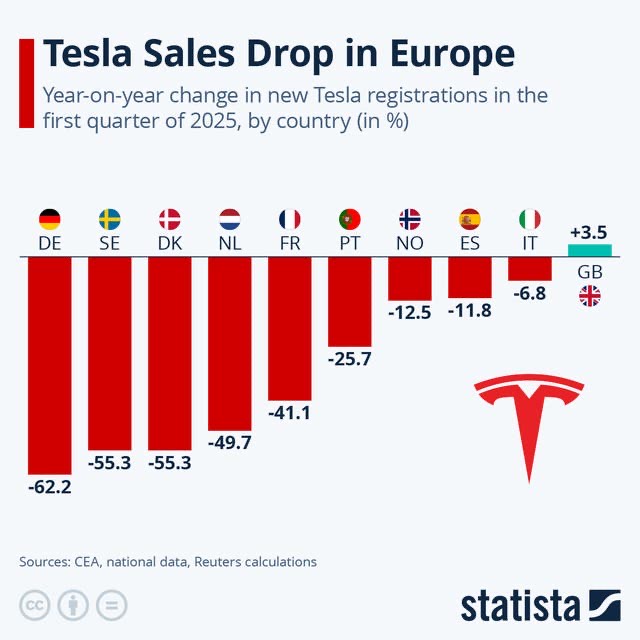
The numbers tell a brutal story. Tesla’s second-quarter deliveries plummeted 13.5% year-on-year to just 384,000 vehicles, whilst European sales collapsed by as much as 45% in early 2025. Even in Tesla’s stronghold markets of China and the United States, rivals including BYD, Volkswagen, and Hyundai are systematically dismantling the company’s once-impregnable market position.

What began as isolated competitive pressure has metastasised into an existential crisis encompassing product stagnation, mounting legal challenges, and a brand toxicity that would have been unthinkable just two years ago. Elon Musk’s response – personally commandeering Tesla’s sales operations from the company’s headquarters – represents either inspired leadership or desperate theatre. The evidence suggests the latter.

Tesla’s troubles extend far beyond routine quarterly fluctuations. Industry analysts point to a fundamental product problem: the company has launched no genuinely new mainstream models since the divisive Cybertruck, leaving its core range looking increasingly antiquated. The Model S and Model X, now approaching their second decade, lack the technological edge that once justified premium pricing, whilst even the refreshed Model 3 and Model Y variants have failed to generate meaningful market excitement.

Manufacturing bottlenecks from Model Y production transitions have exacerbated inventory buildups, creating the paradox of falling sales alongside unsold stock. “Tesla is caught between worlds,” explains one former executive who departed the company last year. “They’re trying to maintain premium positioning whilst competing on volume, and it’s not working.”

The human cost of these missteps extends beyond shareholders. Recent months have witnessed an exodus of senior talent, including the head of North American sales and key battery engineering leaders, suggesting internal recognition that current strategies are failing.

Perhaps more damaging than operational setbacks is Tesla’s reputational crisis. Musk’s increasingly vocal political alignment, particularly his association with Donald Trump, has triggered what industry observers term a “consumer revolt” in traditionally progressive markets where Tesla once dominated.

The “Tesla Takedown” movement, documented across social media platforms, encompasses everything from organised boycotts to physical vandalism of vehicles. Resale values have declined accordingly, with specialist automotive data firms recording measurable drops in Tesla’s brand perception scores throughout 2025.

“We’re seeing something unprecedented,” notes Professor Sarah Davidson, who studies automotive consumer behaviour at Warwick Business School. “Political polarisation is directly impacting purchase decisions in ways we’ve never measured before. Tesla owners are reporting embarrassment about their vehicles.”

Tesla’s troubles extend into America’s courtrooms, where multiple high-stakes cases threaten both immediate operations and long-term viability. California’s Department of Motor Vehicles is pursuing a 30-day sales ban over allegedly misleading advertising of Autopilot and Full Self-Driving capabilities, a move that would devastate Tesla’s largest single market.

Simultaneously, a wrongful death trial in Miami centres on Autopilot’s role in a fatal 2019 crash, with potential punitive damages that could establish precedents for autonomous vehicle liability. Legal experts suggest the outcome could fundamentally reshape how self-driving technologies are marketed and deployed. Tesla’s very own Trolley Car Problem.

Beyond these headline cases, Tesla faces a growing constellation of “phantom braking” complaints, quality control lawsuits, and antitrust challenges to its repair monopoly. Each represents not merely financial exposure but further erosion of consumer confidence in Tesla’s core technologies.

Central to Tesla’s current predicament is a business model that once represented revolutionary thinking but now appears increasingly anachronistic. The company’s rejection of traditional franchise dealerships delivered early advantages in pricing control and customer experience, yet state-level dealership protection laws have created a patchwork of legal restrictions that limit Tesla’s expansion opportunities.

More problematically, Tesla’s insistence on controlling all aspects of vehicle servicing has created what consumer advocates term a “repair monopoly.” Owners face extended delays, higher costs, and limited alternatives when vehicles require maintenance, issues that traditional franchise networks handle through distributed infrastructure and competitive pricing.

“The direct-to-consumer model worked brilliantly when Tesla was a premium niche player with devoted customers,” observes automotive retail consultant James Morrison. “But mass-market consumers expect convenience and choice that Tesla’s current structure simply cannot deliver at scale.”

Industry data supports this assessment. Whilst traditional manufacturers leverage dealer networks to manage demand fluctuations and regional variations, Tesla must shoulder these burdens independently. The resulting bottlenecks in service capacity and inventory management become particularly acute during periods of market stress.

Reports from Tesla’s Fremont headquarters suggest Musk has resumed the hands-on approach that characterised the company’s early years, reportedly employing Musk’ peculiar trademark of sleeping at the facility whilst personally directing sales strategy. The company has rolled out aggressive incentive programmes including discounted financing, complimentary software trials, and targeted offers for military veterans and educators.

These measures represent classic demand stimulation tactics, designed to shore up quarterly numbers ahead of Tesla’s earnings announcement. However, automotive industry veterans express scepticism about their long-term effectiveness.

“Incentives are a sugar rush,” explains former General Motors executive Patricia Williams, now an independent consultant. “They can mask underlying problems temporarily, but they don’t address fundamental issues of product competitiveness or brand perception. Tesla’s challenges are structural, not tactical.”

Stock market analysts echo this assessment, noting that Tesla’s current crisis encompasses precisely the factors that discount-driven sales campaigns cannot address: ageing product lines, manufacturing inefficiencies, legal liabilities, and consumer sentiment.

Tesla’s recovery requires acknowledgement that its original advantages have largely evaporated. The company’s technological lead has narrowed considerably, with competitors matching or exceeding Tesla’s capabilities in areas from battery range to autonomous features. Meanwhile, manufacturing cost advantages have disappeared as established automakers achieve economies of scale in electric vehicle production.

Perhaps most critically, Tesla must confront the limitations of its direct-to-consumer model. Industry experts suggest hybrid approaches, incorporating elements of traditional franchise or agency partnerships, could address current bottlenecks whilst maintaining some operational control.

“Tesla needs to swallow its pride about the dealership model,” argues automotive strategist David Chen. “The best aspects of direct-to-consumer can be preserved whilst addressing the very real scalability and service issues that are alienating customers.”

Similarly, product renewal cannot wait for revolutionary technologies. Tesla requires incremental but meaningful updates to its existing range, coupled with genuinely new models that recapture market imagination.

Where is the Tesla equivalent ‘Dolphin Surf’ or WuLing Baojun’s funky “Yue Ye” a Suzuki Jimny impersonator, on price and desirability?

Tesla’s current predicament represents more than routine corporate turbulence. The company faces simultaneous challenges across every aspect of its operations, from product development to legal compliance to consumer perception. Musk’s personal intervention in sales operations, whilst symbolically significant, addresses none of these fundamental issues.

The electric vehicle market Tesla created has matured beyond recognition, populated by government funded capable competitors offering consumers genuine alternatives. Tesla’s survival depends not on charismatic leadership or promotional campaigns, but on systematic operational reform that acknowledges this new reality.

Whether Musk and his leadership team possess the humility to undertake such reform remains the critical question facing Tesla shareholders, employees, and customers. The company’s next chapter will be written not in boardrooms or Twitter feeds, but in the quotidian work of building better products and serving customers more effectively than increasingly capable rivals.

The Tesla revolution may be ending. What comes next depends entirely on the company’s willingness to evolve beyond the mythology that created it.

COMMENTARY: No Mate, 12 Weeks Minimum.

Why the best businesses don’t need social media (and what that means for the rest of us)

I’m knee-deep in renovating a nearly 50-year-old property on the south coast U.K.

The place is solid as a stick of rock but needs everything doing after years of neglect.

Here’s what’s fascinating: every tradesman I’ve contacted is booked solid for months. No fancy websites, no Instagram presence, barely even a Google listing or review. They survive entirely on word of mouth, repeat customers and replying to messages. Quality work speaks louder than any marketing campaign.

Meanwhile, a talented abstract artist friend in Hove with 12,200 genuine Instagram followers is lucky to get 50 views on her posts. The algorithm has throttled her reach to nothing unless she pays to play. She’s not alone. Countless creative professionals are watching their organic reach disappear.

It’s the same story on LinkedIn. Despite upgrading to Premium, my posts struggle to reach even 50 people. The platform that promises professional networking seems more interested in pushing paid promotion than genuine connection.

There’s a lesson in this contrast. The trades flourish because they’ve built something social media can’t replicate: trust through consistent quality. But for those of us trying to grow beyond our immediate network, the digital landscape feels increasingly pay-to-play.

I help businesses navigate this challenge through strategic digital marketing that focuses on building genuine relationships rather than chasing vanity metrics.

Sometimes the old-school approach of quality and referrals is exactly what modern marketing needs.

How are you finding social media for your business? Are you seeing the same decline in organic reach, or have you found strategies that still work?