OPINION: Cars As iPhones

On a recent trip to the cinema I was presented with two new car adverts, both glossy. My cynical joke about the Range Rover that the owner was driving into the dealer for warranty work was soon overshadowed by the normalisation of a homogenised MG ‘SUV’ being £35000 as the basic price. But of course nobody pays the cash price nowadays, they mentally justify the purchase as multiples of their iPhone monthly payment. Cars as iPhones is a masterclass in behavioural psychology. 


Sometime in the last decade I described modern car buying as the iPhonication of the forecourt and if anything the idea has aged better than most of the vehicles now sold under it.

There was a time when the first question was the price. The full price. A number large enough to demand a pause and some moral arithmetic. Today nobody asks that. They ask how much a month, and the rest is treated as background noise, like terms and conditions or the weather.

The trick is simple. We no longer evaluate cars as capital purchases but as subscriptions. The monthly payment is quietly reconciled against the iPhone in your pocket. Fifty quid a month for a phone feels normal. Three hundred quid a month for a car becomes six phones. You already live with one. Why not six sitting outside?

This is not financial logic so much as consumer conditioning.

PCP and PCH did not just change how cars are paid for, they changed how they are justified. Ownership became vague, temporary, almost impolite to mention. What mattered was whether the number could slip into the standing orders without causing an argument. Once it could, permission was granted.

Electric cars pushed this model to its logical conclusion. On paper many are startlingly expensive. In practice they arrive softened by language about efficiency, tax, sustainability and the future. The monthly figure does the heavy lifting. Nobody emotionally processes fifty or sixty thousand pounds. They process four hundred a month by comparing it to phones, streaming services and a gym membership they forgot to cancel.

The iPhone model also smuggles in another assumption, that upgrading is natural and permanence is old fashioned. You do not keep a phone for a decade. You refresh it, guilt free, because you were never meant to own it outright. PCP borrows that psychology wholesale. Three years, hand it back, move on, feel modern.

Electric cars lean into this harder than most. Big screens, software updates, range improvements promised just around the corner. They are sold less as machines and more as devices, which makes their disposability feel progressive rather than wasteful.

The danger is that when everything is framed as affordable monthly, nothing feels expensive anymore. Stretch the term, adjust the mileage, tweak the deposit and almost anything can be made to behave. The decision shifts from judgement to tolerance. Not can I afford this, but can I live with it?

That is a profound change. It moves cost out of focus and replaces it with habit. Comparison does the rest.

‘The electric transition is often presented as a clean break from the past, but it has been powered by the most contemporary consumer mechanism of all. Permanent payment and planned obsolescence, wrapped in virtue and delivered by direct debit.’

The propulsion may be changing, but the mindset is familiar. We have not made cars cheaper. We have just learned how to stop looking at the whole number, and how to measure our lives in iPhones instead.

AUTOMOTIVE: Porsche Profits Apply The Big Stoppers

Porsche, once the golden child of German engineering and luxury performance, has hit an unexpected crisis in 2025. After years of record profits and unmatched prestige, the carmaker has reported a devastating fall in earnings, with operating profit plunging by more than 99 percent. The decline raises urgent questions about Porsche’s electric strategy, global sales slump, and future in an increasingly uncertain automotive market.

There was a time when the air in Zuffenhausen smelled of success and the confidence of endless growth. Porsche was the brand that never stumbled, the company that made perfection seem routine. Yet this year the balance sheets told a very different story.

For the first time in living memory, Porsche has posted a loss. Not a minor dip or a brief misfire, but a full-blown financial skid. In the third quarter of 2025, the company recorded an operational loss of nearly one billion euros. Across the first nine months of the year, profits collapsed from around four billion to just forty million. The figures landed like a crash through the guardrail at La Source.

The roots of Porsche’s decline lie in its costly electric gamble. Determined to lead the luxury EV revolution, the company poured billions into its own battery programme and an ambitious range of electric cars. The goal was clear: by 2030, eighty percent of new Porsches would run silently rather than roar. The market, however, had other ideas.

Buyers loved the Taycan’s design and speed, but hesitated at the price and limited range. High costs and lukewarm demand forced Porsche to retreat. The battery division was scrapped, new electric SUVs cancelled, and the firm took a three billion euro write-down. The pivot back to hybrids and combustion engines restored a little sanity, but the damage was done. Investors saw indecision. Customers saw confusion.

External pressures made things worse. In America, new tariffs on European luxury cars have already cost Porsche hundreds of millions of euros. Prices have risen, and demand has fallen. Across the Pacific, China’s once-booming market for Western prestige cars has cooled sharply. Sales dropped by more than twenty-five percent as domestic electric brands took centre stage.

Europe offered no comfort either. Economic fatigue and tighter emissions laws have hit the high-end market. Even the 911, the timeless heartbeat of Porsche, faces an uncertain future in a world determined to phase out petrol. Volkswagen Group, Porsche’s parent company, has reported its own steep drop in profit, much of it linked to this turmoil in Zuffenhausen.

The response has been fast and severe. Around four thousand jobs have already gone, and restructuring costs have topped three billion euros. Meetings that once celebrated lap times now focus on cost savings. Michael Leiters, Porsche’s new chief executive and a former McLaren man, has inherited the unenviable task of restoring confidence while steering a bruised and bewildered company back to growth.

Behind the scenes, engineers are refocusing. Porsche will rely on its most loyal strengths: craftsmanship, performance, and the feel of quality that no algorithm can reproduce. Future cars will blend petrol and electric power rather than replace one with the other. The idea is to rebuild gradually, balancing innovation with identity.

For decades, Porsche was defined by certainty. Every car, from the 911 Turbo to the Macan, carried the same message of precision and purpose. But the modern world is no longer so simple. Customers expect luxury, performance and sustainability in a single package. Governments demand cleaner cars. Markets demand profit. Somewhere in that storm, Porsche lost its footing.

Yet history suggests the brand knows how to recover. In the early Eighties, Porsche faced a similar reckoning. Sales were weak, costs were high, and purists feared the end of the 911. The company survived by listening to its engineers rather than its accountants. It rediscovered its essence. That may be the lesson Zuffenhausen needs again today.

If Porsche can blend its heritage with a clearer, more measured path to electrification, it could regain its balance. The 911 remains a global icon, and the Taycan, for all its struggles, proved that electric Porsches can still thrill. What the brand needs now is consistency and patience. The next great Porsche story will not be written in spreadsheets but in steering feel, design integrity and engineering bravery.

For now, though, Porsche’s halo has dimmed. The numbers are harsh, the markets unforgiving, and the pressure immense. Yet if any marque can turn a loss into a lesson, it is the one that made imperfection an art form.

What Porsche Could Do Next?

– Refocus the product line: Build hybrids and performance models that maintain the emotional core of the brand while easing customers toward electric power.
– Control production costs: Simplify supply chains, delay unnecessary launches, and invest only in platforms that deliver profit and flexibility.
– Strengthen brand storytelling: Reignite the emotional link between car and driver through heritage design cues and motorsport engagement.
– Win back key markets: Adjust pricing and marketing strategies in the United States and China to match shifting buyer sentiment.
– Prepare for the long term: Develop a steady, sustainable EV roadmap that doesn’t gamble the company’s identity on unproven demand.

If Porsche manages to balance its heart with its head, it will emerge stronger. The figures may be grim today, but the brand’s legacy of resilience remains intact. The brand is used to the smell of victory.

CAR DESIGN: Positive and Negative Euro Supermini EV

There was once a time when a supermini was a matter of necessity, not indulgence. The 1970s gave us the first Renault 5 a pert little pâtisserie of pressed steel and whimsy in vivid colours, every bit as much at home dodging gendarmes in a subtitled film fantasy as it was rusting gracefully on the fringes of Calais. Fiat, of course, had its own proletarian darling, the original 500, its rear-engined, frugally upholstered buzzbox or colloquially in the Coulter household ‘fart box’ – but nonetheless a model long synonymous with post-war Italian redemption.

Fast forward five decades and we arrive at a curious juncture. Both marques, veterans of automotive egalitarianism, have chosen to reinstate their icons as electric cars (EV) the Fiat 500e appearing first, in 2021, to much fanfare and fawning from urbanites and influencers flown out to test it and now, Renault’s thoroughly modern reinterpretation of the 5 arrives, seemingly sculpted from the same nostalgia-drenched clay. But only one has truly understood the brief.

Let’s examine why, first of all heritage vs homage. Fiat’s 500e is undeniably adorable. Styled with exquisite reverence to Dante Giacosa’s original shape, it trades mightily on its cuteness and perceived Italian flair. But beneath the surface, the car is more pastiche than progression. It is a fashion statement, not a philosophical one.

Yet perhaps this misses the point entirely. Fiat’s approach wasn’t born from ignorance of mass-market electrification, but from a calculated decision to position the 500e as a premium lifestyle product. In urban environments where the 500e primarily operates, its design excellence becomes a genuine strength. The car’s visual impact is undeniable, its ability to turn heads and spark conversations in city centres is precisely what many buyers actually want. When parking space is at a premium and daily commutes rarely exceed 30 miles, the 500e’s boutique-like character transforms from apparent weakness into selling point.

The interior, whilst admittedly compact, demonstrates genuine attention to detail and material quality that feels authentically Italian. The premium feel isn’t accidental, it’s strategic. Fiat understood that electrification offered an opportunity to move upmarket, to transform the 500 from economy car to desirable urban accessory. In Chelsea or Notting Hill, this strategy makes perfect sense.

Renault, by contrast, has dug deeper. The new 5 EV does not merely mimic its predecessor, it reinterprets it. The original 5 was a clever, modular platform that underpinned everything from the humdrum TL to the tempestuous Turbo. It was pragmatic yet cheeky. The new car carries this spirit not in shape alone (though that face is exquisitely reimagined), but in function: it is a clever, resolutely French attempt at democratic electrification, not just a rolling Instagram post.

Secondly, beneath the skin let’s compare engineering. Fiat’s 500e is built upon a bespoke EV platform, dubbed “Mini BEV.” It offers a 42kWh battery, up to 199 miles of range (WLTP), realistically 148 (I owned one for two years) and a single front-mounted motor delivering 117bhp. It is whisper-quiet, beautifully finished especially as my car in top ‘La Prima’ trim, and drives with a certain Mediterranean élan but when the government subsidy dried out became expensive for what it is.

Renault’s 5 EV rides atop the all-new CMF-B EV platform, shared with the forthcoming Nissan Micra EV. It too features a 52kWh battery option (with a 40kWh entry-level variant with range almost mid to top 500e level), promising a range up to 250 miles. Even adjusting for ‘real world’ alone marks a step beyond Fiat’s offering. Moreover, the Renault tips the scales at just 1,450kg some 100kg less than the 500e, due to clever packaging and a refusal to bloat the body with frivolous weight. A gold star from this Chapman ‘add lightness’ acolyte who really struggles with EVs on the scales.

Renault have also opted for a synchronous motor with a wound rotor technically more complex but free of rare earth magnets, which makes it both greener and a subtle exercise in Gallic engineering pride.

Thirdly let’s look at matters inside. The Fiat’s cabin is charming in the same way a Dolcé & Gabbana kitchen appliance is charming. But it is tight, rear accommodation is lacking, and the boot is more gesture than utility. Materials, though pleasant to the touch, drift into lifestyle accessory territory. The 500e is less a car, more a boutique on wheels but in fairness at launch in top trim one of the closest models to evoke the spirit of (ironically) Renault’s Monaco-Baccara-Initiale car as fashion brand ideal.

The Renault 5, however, feels engineered with a more adult sense of purpose. Its cabin is roomier, more rational, yet still playfully detailed. The pixel-matrix dashboard graphics and central avatar (dubbed “Reno”, a digital Gallic shrug in anthropomorphic form) are delightfully French in their eccentricity, but not at the expense of ergonomics or comfort. Predisposed with Google Maps, Google Assistant and Google Play it’s a great leap forward in convenience and easily recognisable tech. The car’s multimedia system ‘openR link’ provides a seamless and customizable interface for all Google connected services

On to dynamics and driving. Neither car is built for Nürburgring glory, but here again Renault shows more depth. The 5 EV’s steering is light but precise, its ride supple yet controlled. It feels composed at speed in a way the 500e doesn’t quite manage. Fiat’s car, while sprightly in a scurry, lacks the damping sophistication to settle itself on rougher A and B-roads. Ride is killed by the semi-run flat seventeens with stiffer low profile sidewalls beloved of designers wanting to make a statement in a new car showroom.

That said, the 500e’s urban capability shouldn’t be underestimated. Its compact dimensions and tight turning circle make it genuinely excellent for navigating congested city streets. The instant torque delivery, whilst less sophisticated than Renault’s implementation, provides perfectly adequate performance for town work. In London traffic, the 500e’s party trick of near-silent operation combined with its striking appearance creates a surprisingly satisfying driving experience.

Renault, by contrast, understands that electric torque delivered abruptly must be tamed, not merely unleashed.

And let us not forget regenerative braking. The 5 EV offers multiple levels, with a true one-pedal drive mode, while the 500e’s regen is more brutal and unsophisticated. For the discerning driver, that matters not merely for efficiency, but for fluidity and passenger comfort.

Fiat’s 500e was, at launch, widely praised. It won a slew of accolades from EV magazines to Marie Claire and a nod in the World Urban Car of the Year awards. It is undeniably chic and competent, particularly in cities. It also played a short burst of very European classical music after the day’s first fifty metres

But Renault’s new 5 has already garnered a 2025 Car Of The Year, the Design Award at the 2024 Geneva Motor Show, and is being positioned not just as a halo car, but the spearhead of Renault’s mass-market EV strategy. Where Fiat’s car is a boutique item, Renault’s is an attempt at mobility for the many, a return to form reminiscent of the R5’s original purpose.

And, most crucially, Renault has priced the 5 EV more aggressively, £22995 for the Evolution base model, with Techno top trims just beneath the £30000 mark. Fiat’s 500e, particularly in its lauded La Prima trim, can stretch well past that. In an era where electric adoption is still handbraked by cost (and potential eye-watering depreciation), this is no small distinction.

In summary, the Fiat 500e is a fine car, as mentioned I ran one for a couple of years and really enjoyed the performance and features of what was my first foray into EV ownership. Its design excellence remains genuinely impressive, and for urban dwellers seeking a premium electric experience, it delivers precisely what was promised. But unfortunately it is not the future – it is an echo.

Renault’s new 5 EV, by contrast, is a forward-thinking machine draped in historical allusion. It is clever, dynamic, well-priced, well equipped and fundamentally imbued with the same spirit that made the original such a quietly revolutionary car.

Fiat built a retro trinket. Renault has built a car and in the process, they’ve done something far more valuable than resurrect an icon, they’ve reminded us that, done properly, the humble hatchback still matters.

Fin.

AUTOMOTIVE: Tesla In Reverse

Tesla faces its gravest crisis yet with plummeting sales, legal battles, and brand toxicity. Can Musk’s desperate sales intervention save the company he built?

Tesla Sales Slump. A Company In Reverse.
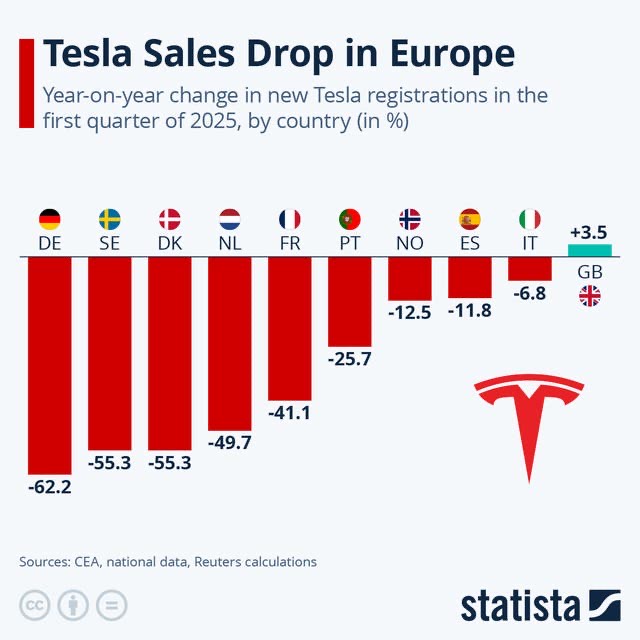
The numbers tell a brutal story. Tesla’s second-quarter deliveries plummeted 13.5% year-on-year to just 384,000 vehicles, whilst European sales collapsed by as much as 45% in early 2025. Even in Tesla’s stronghold markets of China and the United States, rivals including BYD, Volkswagen, and Hyundai are systematically dismantling the company’s once-impregnable market position.

What began as isolated competitive pressure has metastasised into an existential crisis encompassing product stagnation, mounting legal challenges, and a brand toxicity that would have been unthinkable just two years ago. Elon Musk’s response – personally commandeering Tesla’s sales operations from the company’s headquarters – represents either inspired leadership or desperate theatre. The evidence suggests the latter.

Tesla’s troubles extend far beyond routine quarterly fluctuations. Industry analysts point to a fundamental product problem: the company has launched no genuinely new mainstream models since the divisive Cybertruck, leaving its core range looking increasingly antiquated. The Model S and Model X, now approaching their second decade, lack the technological edge that once justified premium pricing, whilst even the refreshed Model 3 and Model Y variants have failed to generate meaningful market excitement.

Manufacturing bottlenecks from Model Y production transitions have exacerbated inventory buildups, creating the paradox of falling sales alongside unsold stock. “Tesla is caught between worlds,” explains one former executive who departed the company last year. “They’re trying to maintain premium positioning whilst competing on volume, and it’s not working.”

The human cost of these missteps extends beyond shareholders. Recent months have witnessed an exodus of senior talent, including the head of North American sales and key battery engineering leaders, suggesting internal recognition that current strategies are failing.

Perhaps more damaging than operational setbacks is Tesla’s reputational crisis. Musk’s increasingly vocal political alignment, particularly his association with Donald Trump, has triggered what industry observers term a “consumer revolt” in traditionally progressive markets where Tesla once dominated.

The “Tesla Takedown” movement, documented across social media platforms, encompasses everything from organised boycotts to physical vandalism of vehicles. Resale values have declined accordingly, with specialist automotive data firms recording measurable drops in Tesla’s brand perception scores throughout 2025.

“We’re seeing something unprecedented,” notes Professor Sarah Davidson, who studies automotive consumer behaviour at Warwick Business School. “Political polarisation is directly impacting purchase decisions in ways we’ve never measured before. Tesla owners are reporting embarrassment about their vehicles.”

Tesla’s troubles extend into America’s courtrooms, where multiple high-stakes cases threaten both immediate operations and long-term viability. California’s Department of Motor Vehicles is pursuing a 30-day sales ban over allegedly misleading advertising of Autopilot and Full Self-Driving capabilities, a move that would devastate Tesla’s largest single market.

Simultaneously, a wrongful death trial in Miami centres on Autopilot’s role in a fatal 2019 crash, with potential punitive damages that could establish precedents for autonomous vehicle liability. Legal experts suggest the outcome could fundamentally reshape how self-driving technologies are marketed and deployed. Tesla’s very own Trolley Car Problem.

Beyond these headline cases, Tesla faces a growing constellation of “phantom braking” complaints, quality control lawsuits, and antitrust challenges to its repair monopoly. Each represents not merely financial exposure but further erosion of consumer confidence in Tesla’s core technologies.

Central to Tesla’s current predicament is a business model that once represented revolutionary thinking but now appears increasingly anachronistic. The company’s rejection of traditional franchise dealerships delivered early advantages in pricing control and customer experience, yet state-level dealership protection laws have created a patchwork of legal restrictions that limit Tesla’s expansion opportunities.

More problematically, Tesla’s insistence on controlling all aspects of vehicle servicing has created what consumer advocates term a “repair monopoly.” Owners face extended delays, higher costs, and limited alternatives when vehicles require maintenance, issues that traditional franchise networks handle through distributed infrastructure and competitive pricing.

“The direct-to-consumer model worked brilliantly when Tesla was a premium niche player with devoted customers,” observes automotive retail consultant James Morrison. “But mass-market consumers expect convenience and choice that Tesla’s current structure simply cannot deliver at scale.”

Industry data supports this assessment. Whilst traditional manufacturers leverage dealer networks to manage demand fluctuations and regional variations, Tesla must shoulder these burdens independently. The resulting bottlenecks in service capacity and inventory management become particularly acute during periods of market stress.

Reports from Tesla’s Fremont headquarters suggest Musk has resumed the hands-on approach that characterised the company’s early years, reportedly employing Musk’ peculiar trademark of sleeping at the facility whilst personally directing sales strategy. The company has rolled out aggressive incentive programmes including discounted financing, complimentary software trials, and targeted offers for military veterans and educators.

These measures represent classic demand stimulation tactics, designed to shore up quarterly numbers ahead of Tesla’s earnings announcement. However, automotive industry veterans express scepticism about their long-term effectiveness.

“Incentives are a sugar rush,” explains former General Motors executive Patricia Williams, now an independent consultant. “They can mask underlying problems temporarily, but they don’t address fundamental issues of product competitiveness or brand perception. Tesla’s challenges are structural, not tactical.”

Stock market analysts echo this assessment, noting that Tesla’s current crisis encompasses precisely the factors that discount-driven sales campaigns cannot address: ageing product lines, manufacturing inefficiencies, legal liabilities, and consumer sentiment.

Tesla’s recovery requires acknowledgement that its original advantages have largely evaporated. The company’s technological lead has narrowed considerably, with competitors matching or exceeding Tesla’s capabilities in areas from battery range to autonomous features. Meanwhile, manufacturing cost advantages have disappeared as established automakers achieve economies of scale in electric vehicle production.

Perhaps most critically, Tesla must confront the limitations of its direct-to-consumer model. Industry experts suggest hybrid approaches, incorporating elements of traditional franchise or agency partnerships, could address current bottlenecks whilst maintaining some operational control.

“Tesla needs to swallow its pride about the dealership model,” argues automotive strategist David Chen. “The best aspects of direct-to-consumer can be preserved whilst addressing the very real scalability and service issues that are alienating customers.”

Similarly, product renewal cannot wait for revolutionary technologies. Tesla requires incremental but meaningful updates to its existing range, coupled with genuinely new models that recapture market imagination.

Where is the Tesla equivalent ‘Dolphin Surf’ or WuLing Baojun’s funky “Yue Ye” a Suzuki Jimny impersonator, on price and desirability?

Tesla’s current predicament represents more than routine corporate turbulence. The company faces simultaneous challenges across every aspect of its operations, from product development to legal compliance to consumer perception. Musk’s personal intervention in sales operations, whilst symbolically significant, addresses none of these fundamental issues.

The electric vehicle market Tesla created has matured beyond recognition, populated by government funded capable competitors offering consumers genuine alternatives. Tesla’s survival depends not on charismatic leadership or promotional campaigns, but on systematic operational reform that acknowledges this new reality.

Whether Musk and his leadership team possess the humility to undertake such reform remains the critical question facing Tesla shareholders, employees, and customers. The company’s next chapter will be written not in boardrooms or Twitter feeds, but in the quotidian work of building better products and serving customers more effectively than increasingly capable rivals.

The Tesla revolution may be ending. What comes next depends entirely on the company’s willingness to evolve beyond the mythology that created it.