AUTOMOTIVE: Red Alert – The Chinese EV Disruptors

2025 Chinese EV Biggest Sellers in EU and UK

The numbers don’t lie: Chinese Electric Vehicles (EV) now command over a quarter of Europe’s electric vehicle market, up from virtually nothing in 2020. This isn’t just market disruption – it’s a complete rewriting of automotive rules. I investigate how European manufacturers are responding to the challenge of a lifetime, and what it means for the future of legacy manufacturers and motoring.

If someone had told you in the days of driving a Ford Cortina with a ten-day holiday in the Costas that by 2025, European roads would be bustling with fully electric cars bearing names like BYD and XPeng, you’d have assumed they’d been at the sherry. Yet here we are, witnessing one of the most dramatic shifts in automotive history. Chinese electric vehicle manufacturers haven’t just entered the European market, they’ve fundamentally altered it.

The numbers tell a remarkable story. The market share of Chinese-built EVs (including foreign brands such as Tesla) rose from 3.5% in 2020 to 27.2% of all EVs sold in the EU in the second quarter of 2024. Naturally there are country differences, but across Europe in total that’s not a gradual market entry, it’s a seismic shift that’s left traditional European manufacturers scrambling to respond.

What’s driving this transformation? It’s a combination of competitive pricing, impressive technology, and strategic timing. Chinese manufacturers have leveraged their domestic market scale to achieve manufacturing efficiencies that European competitors are struggling to match. China’s BEV market share hit 27% in 2024, far ahead of the EU (13%) and U.S. (8%).

Take BYD, now a household name in many European markets. Their vehicles consistently undercut European alternatives whilst offering sophisticated infotainment systems, advanced driver assistance features, and impressive safety ratings. The company has demonstrated that affordable doesn’t mean compromised, a lesson that’s resonating strongly with European consumers facing cost-of-living pressures.

In the EU, the new BYD Dolphin Surf is available from €22,000. Compare that to the latest Renault 5 E-Tech EV starting at €27,000 and the Peugeot e-208 at €28,000. With car finance around €30 per month per thousand borrowed, that could mean a €150 per month saving to a cost-conscious family.

The appeal extends beyond mere affordability. These vehicles often feature over-the-air updates, AI-enhanced driving systems, and battery technology that delivers competitive range figures. Chinese manufacturers have essentially leapfrogged traditional automotive development cycles. They’ve moved straight to the latest technologies without the burden of legacy systems.

To meet production the Chinese brands are scrambling to sign up franchisees across the continent to meet sales and after-sales demand. BYD alone is seeking 1,000 service facilities across EU markets this year. Chinese cars adopt the familiar CCS2 charging standard, enabling easy charging at third-party facilities between 65kW and 85kW – not ground breaking but offering acceptable charge times. Manufacturer warranty at six years/150,000km for the car and eight years/200,000km for the battery makes the cars competitive on peace of mind.

European manufacturers haven’t been sitting idle. Stellantis, Renault-Nissan and Volkswagen, along with prestige German brands, are all accelerating their electrification programmes. They’re investing heavily in battery technology and manufacturing capabilities. However, they’re operating from a different starting point, retrofitting existing business models rather than building from scratch around electric-first principles.

The structural advantages Chinese manufacturers possess run deep. They benefit from integrated supply chains, significant government support for the EV transition, and a domestic market that provides both scale and testing ground for new technologies. European manufacturers are now having to navigate this new ultra-competitive landscape whilst simultaneously managing the transition away from internal combustion engines – still in real demand from a population weighing up the EV pros and cons in a media landscape that is fairly hostile to EV in general. Luddite is too strong a word, but the ICE demand is strong due to a Western pro-carbon fuel sentiment and the convenience of familiarity, legacy infrastructure and no range anxiety.

In Europe, BEVs are expected to account for 16.8% of total light vehicle sales this year (compared to 14.1% in 2024). This growth is driven by policy pressure and localised battery production. It’s occurring against a backdrop of intensifying competition that’s forcing down prices and tightening margins across the industry.

The European Union’s response has been swift and decisive. The EU has imposed tariffs ranging from 7.8% for Tesla to 35.3% for SAIC, on top of the standard 10% car import duty. These measures, implemented in October 2024, represent the EU’s largest trade case to date and signal genuine concern about market distortion.

The tariffs are specifically designed to address what the European Commission views as unfair subsidies provided by the Chinese government to domestic manufacturers. However, early evidence suggests these measures may have limited impact. BYD managed to outperform Tesla in European EV sales despite facing higher tariffs, indicating that the competitive advantages run deeper than just pricing.

There’s also ongoing discussion about replacing tariffs with minimum price agreements. These would establish floor prices for Chinese EVs whilst allowing market competition to continue. This approach might prove more effective than blanket tariffs, though negotiations remain complex.

The current situation represents more than just increased competition, it’s a fundamental reshaping of the automotive industry. Chinese brands were responsible for 62% of EV global sales in 2024, demonstrating their dominance extends far beyond Europe.

For European consumers, this shift has brought tangible benefits: more choice, better value, and accelerated adoption of electric vehicle technology. The increased competition is also spurring innovation among traditional manufacturers, ultimately benefiting the entire market.

The industrial implications are significant. European manufacturers are being forced to reconsider their entire approach to vehicle development, manufacturing, and market positioning. Some are forming partnerships with Chinese companies, others are investing heavily in their own capabilities, and all are grappling with the new competitive reality.

This transformation isn’t slowing down. Chinese manufacturers continue to expand their European presence, with many establishing local manufacturing facilities and service networks. They’re also diversifying their offerings, moving beyond basic models to premium segments that directly challenge European luxury brands.

The success of Chinese EVs in Europe reflects broader changes in global automotive manufacturing. It’s a story of how quickly established market positions can shift when new technologies create opportunities for disruption. European manufacturers, once confident in their engineering prowess and brand heritage, are discovering that in the electric age, different rules apply.

Of course, with anything China there’s a darker undertone to all this. Some of the continental boffins are fretting about data privacy. Chinese firms are obliged to share data with state security if asked, and that has set off alarm bells in Brussels and beyond. Imagine your car knowing not just where you’ve been but who you’ve been with, and that information possibly ending up in a CCP filing cabinet. Orwell, anyone?

Some defence ministries have already banned the use of Chinese EVs on or near sensitive infrastructure. One assumes that if your Tesla can dance, your BYD might be able to whistleblow.

Ultimately what we’re witnessing isn’t just a market shift, it’s a case study in industrial transformation. The question now isn’t whether Chinese EVs will continue to gain market share in Europe, but how European manufacturers will adapt to this new reality. The answers will shape the automotive industry for decades to come.

The electric revolution has arrived, and it’s powered by competition that’s forcing everyone to raise their game. For consumers, that’s undoubtedly good news. For the traditional European automotive establishment, it’s the challenge of a lifetime.

 

NEWS: Pro-Motor: A Smarter Way to Sell Your Car in West Sussex

After more than four decades in the automotive industry and many years as a digital marketer, I am excited to launch Pro-Motor – a new service designed to help car owners in West Sussex sell their vehicles faster and achieve significantly better returns.

Why Pro-Motor?

Selling a car today can feel like a choice between two extremes:

  • Accepting a quick but low-value offer from “instant buy” sites
  • Or struggling to create a listing that attracts serious buyers

That’s where Pro-Motor comes in. With 45 years of experience in automotive sales and marketing – right up to manufacturer level – I know exactly what buyers look for and how to showcase a car to its best advantage.

By combining that industry knowledge with modern digital marketing expertise, Pro-Motor offers something unique: a professional car selling service that achieves on average 30% more for clients than quick-sale disruptors.

What the Service Includes

From only £250, Pro-Motor provides:

  • A pre-sale valet to ensure your car looks its best
  • High-quality photography and video
  • Professionally written copy tailored to engage buyers
  • Your own Sales Manager for advice throughout sale
  • Advertising on national platforms for maximum reach
  • Local, personal service for sellers within one hour of Littlehampton

The Difference Professional Marketing Makes

Presentation is everything. Buyers are more confident and willing to pay more when a car is clean, photographed beautifully, and described with care. My background in digital marketing ensures your listing isn’t just well presented – it’s strategically placed to reach the right audience at the right time.

A Local Service with National Reach

Based in Littlehampton, Pro-Motor is designed for sellers across West Sussex. While I work closely with local clients to prepare and market their cars, the adverts themselves reach buyers nationwide.

Sell Smarter, Not Cheaper

Pro-Motor is all about creating value. Instead of underselling your car for the sake of speed, this service combines professional presentation with targeted marketing to deliver stronger offers.

If you’re based in Southern England* and thinking of selling your car, I’d love to show you how Pro-Motor can help you achieve the best result.

📞 Call 07407 038877 or e-mail steve@stevecoulter.co.uk

* A practical service for anyone within one hour of Littlehampton, West Sussex, so includes Hampshire, Kent and Surrey.

Steve Coulter Pro-Motor Up To 30% More For Your Car!

BREAKING: Google Just Nuked the Long Tail of the Internet

The Survival Guide: How Startups and SMEs Can Thrive After Google Killed the Long Tail

Google has changed the rules overnight. By removing the `num=100` parameter, search results now stop at 10 instead of 100. For small businesses and startups, this is not just a tweak. It is an earthquake. If your growth strategy relied on organic search past page one, you have just lost 90 per cent of your discovery. This startup marketing survival guide and handbook is your playbook for survival.

Accept That Google Is No Longer Your Only Gateway

Do not make the mistake of seeing Google as the only path to growth. Treat it as one channel in a bigger mix. The new search reality rewards big brands that already sit at the top. If you are not in the top 10, you are invisible. That means you must diversify.

  • Look to LinkedIn, TikTok, YouTube Shorts, and niche directories.
  • Get involved in forums, industry Slack groups, and relevant Discord servers.
  • Push your content to platforms where your customers already gather.

Build Direct Distribution You Own

You cannot afford to rent all of your reach from platforms you do not control. Building direct lines to your audience is now essential.

  • Start a mailing list and grow it with useful lead magnets.
  • Launch a simple newsletter that delivers consistent value.
  • Create a knowledge hub or resource page that makes your site a bookmark, not just a click.

Every email sign-up is an asset you own, not a visitor you hope Google will send.

Make Your Content Work for AI

Large language models are fast becoming new discovery engines. They draw on structured, well-framed content. This is where SMEs can get smart.

  • Write in clear, direct answers to questions.
  • Add schema markup so machines can parse your content easily.
  • Syndicate content on platforms AI already scrapes such as Medium, Quora, or Substack.

By designing your content for humans and machines, you keep yourself visible in the next wave of search.

Use Partnerships and Thought Leadership

When you cannot dominate the algorithm, borrow trust from others who can. Build visibility by showing up where audiences already pay attention.

  • Collaborate on podcasts or live events.
  • Guest post on established industry sites.
  • Partner with micro-influencers who know your market.

Visibility is not only about rankings. It is about presence in the right rooms.

Stretch Your Paid Spend with Precision

You do not need corporate budgets to make paid distribution work. The key is sharp targeting and small-scale tests.

  • Run micro-ads to job titles or niches on LinkedIn.
  • Use TikTok or Reddit to hit communities directly.
  • Apply retargeting ads so you keep contact with warm leads.

Small budgets, used well, can open doors that organic search no longer provides.

Repurpose and Multiply Your Content

Do not burn time creating endless one-offs. Create once, distribute often.

  • Record a webinar and slice it into short clips.
  • Turn a blog into a LinkedIn thread, an infographic, and an email drip.
  • Re-use insights across formats to reach people wherever they are.

This multiplies your reach without multiplying your effort.

Final Word: Distribution Is the Product

For years, small businesses were told to focus on making a great product and trust that people would find it. That is no longer true. Distribution is not a side strategy. It is the core strategy.

By owning your channels, tapping into communities, and positioning content for both humans and AI, you can still win. The long tail may be gone from Google, but opportunity has not vanished. It has just shifted.

To discuss this in the context of protecting your business please contact me

DIGITAL MARKETING: AI Search and Answer Optimisation

Why Your Website Must Be AI Search and Answer Optimised

Search engines no longer read and rank websites as humans do. Algorithms powered by natural language models depend on clean coding, structured schemas, and context-rich content to identify authority. Without this, your site is at risk of being bypassed by AI in favour of competitors who have invested in AI Search Optimisation. The impact is clear: unless your website is AI-ready, you could lose visibility, customers, and crucial opportunities to competitors in an era dominated by Zero Click searches.

The shift to AI search

The way people find information online is undergoing its biggest transformation since the birth of Google. Traditional search results, once dominated by blue links and snippets, are now led by artificial intelligence overviews and direct answers. This change is driving the Zero Clicks phenomenon, where users leave search engines with the answers they need without visiting a website.

For senior leaders, this shift means visibility is no longer guaranteed, even if your website has ranked well in the past. Without AI-focused optimisation, your brand risks being dropped from the conversation entirely.

Why optimisation is no longer optional

At the heart of this change lies how search engines process and comprehend content. Algorithms do not evaluate pages like humans. They read structured data, clear signals, and semantic patterns. When these are missing, your content may never surface.

AI search optimisation is about ensuring your content is technically visible and contextually authoritative. Answer optimisation makes that content extractable, quotable, and deployable in AI-generated overviews.

The new “page one”: AI Search Summary citations

In traditional search, the goal was to secure a top ranking. Today, the new priority is being named as a trusted reference within AI Search Summary citations. These summaries decide what users see first and which sources they associate with authority. If your business is excluded, competitors gain the credibility and traffic instead. Citations are now the digital equivalent of being on page one—and failing to appear means disappearing from consideration.

Principles of AI Search and Answer Optimisation

  • Structured data: Using schema markup in JSON-LD to define your services, products, and business details.

  • Answer-first content: Presenting clear, concise responses that match customer intent.

  • Code readability: Clean separation of meaningful content from design features so crawlers can interpret with ease.

  • Authority signals: Providing expertise, relevance, and trust so AI recognises your credibility.

  • Content alignment: Anticipating customer questions and supplying strong, original responses.

The commercial stakes

For directors and business owners, the bottom line is straightforward. Your website either contributes to visibility and lead generation in AI searches, or it does not. Zero Click behaviour reduces traffic, limits conversions, and weakens brand presence. Sites that secure AI Search Summary citations hold the advantage, because they remain visible and authoritative even if the user never clicks through. Getting in early – Now, ensures your offering is crystallised into the AI search algorithm and becomes the relevant answer to surpass for inclusion.

Your Call To Action

This is not a trend on the horizon. It is a present reality.

Were you aware of this paradigm shift in search, and have you ensured your business remains cited, visible, and authoritative in the Zero Click era?

Please Contact Me if you would like to discuss this in the context of your own business.

AI: Five Ways for SMEs to Protect Sales Leads and Marketing Efficiency in the Age of AI

The rise of artificial intelligence and AI Search Summaries (Resulting in answers from Zero Clicks) is changing the way people find and choose businesses online. For SME owners, this shift means the traditional paths to generating sales leads and website traffic are under significant pressure. AI-driven search tools often provide direct answers without needing users to click through to websites. This can reduce the number of leads and enquiries your business may get from online marketing. But there are clear steps small businesses can take this week to adapt and safeguard their sales efforts.

Here’s five immediate moves you can make THIS WEEK. 


1. Optimise for AI-Driven Search

Simply relying on old-fashioned search engine optimisation is no longer enough. Generative AI and tools like Google’s AI Overviews pick and summarise information directly from websites. It pays to adapt your content and code with clear, authoritative answers to common questions your customers ask. Using structured data on your site helps AI systems extract your business information accurately, increasing the chance your company will be referenced and recommended even without a traditional link click.

2. Broaden Your Lead Generation Channels

With fewer website visits from AI summaries, it is wise to build leads through multiple channels. Boost your presence on LinkedIn, local business directories, review platforms, and relevant industry forums. Keeping these online profiles up to date ensures your company can be found through AI recommendations in different digital spaces, capturing customers who no longer start with a Google search alone.

3. Strengthen Trust and Credibility Signals

AI tools favour sources that demonstrate expertise and trustworthiness. Ensure your website clearly shows accreditations, client testimonials, and case studies. Keep your legal pages, such as privacy and terms, current and transparent – these may be automated using AI tools. These elements help build the confidence AI systems and your customers need to choose your business over others.

4. Focus on Direct Nurture and Retargeting

Since organic site traffic might drop, it is important to maintain contact with existing and potential customers through email newsletters, retargeting adverts, and downloadable resources. Collecting first-party data – for example, through newsletter sign-ups – with clear consent – means you can continue marketing directly to interested leads, even as search behaviours evolve. Building your own customer database and reviews away from major retail platforms like Autotrader and Right Move is vital.

5. Review Your Analytics and Tracking

AI search changes and stricter privacy rules may reduce the accuracy of traditional website analytics. Take a detailed look at your tracking and attribution methods. Consider tools that track referrals from AI platforms, branded searches, and mentions. Adjusting your measurement models allows better insight into where leads come from and how AI impacts your digital visibility. Also check typical searches on the major AI LLM apps like ChatGPT and Perplexity to see if you are included in citations – if not who is? What information is being picked up and can you emulate this?

***

AI technologies are here to stay, but with the right approach, SMEs can continue to thrive. Taking these practical steps this week helps protect your sales pipeline and marketing success in a rapidly changing digital landscape.

***

Too busy, or this is outside your level of expertise? Contact Me today for a conversation about how my agency might assist. 

DIGITAL MARKETING: AI-First SEO Era

This paper presents the findings of a year-long study into how generative AI is disrupting the search landscape, marking a decisive shift from traditional SEO to a new era of AI-first discovery. Drawing on extensive research, expert insight and real-world testing, it examines the rise of Generative Engine Optimisation (GEO) and outlines the strategies modern brands must adopt to remain visible, authoritative, and trusted in AI-driven search environments. A definitive guide for organisations seeking to understand and thrive in the rapidly evolving world of generative search.

FYI I have a draft book manuscript ‘Ultimate GEO’ which you are welcome to please contact me for a copy. 


The AI-First SEO Era: Navigating Generative Search

Executive Summary

Context: The rise of generative AI is transforming how people search, shifting from traditional keyword-based search to AI-first paradigms.

Thesis: SEO is no longer just about ranking, it’s about being cited and trusted by AI models.

Key Trends: Generative Search Engines (GSEs), multi-intent queries, AI citations, structured content optimisation, and the new metrics of search success.

Recommendations: Build content with topical authority; prioritise experience and expertise (E-E-A-T); measure AI visibility, not just click-through; invest in AI + human content workflows.


1. Introduction: The Generative Search Shift

Search is evolving: Platforms like ChatGPT, Perplexity, Gemini, and others are no longer niche — they are fast becoming primary touchpoints for information discovery.
Implication for SEO: Traditional SEO based on PageRank, backlinks, and keyword frequency is being disrupted. The new frontier is Generative Engine Optimisation (GEO).
Users now expect concise, synthesized answers rather than lists of links.


2. Defining Generative Engine Optimisation (GEO)

What is GEO?

GEO is the practice of optimising content so that generative AI models can:

 1. Understand it deeply (semantic meaning, entities)
 2. Cite it when constructing responses to queries
 3. Attribute it in generated answers (i.e., as a source)

Key components of GEO:
Topical authority: building deep, interconnected clusters of content.

Semantic relevance: using structured data, knowledge graph signals, clarity of entities.
Credibility signals: authored by experts, backed by data / research, with original insights.
Clarity and structure: FAQ format, schema markup, headings, concise summarisation.


3. Emerging Ranking Signals in the AI-Driven Search Landscape

These are the signals that matter more in a generative AI search context, compared to classic SEO:

1. Topical Depth Over Keyword Density

AI models reward content that demonstrates deep understanding.
Topic clusters (pillar pages + subtopics) perform better than isolated blog posts.

2. Experience, Expertise, Authority, Trustworthiness (E-E-A-T)

AI increasingly values real experience: first-hand case studies, expert authors, unique data.
Verified credentials, research, and transparency matter more than ever.

3. Semantic and Contextual Relationships

AI uses entity recognition and knowledge graphs to understand relationships between topics.
 Internal linking, co-occurrence of ideas, and concept mapping help AI navigate your content.

4. Behavioral / Predictive Signals

AI engines use predictive behaviour: they try to infer next user intent, not just respond to the query.
Content needs to anticipate multi-step journeys (e.g., compare → buy → research).

5. Structured Data & Schema

Use of schema (FAQ, Article, HowTo, etc.) makes content more machine-readable.
Structured content helps AI summarise and cite your page correctly.


4. The Impact on Search Behaviour

Zero-click Searches Surge: AI overviews and answer-generation mean many users get their answer without clicking through. 
Changing Click Patterns: Traditional CTR becomes less reliable; instead, visibility is measured via citations in AI-generated responses.
Multi-intent Queries: Search intent is more layered, users may be comparing, buying, exploring, or interrogating. AI helps surface richer, intent-aware responses.
Discovery vs. Engagement: The goal shifts from driving traffic to being used as a trusted source by AI.


5. Risks and Challenges

AI-generated content pitfalls: Generic content, without depth or authority, is penalised by AI models. 
Brand bias and big-brand advantage: Larger, well-known brands may be more likely to be cited by AI if they already dominate topically.
Transparency & Attribution Issues: If AI cites your content incorrectly, or without a link, how do you ensure fair use?
Analytics Blind Spots: Traditional tools like Google Analytics / Search Console may not capture AI-driven visibility. As Reddit conversations highlight, SEO pros are “checking Search Console way less” in an AI-first world. 
Over-optimization risk: There’s a balance to strike, too much structure purely for machines can make content robotic or disjointed for human readers.


6. Strategic Imperatives for Businesses

To win in the generative search era, brands should:

1. Build Topic Clusters with Authority

Map out core themes → subtopics → supporting content.
Publish long-form, data-rich content, not just shallow blog posts.

2. Elevate E-E-A-T

Leverage subject-matter experts, generate original research, and highlight first-hand experience.
Use author bios, credentials, and case studies.

3. Optimise for AI Appearance

Use schema markup (especially FAQ, Q&A) to make it easier for AI to parse.
Create summaries, intros, and structured sections in your content to improve scannability.

4. Monitor AI Visibility, Not Just Clicks

Track citations in AI platforms (e.g., “Which sources did ChatGPT / Gemini / Perplexity cite?”).
Use tools that monitor generative engine visibility or build internal dashboards.

5. Adopt a Hybrid Content Workflow

Combine human expertise + AI drafting: AI can help generate first drafts, but humans should refine and fact-check.
Iterate based on how generative engines reference your content.

6. Prepare for Future Generative Search Modes

Voice, image, and even agent-based search (AI agents doing tasks) will become more common.
Make sure your content is multimodal-ready (e.g., alt text, conversational copy, structured data).


7. Case Studies & Examples (Hypothetical / Real)

Brand A (B2B SaaS): By building a deep topic cluster around “AI for Sales Automation,” they increased citations in AI overviews by 200% in six months.
Brand B (Health & Wellness): Expert-led content (doctors, nutritionists) was more frequently cited by generative models than competitor sites using generic AI content.
Brand C (E-commerce): Implemented FAQ schema on product pages and saw their pages being directly referenced in AI answer engines for common product questions.


8. The New SEO Tech Stack

To operate in this new era, businesses need a modern SEO stack:

AI Keyword & Topic Research Tools: For clustering by semantic meaning and intent.
Predictive SEO Platforms: That use forecasting to simulate how AI engines will respond to content.
AI Content Scoring / Quality Tools: To evaluate readability, topical depth, and authority.
AI Search Visibility Trackers: Tools specifically designed to capture how often your content is referenced or cited in generative AI outputs.
Automated Technical SEO Tools: For ensuring structured data, schema markup, fast-loading sites, and mobile readiness.


9. Future Outlook

Increasing dominance of generative search: As more users adopt AI for search, generative engines will capture a larger share of queries.
AI agents and multi-modal search: Autonomous AI agents (agents that search, compare, and transact) will create new demand for content structured not just for humans, but for other AIs. 
Evolving measurement frameworks: Traditional SEO KPIs (rankings, clicks) will be supplemented / replaced by “AI citations,” “answer appearances,” and “AI-engaged traffic.”
Ethical and trust considerations: Brands that provide transparent, trustworthy, expert-led content will be rewarded. Others risk being de-prioritised by generative engines.


10. Conclusion & Call to Action

The SEO landscape is undergoing a fundamental transformation, not incremental change, but a structural shift.
Brands that adapt their content strategy to be “AI-citable” and demonstrate genuine expertise will thrive.
It’s time to rethink SEO: from chasing rankings to building authority in the eyes of generative models.

The question for every business: Are you ready to optimise for the AI-first search world, or will you get left behind?

For more information or explanation of anything in my GEO Industry report and how this affects your own business please contact me.

DIGITAL MARKETING: Google’s Nuclear Button

How Google’s AI Mode Button Has Changed Search Forever & What Every Business Needs to Know

There’s a seismic shift underway in the world of online search, and if your business or brand relies on visibility in Google, you cannot afford to ignore it. With the introduction of the new AI Mode button, now placed right at the top left and in the first position of Google’s search interface, everything you thought you knew about search engine optimisation is changing fast.

What Is Google’s AI Mode Button?

Google’s AI Mode button instantly transforms traditional search into a conversational, AI-powered experience. When users click (or, increasingly, tap by default) the new button, classic blue links and ten-result lists give way to something different. The search results page now delivers an intelligent, summarised answer, drawn from across the web, bolstered by only a few cited sources.

Why This Placement Is a Game-Changer

Let’s not underestimate the significance of the AI Mode button sitting right at the top left, in prime position. Most users won’t even think twice before clicking it. For businesses, this spells both fantastic opportunity and real risk – because user behaviour is shifting, and it is shifting fast.

The New Reality for Search and SEO

– Goodbye Clicks, Hello Summaries: AI Mode is designed to answer queries directly on the search page. This means fewer people clicking through to websites. The familiar flow from search to site is being replaced by instant answers, right there in Google.

– SEO Is No Longer Just Rankings: Traditional methods focused on keywords and moving up the search ranks. That isn’t enough now. To stand out, your content must be picked as a trusted source for Google’s AI-generated answers. If your site isn’t cited, it risks being invisible.

– Semantic Relevance Is Everything: The days of gaming Google with repetitive keywords are over. AI Mode matches user queries with content that best answers the meaning, not just the wording. Your content needs to be rich, informative and genuinely authoritative to even be in the running.

– Expertise and Trust Are Essential: Only the most reputable, accurate and well-presented information gets chosen. Demonstrating true expertise and trustworthiness is now the entry fee for being cited.

– Analytics Have Changed, Too: Old metrics like clicks and impressions don’t tell the whole story any more. Success is about being seen and cited within AI-generated answers. That means rethinking both how we track results, and how we report on them.

What Every Business Must Do Now

– Review your website’s content and update it to offer real, valuable answers to your audience’s questions.
– Focus on creating and highlighting expertise, clear authority and trust. Use facts, current data, and cite reputable sources within your content, not just opinions.
– Diversify your content formats, including summaries and key points – make it easy for Google’s AI to pick out your insights.
– Monitor your visibility in AI responses, not just classic search rankings.

Ready or Not, Change Is Here

Google’s AI Mode button marks a new era for search. It rewards brands and businesses who invest in high-quality, well-crafted content that genuinely helps users. Those who continue clinging to short-term tactics or keyword stuffing risk losing out as Google continues to drive users towards more efficient, AI-powered synthesised answers.

Don’t be left behind. Start adapting your content strategy today – audit your website, rewrite your key pages, and ensure your most important insights are unmissable and authoritative.

Book a call with our team now to future-proof your SEO for the age of AI search. Your digital presence and future viability depends on it.


DIGITAL MARKETING: AFFORDABLE AI & SEO HEALTH CHECK

Is your business visible when it matters most?

With Google’s AI summaries now dominating search results, the digital landscape has shifted dramatically – and quickly.

What worked last March might be costing you customers today.

As an SME owner or director, you’re juggling countless priorities. But here’s the reality: whilst you’ve been focused on running your business, the way customers discover and evaluate companies has fundamentally changed. Google’s AI now determines which businesses get featured in those crucial summary boxes that appear before traditional search results.

The question isn’t whether you need a digital presence – it’s whether your current one is working.

Many SME owners assume their website and social media are “sorted” because they exist. But an empirical analysis often reveals:

• Your ideal customers can’t find you when they’re actively searching

• Competitors with weaker offerings are appearing ahead of you

• Your digital messaging doesn’t reflect your actual business strengths

• You’re missing opportunities in channels where your customers actually spend time

This isn’t about expensive overhauls or complex tech solutions. It’s about getting an objective, data-driven assessment of where you stand and what simple changes could make the biggest impact.

The businesses thriving right now aren’t necessarily the biggest – they’re the ones that understand their digital footprint and have aligned it with how customers actually behave online.

If you’ve been putting off that digital review because it feels overwhelming or expensive, consider this: the cost of not knowing where you stand is likely far higher than finding out.

The bonus is that my service is not only invaluable, but very affordable – I’ve started and run SME sized businesses so I understand cost control and value.

Don’t let your competitors steal tomorrow’s customers whilst you’re serving today’s.

Message me to get the ball rolling. 

AUTOMOTIVE: Tesla In Reverse

Tesla faces its gravest crisis yet with plummeting sales, legal battles, and brand toxicity. Can Musk’s desperate sales intervention save the company he built?

Tesla Sales Slump. A Company In Reverse.
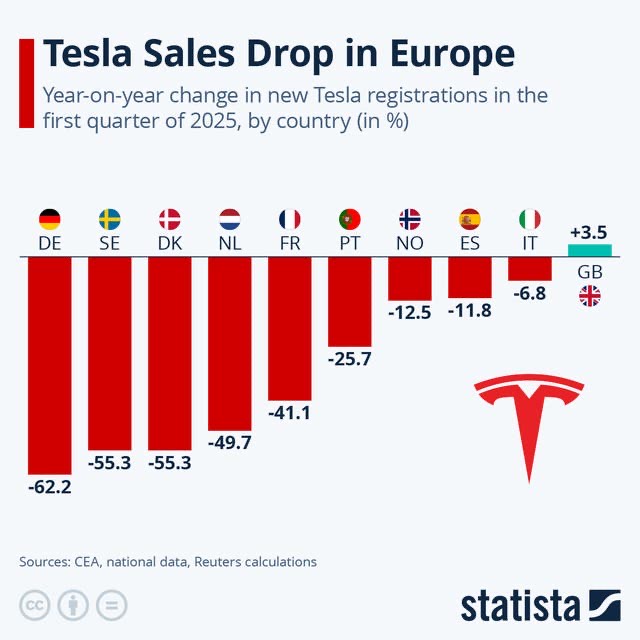
The numbers tell a brutal story. Tesla’s second-quarter deliveries plummeted 13.5% year-on-year to just 384,000 vehicles, whilst European sales collapsed by as much as 45% in early 2025. Even in Tesla’s stronghold markets of China and the United States, rivals including BYD, Volkswagen, and Hyundai are systematically dismantling the company’s once-impregnable market position.

What began as isolated competitive pressure has metastasised into an existential crisis encompassing product stagnation, mounting legal challenges, and a brand toxicity that would have been unthinkable just two years ago. Elon Musk’s response – personally commandeering Tesla’s sales operations from the company’s headquarters – represents either inspired leadership or desperate theatre. The evidence suggests the latter.

Tesla’s troubles extend far beyond routine quarterly fluctuations. Industry analysts point to a fundamental product problem: the company has launched no genuinely new mainstream models since the divisive Cybertruck, leaving its core range looking increasingly antiquated. The Model S and Model X, now approaching their second decade, lack the technological edge that once justified premium pricing, whilst even the refreshed Model 3 and Model Y variants have failed to generate meaningful market excitement.

Manufacturing bottlenecks from Model Y production transitions have exacerbated inventory buildups, creating the paradox of falling sales alongside unsold stock. “Tesla is caught between worlds,” explains one former executive who departed the company last year. “They’re trying to maintain premium positioning whilst competing on volume, and it’s not working.”

The human cost of these missteps extends beyond shareholders. Recent months have witnessed an exodus of senior talent, including the head of North American sales and key battery engineering leaders, suggesting internal recognition that current strategies are failing.

Perhaps more damaging than operational setbacks is Tesla’s reputational crisis. Musk’s increasingly vocal political alignment, particularly his association with Donald Trump, has triggered what industry observers term a “consumer revolt” in traditionally progressive markets where Tesla once dominated.

The “Tesla Takedown” movement, documented across social media platforms, encompasses everything from organised boycotts to physical vandalism of vehicles. Resale values have declined accordingly, with specialist automotive data firms recording measurable drops in Tesla’s brand perception scores throughout 2025.

“We’re seeing something unprecedented,” notes Professor Sarah Davidson, who studies automotive consumer behaviour at Warwick Business School. “Political polarisation is directly impacting purchase decisions in ways we’ve never measured before. Tesla owners are reporting embarrassment about their vehicles.”

Tesla’s troubles extend into America’s courtrooms, where multiple high-stakes cases threaten both immediate operations and long-term viability. California’s Department of Motor Vehicles is pursuing a 30-day sales ban over allegedly misleading advertising of Autopilot and Full Self-Driving capabilities, a move that would devastate Tesla’s largest single market.

Simultaneously, a wrongful death trial in Miami centres on Autopilot’s role in a fatal 2019 crash, with potential punitive damages that could establish precedents for autonomous vehicle liability. Legal experts suggest the outcome could fundamentally reshape how self-driving technologies are marketed and deployed. Tesla’s very own Trolley Car Problem.

Beyond these headline cases, Tesla faces a growing constellation of “phantom braking” complaints, quality control lawsuits, and antitrust challenges to its repair monopoly. Each represents not merely financial exposure but further erosion of consumer confidence in Tesla’s core technologies.

Central to Tesla’s current predicament is a business model that once represented revolutionary thinking but now appears increasingly anachronistic. The company’s rejection of traditional franchise dealerships delivered early advantages in pricing control and customer experience, yet state-level dealership protection laws have created a patchwork of legal restrictions that limit Tesla’s expansion opportunities.

More problematically, Tesla’s insistence on controlling all aspects of vehicle servicing has created what consumer advocates term a “repair monopoly.” Owners face extended delays, higher costs, and limited alternatives when vehicles require maintenance, issues that traditional franchise networks handle through distributed infrastructure and competitive pricing.

“The direct-to-consumer model worked brilliantly when Tesla was a premium niche player with devoted customers,” observes automotive retail consultant James Morrison. “But mass-market consumers expect convenience and choice that Tesla’s current structure simply cannot deliver at scale.”

Industry data supports this assessment. Whilst traditional manufacturers leverage dealer networks to manage demand fluctuations and regional variations, Tesla must shoulder these burdens independently. The resulting bottlenecks in service capacity and inventory management become particularly acute during periods of market stress.

Reports from Tesla’s Fremont headquarters suggest Musk has resumed the hands-on approach that characterised the company’s early years, reportedly employing Musk’ peculiar trademark of sleeping at the facility whilst personally directing sales strategy. The company has rolled out aggressive incentive programmes including discounted financing, complimentary software trials, and targeted offers for military veterans and educators.

These measures represent classic demand stimulation tactics, designed to shore up quarterly numbers ahead of Tesla’s earnings announcement. However, automotive industry veterans express scepticism about their long-term effectiveness.

“Incentives are a sugar rush,” explains former General Motors executive Patricia Williams, now an independent consultant. “They can mask underlying problems temporarily, but they don’t address fundamental issues of product competitiveness or brand perception. Tesla’s challenges are structural, not tactical.”

Stock market analysts echo this assessment, noting that Tesla’s current crisis encompasses precisely the factors that discount-driven sales campaigns cannot address: ageing product lines, manufacturing inefficiencies, legal liabilities, and consumer sentiment.

Tesla’s recovery requires acknowledgement that its original advantages have largely evaporated. The company’s technological lead has narrowed considerably, with competitors matching or exceeding Tesla’s capabilities in areas from battery range to autonomous features. Meanwhile, manufacturing cost advantages have disappeared as established automakers achieve economies of scale in electric vehicle production.

Perhaps most critically, Tesla must confront the limitations of its direct-to-consumer model. Industry experts suggest hybrid approaches, incorporating elements of traditional franchise or agency partnerships, could address current bottlenecks whilst maintaining some operational control.

“Tesla needs to swallow its pride about the dealership model,” argues automotive strategist David Chen. “The best aspects of direct-to-consumer can be preserved whilst addressing the very real scalability and service issues that are alienating customers.”

Similarly, product renewal cannot wait for revolutionary technologies. Tesla requires incremental but meaningful updates to its existing range, coupled with genuinely new models that recapture market imagination.

Where is the Tesla equivalent ‘Dolphin Surf’ or WuLing Baojun’s funky “Yue Ye” a Suzuki Jimny impersonator, on price and desirability?

Tesla’s current predicament represents more than routine corporate turbulence. The company faces simultaneous challenges across every aspect of its operations, from product development to legal compliance to consumer perception. Musk’s personal intervention in sales operations, whilst symbolically significant, addresses none of these fundamental issues.

The electric vehicle market Tesla created has matured beyond recognition, populated by government funded capable competitors offering consumers genuine alternatives. Tesla’s survival depends not on charismatic leadership or promotional campaigns, but on systematic operational reform that acknowledges this new reality.

Whether Musk and his leadership team possess the humility to undertake such reform remains the critical question facing Tesla shareholders, employees, and customers. The company’s next chapter will be written not in boardrooms or Twitter feeds, but in the quotidian work of building better products and serving customers more effectively than increasingly capable rivals.

The Tesla revolution may be ending. What comes next depends entirely on the company’s willingness to evolve beyond the mythology that created it.

AUTOMOTIVE: China Crisis?

China’s electric vehicle sector has emerged as one of the most significant industrial transformations of our time, fundamentally reshaping global automotive markets through strategic state investment and genuine technological innovation. From Manchester offices to Berlin showrooms, Chinese EVs are capturing consumer attention with competitive pricing and advanced features, whilst raising important questions about trade fairness, data security, and technological sovereignty. This comprehensive analysis examines how coordinated industrial policy, supply chain integration, and genuine market innovation have enabled Chinese manufacturers like BYD and NIO to challenge established Western competitors, exploring both the legitimate security concerns and economic opportunities presented by this automotive revolution.

The rise of Chinese EV Around The World Security Threat

A sleek electric vehicle charges quietly outside a Manchester office block. In Berlin, a young professional considers a Chinese-made EV for half the price of its German equivalent. Across Southeast Asia, affordable electric cars are transforming urban transport. These scenes reflect one of the most significant industrial shifts of our time, driven by China’s remarkable rise in the electric vehicle sector.

This transformation raises important questions about trade, technology, and national security that deserve careful examination beyond the headlines about trade wars and technological threats.

China’s dominance in electric vehicles did not emerge by accident. Following decades of playing catch-up in traditional automotive manufacturing, Beijing identified electric mobility as an opportunity to leapfrog established competitors. The timing was astute: Western manufacturers were still heavily invested in combustion engine technology, creating space for new entrants.

Between 2009 and 2023, the Chinese government invested approximately $230 billion in subsidies across the EV supply chain, from battery research to charging infrastructure. This approach enabled companies like BYD, NIO, and CATL to achieve scale and vertical integration that would have taken decades through market forces alone.

However, this state support, whilst substantial, occurred alongside similar programmes in other nations. The United States has committed over $100 billion through the Inflation Reduction Act, whilst the European Union has allocated €3 billion specifically for battery manufacturing. The difference lies not in the presence of state support, but in its coordination and timing.

China’s approach also reflected genuine domestic priorities. With 70% of oil imports traversing potentially contested sea lanes, electric vehicles offered a path towards energy security that aligned with both economic and strategic interests. This convergence of commercial and security considerations helped sustain long-term investment even when short-term returns remained uncertain.

Chinese EVs succeed internationally because they offer genuine value to consumers. Modern Chinese electric vehicles combine competitive pricing with advanced features, often incorporating software capabilities that rival Silicon Valley products. The price advantage, typically 30-50% below Western equivalents, reflects not just subsidies but also manufacturing efficiencies and supply chain integration.

European consumers increasingly choose Chinese EVs based on practical considerations: lower purchase prices, competitive range, and modern infotainment systems. This market response suggests that Chinese success stems from meeting consumer needs, not merely undercutting competitors through state support.

Yet this consumer appeal operates within a broader industrial context. Chinese manufacturers benefit from controlling much of the battery supply chain, from lithium processing to cell production. This vertical integration creates cost advantages that would be difficult to replicate quickly, regardless of subsidy levels.

The data collection capabilities of modern electric vehicles do raise genuine privacy and security concerns. Contemporary EVs function as mobile data centres, gathering information about location patterns, driving habits, and even conversations through voice assistants. Under China’s 2017 National Intelligence Law, domestic companies must cooperate with intelligence gathering when requested.

These concerns apply broadly to connected vehicles regardless of origin. Tesla vehicles collect extensive data, as do European manufacturers increasingly reliant on Chinese components. The issue is not unique to Chinese brands, but rather reflects the broader challenge of data governance in an interconnected automotive sector.

Security analysts have identified potential vulnerabilities in vehicle connectivity systems that could theoretically enable remote interference. However, documented cases of such interference remain limited, and automotive cybersecurity standards are evolving to address these risks across all manufacturers.

The more immediate concern may be economic rather than directly security-related. As Chinese companies gain market share, they increasingly influence technical standards for charging protocols, battery interfaces, and vehicle software. This standardisation power could create long-term dependencies that extend beyond individual purchase decisions.

The rapid expansion of Chinese EV exports has created significant pressure on established automotive manufacturers. In 2023, Chinese firms exported 1.5 million electric vehicles, compared to fewer than 200,000 three years earlier. This growth has coincided with mounting challenges for European manufacturers, from Volkswagen’s plant closures to Ford’s restructuring plans.

However, attributing these difficulties solely to Chinese competition oversimplifies complex market dynamics. European manufacturers also face regulatory pressure to accelerate electrification, supply chain disruptions, and changing consumer preferences that favour software-defined vehicles over traditional automotive engineering.

Some European companies are adapting by forming partnerships with Chinese firms or sourcing Chinese components whilst maintaining design and assembly operations in Europe. This approach suggests that the relationship need not be purely adversarial, though it requires careful management of technological dependencies.

Western governments are implementing various measures to address the challenges posed by Chinese EV expansion. The United States has imposed tariffs exceeding 100% on Chinese electric vehicles and restricted federal subsidies for vehicles containing Chinese components. The European Union has launched anti-subsidy investigations and is considering additional trade measures.

These responses reflect legitimate concerns about fair competition and technological dependency. However, they also risk delaying the transition to electric mobility and increasing costs for consumers. The challenge lies in balancing security considerations with the benefits of technological competition and innovation.

More constructive approaches might focus on strengthening domestic capabilities whilst maintaining open markets. This could include accelerating investment in European and American battery manufacturing, developing robust cybersecurity standards for all connected vehicles, and creating reciprocal market access agreements that ensure fair competition.

China’s success in electric vehicles occurs within a larger context of technological competition between major powers. Similar dynamics are visible in renewable energy, semiconductors, and artificial intelligence. The question is not whether such competition will occur, but how it can be managed constructively.

The electric vehicle sector demonstrates both the benefits and risks of economic interdependence. Chinese innovation has accelerated global EV adoption and reduced costs for consumers worldwide. Simultaneously, the concentration of production capabilities raises questions about supply chain resilience and technological sovereignty.

China’s rise in the electric vehicle sector represents a significant shift in global industrial capabilities that reflects both strategic planning and genuine technological achievement. Whilst legitimate concerns exist about data security and market dependencies, addressing these challenges requires nuanced policies that distinguish between different types of risks.

The success of Chinese EVs demonstrates the effectiveness of coordinated industrial policy combined with genuine innovation. Rather than simply restricting market access, Western nations might focus on strengthening their own capabilities whilst developing frameworks for managing technological interdependence constructively.

The electric vehicle revolution will continue regardless of trade disputes or security concerns. The question is whether this transformation can occur in ways that benefit consumers whilst addressing legitimate national security considerations. This balance requires sophisticated policy responses that move beyond simple narratives of technological conflict towards more constructive approaches to managing global industrial competition.

The Chinese EV challenge is real, but it is also an opportunity to develop better frameworks for technological cooperation and competition in an interconnected world. How we respond will shape not just the automotive sector, but the broader relationship between economic integration and national security in the twenty-first century.

AUTOMOTIVE: Enter The Dragon

China’s EV brands are conquering the UK market faster than Japan did in the 1970s. How BYD, MG, and others are reshaping British motoring through technology, pricing, and perfect timing.

Chinese EV Surge In U.K.

How China’s U.K. EV Assault Surpasses Japan’s Seventies Invasion.

There’s a familiar tremor running through the British motor trade. A certain déjà vu. The showroom floors, now electrified with pixel-heavy infotainment and suede-trimmed crossovers bearing names like BYD, Omoda and Jaecoo, are humming not just with battery current – but with history. We’ve seen this play out before. Back in the oil-slicked, strike-riddled 1970s, when Japanese badges like Datsun and Toyota crept into British driveways while the unions down at Cowley and Longbridge were still arguing over tea breaks.

But here’s the kicker: this isn’t just a rerun with better batteries. It’s something bigger, bolder, and infinitely faster.

Let’s rewind to the early 1960s. Britain was still clinging to its imperial swagger, and its car industry was a global heavyweight. We were second only to the Americans in output, churning out Cortinas, Minxes and Victors at a blistering pace. But beneath the bonnet lay a wheezing, smoke-belching machine that hadn’t seen a proper rebuild in decades. Chronic underinvestment, fractious management, and mass walkouts meant the rot was deep-set long before anyone uttered the word “Datsun”.

By the close of that decade, Japan had quietly overtaken us, not with muscle cars or motoring romance, but with small, efficient, no-nonsense machines that started every morning and didn’t eat their own gearboxes. British Leyland, our great white hope, was a bureaucratic Frankenstein built to paper over the cracks. The Japanese, meanwhile, had mastered kaizen, built factories that ran like Swiss watches, and tapped into a global shift toward smaller, thriftier motoring just in time for the 1973 oil crisis.

Now? Britain’s car industry still exists, but mostly as an assembly annex for global players; Jaguar Land Rover (Indian-owned), Mini (German), Nissan (Japanese). There’s no national champion, no coherent industrial policy, and certainly no answer to what’s happening in 2025.

If the Japanese invasion of the Seventies was a creeping tide, China’s EV offensive is a tsunami and it’s already at the top of the high street.

Brands like BYD aren’t interested in mimicking Europe. They’re not building cut-price Golfs or knock-off 3 Series. They’re building next-generation tech ecosystems, cars integrated with their own batteries, software, semiconductors and AI platforms. Vertical integration gives them control over cost, quality, and pace that would’ve made Soichiro Honda weep with envy.

MG, once the darling of leafy Home Counties motoring is now a Chinese spearhead, its ZS EV undercutting legacy rivals by thousands while offering more kit, more range and fewer reasons to say no. Omoda and Jaecoo, still unfamiliar to British tongues, are bringing cars that wouldn’t look out of place in a Mercedes showroom but cost the same as a base Focus.

Unlike the Japanese back in the day, these newcomers don’t need to earn trust through decades of reliability reports and mechanically sound mediocrity. They’ve entered a market that wants disruption. Today’s car buyer shops online, trusts tech reviews more than showroom patter, and is more concerned with charging speed and infotainment updates than whether the badge has a Le Mans win.

The Seventies were no picnic; oil shocks, inflation, a government more concerned with surviving until Thursday than with industrial strategy. But crucially, consumers shifted toward Japanese imports because of price and economy. The Datsun 120Y, the darling of driving school cars, wasn’t just cheaper, it went further on a gallon, didn’t need fettling every weekend, and looked vaguely modern compared to a Maxi.

Today, the driver isn’t petrol prices, it’s policy. The UK’s net-zero mandate has lit a fire under EV adoption, and with the 2030 ICE ban looming, demand is being turbocharged not by market whim, but by regulation.

The Chinese have timed it to perfection. While European and Japanese marques scramble to electrify ICE platforms and untangle semiconductor bottlenecks, Chinese firms are shipping fully electric, ground-up platforms by the boatload. And they’re doing it without the millstone of legacy dealerships or brand baggage.

The UK, still licking its post-Brexit wounds, has kept tariffs off the table. Although just this week has excluded Chinese EV from the £3750 EV Subsidy redux. Unlike the EU, which has slapped Chinese EVs with duties up to 45% and minimum pricing, Britain remains wide open. The logic? Lower prices accelerate EV adoption. There’s no domestic champion to shield, and Downing Street would rather see a car plant in Swindon even if it flies a red star than an empty field.

In the Seventies, faced with growing Japanese dominance, the UK government tried the polite approach: voluntary export restraints, 20% tariffs, and veiled threats in Hansard. It didn’t work and by the time ministers finished their brandy, Nissan was already laying foundations in Sunderland.

This time, we’re not even pretending to resist. Open markets, loose regulation, and generous tax incentives make the UK a Chinese dream. While Brussels rattles sabres, Whitehall rolls out the red carpet.

Strategically, it’s a gamble. We’re hoping that in return for market access, Chinese brands will localise production, build battery plants, and create jobs. It’s industrial policy by osmosis. If it works, we’ll get investment without picking winners. If it doesn’t, we’ll be left with a forecourt full of imports and no local stake in the future of motoring.

Let’s put it in context. Japanese brands took a decade to crack the UK market. Chinese brands have done it in less than five years. BYD sells more EVs than Volkswagen globally. Their battery division, CATL, probably supplies half the industry. This isn’t incremental progress it’s industrial domination.

Technologically, the difference is night and day. Japan gave us better-built Escorts. China is giving us cars that update over-the-air, offer Level 2 autonomy, and come with smartphone apps that track your tyre pressure from Tenerife, they’re also safe with the top 5 Star NCAP safety rating. The EV isn’t just a new drivetrain – it’s a software platform, and China with 1.5 Billion inhabitants to test new tech on is miles ahead on that front. They can launch in foreign markets with proven new tech.

British car buyers in the 1970s were brand-loyal, suspicious of imports, and only changed their tune after being burned too many times by dodgy electricals and engines that were engineered to throw con-rods for fun at sixty five thousand miles (cough Ford). Today’s buyers are patently open to new brands and don’t care where a car is built – they care if it syncs with Spotify and charges in under 30 minutes.

Younger buyers, the key demographic for EVs, have no nostalgic attachment to Ford or Vauxhall. They trust influencers more than dealers. They’re digital natives in a world where Tesla has already redefined what a car can be and how it’s sold. Chinese brands, with their TikTok-savvy launches and online sales funnels, get this. The legacy players mostly don’t.

Will Chinese EVs kill off what remains of the British car industry? Unlikely, it’s already on life support. But they will dictate the pace, the technology, and the price point of Britain’s motoring future. That, more than anything, is the lesson we should have learned in the Seventies.

Then, we tried to shield British brands behind tariffs and pride. Now, we’ve flung the gates open and invited the dragon to dinner.

POSTSCRIPT:

In the Eighties, the Japanese built factories here. They hired local. They became part of the landscape. The Chinese? That’s still up in the air. The smart money says we’ll see BYD or Chery setting up UK operations soon – if not for patriotism, then for EU access via a tariff-free back door.

And when they do, remember this: we weren’t conquered. We just let them in. Smiling, silent, and WiFi-enabled – and that, is another story.

COMMENTARY: No Mate, 12 Weeks Minimum.

Why the best businesses don’t need social media (and what that means for the rest of us)

I’m knee-deep in renovating a nearly 50-year-old property on the south coast U.K.

The place is solid as a stick of rock but needs everything doing after years of neglect.

Here’s what’s fascinating: every tradesman I’ve contacted is booked solid for months. No fancy websites, no Instagram presence, barely even a Google listing or review. They survive entirely on word of mouth, repeat customers and replying to messages. Quality work speaks louder than any marketing campaign.

Meanwhile, a talented abstract artist friend in Hove with 12,200 genuine Instagram followers is lucky to get 50 views on her posts. The algorithm has throttled her reach to nothing unless she pays to play. She’s not alone. Countless creative professionals are watching their organic reach disappear.

It’s the same story on LinkedIn. Despite upgrading to Premium, my posts struggle to reach even 50 people. The platform that promises professional networking seems more interested in pushing paid promotion than genuine connection.

There’s a lesson in this contrast. The trades flourish because they’ve built something social media can’t replicate: trust through consistent quality. But for those of us trying to grow beyond our immediate network, the digital landscape feels increasingly pay-to-play.

I help businesses navigate this challenge through strategic digital marketing that focuses on building genuine relationships rather than chasing vanity metrics.

Sometimes the old-school approach of quality and referrals is exactly what modern marketing needs.

How are you finding social media for your business? Are you seeing the same decline in organic reach, or have you found strategies that still work?

DIGITAL MARKETING: More Creator Content Intel

Authentic creator content is now proving more effective than traditional advertising methods when it comes to audience engagement and building brand trust.

Recent research shows that creator-led campaigns consistently outperform standard digital ads, both in terms of engagement rates and return on investment. For example, 94% of brands now believe creator content delivers better ROI than traditional ads, a significant jump from previous years.

The reason is clear: creators offer *real stories and honest opinions*, which audiences find far more relatable than polished, scripted adverts. This authenticity leads to higher levels of trust, with consumers more likely to value recommendations from creators they follow over direct brand messaging. In fact, creator content has been found to perform better than 77% of traditional ads in delivering new information and 72% in terms of credibility.

Engagement rates are also much higher. Influencer-generated content receives up to eight times more engagement than brand-produced content, and campaigns featuring creators often spark meaningful conversations rather than just impressions. Brands are responding to these results by shifting more of their marketing budgets towards creator partnerships, recognising that authentic content not only captures attention but also drives action and loyalty.

In short, authentic creator content is not just a trend but a proven strategy that now outpaces traditional advertising in effectiveness, building stronger connections and trust with today’s audiences.

If you are interested in applying my digital transformation research, strategies and philosophy to improve your business marketing endeavours please contact me.

DIGITAL MARKETING: The 2025 Creator Content Premium

Why Creator Content is Outperforming Traditional Advertising

The marketing landscape has changed dramatically in recent years, with the rise of the creator economy at the heart of this transformation. New research confirms what many marketers have suspected: content made by creators doesn’t just match the impact of traditional advertising, it actually outperforms it. This is true for both long-term brand equity and short-term sales.

What the Research Tells Us

Several recent studies have compared creator content directly with standard industry advertising. The findings are compelling:

– Superior Performance: Creator content consistently beats traditional adverts on measures such as emotional resonance, memorability, and trustworthiness.
– Emotional Connection: Viewers are much more likely to feel an emotional response to content made by creators. In some cases, up to a third of people reported a genuine emotional reaction, which is invaluable for brands aiming to stay top of mind.
– Real Results: Brands aren’t just seeing warm feelings. Around 70% of brands say their most successful campaigns have involved creators, and most believe that creator-led content delivers a better return on investment than conventional adverts.
– Driving Action: Research shows that 80% of consumers have taken action after engaging with creator content, whether that’s looking up a brand, following them on social media, or making a purchase.

Why Are Creators So Effective?

There are a few key reasons why creators deliver such impressive results:

– Authenticity: People trust real voices more than polished adverts. Creators speak directly to their followers, often sharing personal stories and honest opinions. This authenticity is especially valued by younger audiences, who are increasingly sceptical of anything that feels too scripted.
– Emotional Engagement: Creators are skilled at building genuine connections with their communities. When a creator is enthusiastic about a product, that excitement rubs off on their audience, making a real difference to brand recall.
– Relevance: Creator content is often tailored to the interests and needs of a specific audience, making it far more relevant and effective than generic advertising.

The Power of Short-Form Video

Platforms like TikTok, Instagram Reels, and YouTube Shorts have amplified the impact of creator content. Short-form videos are quick, engaging, and perfectly suited to the way we consume media today. Nearly half of UK social shoppers say they’ve bought something after seeing it featured by a creator.

What Does This Mean for Brands?

The message is clear: if you want to make a real impact, it’s time to invest in creator partnerships. As the digital world becomes more crowded and AI-generated content becomes more common, the human touch offered by creators will only become more valuable.

Brands that embrace this shift and work with creators who genuinely align with their values are set to reap the rewards, both now and in the future.

–  “When creators grab and hold attention in social feeds, it generates an extended emotional reaction that fosters deep connections with the brand, driving brand memory and making it easier and faster for audiences to recall brands when making purchasing decisions.” Ben Jeffries, CEO of Influencer.

In summary, creator content isn’t just a passing trend. It’s the new gold standard for building brands and driving sales in the digital age.

DIGITAL MARKETING: Get An Upgrade

Get An Upgrade Website SEO Offer

Ready to transform your digital presence? Introducing a state-of-the-art website offer that’s designed to elevate your brand, engage your audience, and drive results.

Six great reasons to refresh your website and digital presence today:

– Instantly boost your credibility and authority with a modern, professional design.

– Enhance user experience and keep visitors engaged with seamless navigation and updated features.

– Improve security and reduce the risk of hacks by upgrading to the latest technology.

– Stay ahead of competitors by integrating the newest tools and functionalities your audience expects.

– Save time and improve customer service with easier site management and automation.

– Expand your reach and connect with a global audience 24/7 – your website never sleeps.

Don’t let an outdated site hold your business back. Ready for a digital upgrade? Let’s chat and unlock your brand’s full potential!

A website is for life, not just for Christmas. Take a look at the projects page for more details about Steve Coulter Creative, the team and our work to update and fine tune your digital marketing.