Search: AI Ate Your Traffic. Now What?

The new rules of search: zero click, multi-platform and brand led

Search used to work in a simple way. You typed a question, Google gave you a list of links, you clicked one, and you landed on a website. That website might belong to a business trying to sell you something, answer your question, or both. The click was the whole point.

That model is breaking down.


What has actually changed

AI tools like Google’s AI Overviews, ChatGPT, Perplexity and others now answer your question directly, on the spot, without sending you anywhere. You ask “what’s the best way to insulate a loft?” and you get a full answer, right there, no clicking required.

For the person asking the question, this is brilliant – hence the habit change. For the business whose website used to get that click, it is a serious problem.

The visit to your site was the start of everything commercially useful: someone reads your content, likes what they see, fills in your contact form, or buys something. If the AI answers the question before they ever reach you, that visit never happens. No visit, no lead. No lead, no sale.

This is what people mean by zero-click search. The question gets answered, but nobody goes anywhere.


It is not just Google any more

On top of this, search is no longer one place. While it never was exactly, Google has been preeminent for two decades. People are now asking questions on ChatGPT, Perplexity, Gemini, Apple Intelligence, Microsoft Copilot, and a growing pile of AI tools built into browsers, phones and apps. Each of these has its own way of finding information and deciding who to credit.

For years, SEO meant optimising your website for Google. One engine, one rulebook, broadly understood. That is still relevant, but it is no longer the whole picture. You now need your content to be findable, usable and citable by a range of AI systems that each work slightly differently.


What gets a brand or business cited

When an AI app does mention a source, it is not random. These systems consistently favour content with specific characteristics;

Concrete, specific facts. AI tools like content that contains clear, direct, checkable information. A claim like “our service covers the South East” is not citable. A claim like “we reduced average page load time by 40% across 12 client sites” is. The AI needs something it can pull out and attribute accurately.

Clear question and answer structure. Content written around real questions, with direct answers, tends to do well. This is partly because AI models are trained on that kind of content, so they recognise and trust the pattern. If your content dances around a question rather than answering it plainly, it tends to get skipped.

A brand the AI actually knows. This one surprises people. If the AI has no clear sense of who you are as a business, it will not name you. That means consistent naming across your website, your social profiles, your directory listings and any press coverage. The more places your brand appears in a coherent, consistent way, the more likely the AI is to recognise you as a real, trustworthy entity worth citing.

Other people saying the same thing. AI systems are more confident citing a claim if they have seen it backed up in multiple places independently. Coverage in trade press, customer reviews, expert mentions, and third-party references all help. If only your own website makes a particular claim, the AI may quietly ignore it.

A website the AI can actually read. This is straightforward technical hygiene. If your site is slow, badly structured, blocks crawlers, or is missing basic schema markup, AI systems may simply never see it. You cannot be cited if you cannot be found.


Why brand now matters more than ranking

Put all of this together and you get to the uncomfortable truth: being on page one of Google is no longer enough on its own.

What matters now is whether the AI knows your brand, trusts your content, and considers you worth mentioning when a relevant question comes up. That is a different challenge from traditional SEO, and it sits much closer to how you build a brand reputation than how you build a link profile.

The businesses that will do well in AI search are the ones that own a clear point of view in their field, produce specific and useful content regularly, and build enough presence across the web that the AI has plenty of good reasons to name them.

The click is no longer guaranteed. The mention is the new metric. Getting ready for that shift is the work.

Steve Coulter, State Of The Art Digital – May 2026

Search: Non-Commodity Content. What?

This is not a drill.

I make no apologies that this is a long read, but a vital one for all business owners.

The rise of AI search summaries and your highly probable non-inclusion is an existential travesty that your present agency has not flagged for you. A major problem compounded by Googles’ latest May 2026 ‘AI Optimisation Guidance’ update that totally prioritises Non-Commodity content. What? I hear you say.

Grab a coffee and learn what will make your business not only preeminent in search, but taking an unassailable early adopter advantage. I’ve used the example of Estate Agency (Real Estate Agency for US friends).

Thank me later.


The End of Commodity Content: Why Estate Agents (& All Other Businesses) Must Build Proprietary Knowledge Assets.

The strategic advantage now available to hyperlocal businesses across every sector is unprecedented. Whether you operate as an estate agent in Tunbridge Wells, a dental practice in Harrogate, or a veterinary surgery in Exeter, the competitive landscape in your immediate geography is about to be reset. Google’s May 2026 shift to answer-optimised search means that the first business in each town to build substantive, non-commodity content will dominate AI citations for their sector. The locksmith, solicitor, or accountant who documents genuine local expertise in structured, citable form will appear in AI Overviews while competitors remain invisible. This is not incremental advantage. This is first-mover monopoly in local search visibility. Every hyperlocal business category in every town is currently wide open: whoever moves first and builds the knowledge assets wins the territory. For estate agencies, dental practices, veterinary surgeons, and every other geographically bound service business, the question is whether you recognise this as the fundamental strategic opportunity it represents, or whether you let a competitor claim it while you continue publishing the same generic content as everyone else.

Google’s announcement in May 2026 represents the most significant shift in search behaviour since the introduction of mobile-first indexing. The mandate is unambiguous: AI Overviews and AI Mode will prioritise answer engines over traditional link farms, and websites that cannot demonstrate genuine expertise through original, substantive content will lose visibility entirely.

For estate agencies, this creates an immediate strategic problem. Most agency websites currently operate as variations on the same template: property listings fed from the same CML data, area guides plagiarised from Wikipedia, service pages that promise “expert local knowledge” without providing any, and blog content recycled from national property portals. None of this will survive contact with generative engine optimisation.

The technical term for what Google now penalises is commodity content: information that exists in functionally identical form across multiple domains. If your area guide for Cheltenham could be republished word-for-word as an area guide for Harrogate by changing only the place names, it has no value to a language model trying to synthesise authoritative answers. Google’s AI will cite the original source or the most comprehensive treatment, not the fifteenth derivative version.

What answer optimisation actually means

Answer engines work by parsing structured content to construct responses to natural language queries. When someone asks “what should I know before buying a Victorian terrace in Clifton”, the AI doesn’t return ten blue links. It synthesises an answer from multiple sources, citing only those that contribute novel, specific, verifiable information.

Traditional SEO optimised for ranking factors: keyword density, backlink profiles, domain authority. GEO optimises for citability: is your content substantive enough to be quoted as a source? Does it contain specific claims that can be verified? Does it offer information that cannot be derived from other published sources?

For estate agencies, this requires a fundamental shift from marketing copy to knowledge publishing. The question is no longer “how do I rank for ‘estate agents Bristol'” but “what do I know about property in Bristol that nobody else has documented?”

The proprietary knowledge problem

Most agencies possess substantial proprietary knowledge. The negotiator who has handled three generations of the same family understands inheritance patterns and family property decisions. The valuer who has appraised every house type in the town knows which streets command premiums and why. The lettings manager who has placed five hundred tenants understands seasonal demand patterns and rental price elasticity.

Almost none of this knowledge is published. It sits in email threads, verbal exchanges, and institutional memory. Meanwhile, the agency website publishes generic content about “our commitment to service excellence” and “comprehensive local knowledge” without ever demonstrating what that knowledge comprises.

The challenge for now and ongoing is making proprietary knowledge externally visible in structured, citable form. This means original research, original photography, original data analysis, and original testimony from sources who cannot be replicated.

Examples of non-commodity content that works

Commission your maintenance contractors to document common issues by property age and type. Get the plumber to explain what causes damp in 1930s semis versus Victorian terraces, which boiler brands fail most frequently, what actually needs replacing versus what can be repaired. This is knowledge derived from hundreds of callouts across your patch. Nobody else has it in this form.

Analyse your own transaction data to identify patterns invisible in national statistics. Document average void periods by property type, most common reasons for offer rejection, the actual gap between asking price and achieved price across different streets. Publish the findings with specific numbers, specific locations, specific time periods. This is proprietary data that cannot be sourced elsewhere.

Create measurement guides showing what physically fits in local property types. Which Victorian terraces can accommodate a standard three-seater sofa up the stairs, typical room dimensions in Edwardian semis for furniture planning, whether king-size beds fit in second bedrooms of common house types. This requires access to hundreds of properties and tedious documentation work. It is also exactly the kind of specific, practical information that answer engines will cite.

Interview long-standing residents about lived experience in the area. The family who have been in the same street for forty years can explain how the high street has changed, which local amenities have closed or opened, what the community rhythm actually feels like. These testimonials should be specific: names, dates, verifiable details. Not “I love living here” but “we moved here in 1987 when the factory was still operating, the high street had three butchers then, now it’s all coffee shops but the bakery on Crown Street is still the same family”.

Document the informal knowledge that demonstrates embeddedness. Which builder works regularly in the conservation area and understands the planning constraints, where you can actually get a plumber at short notice, the tree surgeon who knows the local authority’s approval process. This is concierge-level information that proves you are part of the community fabric rather than simply claiming it.

The controversy trap

The instinct when pursuing distinctive content is to reach for controversy: planning disputes, flooding risks, infrastructure problems, local political divisions. This demonstrates knowledge but introduces doubt at precisely the moment you need to build confidence.

An estate agency exists to facilitate transactions. Content that raises problems without resolving them creates friction in the buying decision. The goal is to prove local expertise while reducing perceived risk, not increasing it.

Better to focus on practical knowledge that helps buyers and sellers make informed decisions: seasonal patterns in your specific market, which streets have the strongest demand from families versus young professionals, what improvements actually increase sale prices based on your transaction data, which solicitors and mortgage brokers your clients report back as being efficient.

The content should answer questions people are genuinely asking but struggling to get answers to. Not “why choose us” but “what do we know that helps you”. The former is marketing. The latter is knowledge publishing.

Why this matters now

Google’s May 2026 mandate is not optional. Nor is your future inclusion in the results of AI Apps like Chat GPT, Claude, Gemini and Perplexity. Agencies and any business that continue to rely on commodity content will lose visibility as AI Overviews and AI Mode become the dominant search interface. The traffic that currently arrives via traditional organic search will increasingly be answered directly by the AI without a click-through. The so-called Zero Click phenomenon, or ‘Position Zero’.

The only websites that will retain visibility are those cited as sources in AI-generated answers. Citation requires original, substantive, structured content that contributes information unavailable elsewhere.

For agencies, this means treating content creation as knowledge asset development rather than marketing overhead. The investment required is significant: staff time to document expertise, original photography, data analysis, commissioned testimony. But the alternative is gradual invisibility as search behaviour shifts away from link-based results.

The agencies that will dominate local markets post-May 2026 are those that have built citable knowledge assets demonstrating genuine expertise. Not those with the best marketing copy, but those with the most substantive published evidence of what they actually know.

This is not a speculative trend. It is a structural shift already underway. The question is whether your agency treats it as an optional nice-to-have or as the fundamental precondition for future visibility.


For more information on how your business can capitalise on this paradigm shift please contact me.

From Your Correspondent: Google Might Be About To Widen The Pool

For over a decade, SEO has operated within a fixed constraint: Google’s deep learning ranking systems only evaluate the top 20–30 candidate pages because running neural networks on more results is too expensive. That number wasn’t chosen for quality reasons. It was set by hardware budgets and memory costs. Court testimony from Google’s VP of Search confirmed it, and now Google Research has published the algorithm that could remove the constraint. TurboQuant compresses vector representations by 4x whilst maintaining retrieval quality, making it economically viable to evaluate far larger candidate sets. When the ranking window widens, the rules change. Sites with strong content and structured data get a fair hearing against established players with dominant backlink profiles. The moat around incumbent rankings is about to shrink.

Google has historically ranked pages using a two-stage process that evaluates tens of thousands of candidates before applying deep learning (RankBrain, BERT) to just 20–30 finalists. This narrow window exists because running neural ranking on more pages is too expensive in compute and memory. That constraint was confirmed under oath by Google’s VP of Search, Pandu Nayak, during the DOJ antitrust trial.

Now the hardware economics are shifting. Google has published TurboQuant, a vector compression technique that reduces memory requirements by 4x whilst keeping retrieval quality high. CEO Sundar Pichai has acknowledged severe supply constraints on memory and foundry capacity, but TurboQuant addresses exactly that bottleneck by making retrieval indexing “virtually free” and reducing memory load per vector dramatically.

If deployed, TurboQuant lets Google evaluate a much larger candidate set before final ranking without adding hardware cost. The 20–30 page window was never a design decision. It was a budget ceiling. When the ceiling lifts, the entire competitive surface changes.

Why widening the search pool is good news

A wider candidate set levels the playing field. Under the current constraint, strong content on smaller or newer sites often never reaches the deep learning ranking layer because it gets culled in early retrieval stages dominated by classical signals like domain authority and link equity. The top 20–30 slots tend to go to established players with robust backlink profiles, not necessarily the pages with the best answers.

When Google can afford to evaluate 100 or 200 candidates instead of 20, retrieval-ready content gets a fair hearing. Pages with clear, citable claims, strong entity associations and semantic coherence can enter the ranking window even without legacy domain authority. Sites that have invested in content quality and structured information rather than link-building arms races get a shot they didn’t have before. The moat around incumbent positions shrinks.

For SMEs, local businesses and specialist publishers without big backlink budgets, this matters. If your page is genuinely retrieval-friendly (meaning AI systems can extract, verify and cite it), you’re now competing on content merit in a larger pool rather than being filtered out before ranking even starts. The game shifts from “can I outrank these 20 entrenched sites” to “can I be one of the 100 or 200 pages Google considers worth evaluating”. That’s a much more achievable threshold for quality content.

In practical terms for your consultancy clients: automotive retailers and estate agents with well-structured, citation-ready content (clean JSON-LD, strong NAP consistency, clear expertise signals) will have a better chance of appearing in AI-mediated results and wider ranking windows than they do now, where they’re often squeezed out by aggregator sites with stronger link profiles.

The shift favours signal over legacy authority.

COMMENTARY: It’s The Ecosystem Stupid.

Google Search AI Optimisation: Practical Guide for SEO & GEO Experts

Core principle

Google’s AI-powered search features (AI Overviews, formerly SGE) work fundamentally the same way as traditional Search: they rank and surface content from the web index using established quality signals. The same content that ranks well organically can appear in AI summaries.

What you need to do

1. Stick to established SEO fundamentals

Quality content that follows Google’s existing guidance will perform in AI features. No separate optimisation track is required. Focus on:

  • E-E-A-T signals: Demonstrate expertise, experience, authority and trustworthiness
  • Helpful content: Write for people, not algorithms
  • Technical foundations: Fast loading, mobile-friendly, crawlable architecture
  • Structured data: Use schema markup where relevant (though not a ranking factor, it helps Google understand context)

2. Understand how AI Overviews select content

AI Overviews pull from multiple high-quality sources to provide comprehensive answers. Your content is more likely to appear when:

  • It directly answers specific queries with clear, authoritative information
  • It ranks well in traditional search results for related queries
  • It demonstrates topical authority and expertise
  • It provides unique insights or perspectives not widely available elsewhere

3. Monitor performance differently

Track visibility using:

  • Google Search Console: Check impressions and clicks from AI Overview features (filter by search appearance type)
  • Traditional ranking data: Strong organic rankings remain the foundation
  • Click-through patterns: AI Overviews may reduce clicks for simple informational queries but can drive qualified traffic for complex topics

4. Optimise for citation-worthy content

Make your content more likely to be referenced:

  • Clear, factual statements: AI systems favour unambiguous information
  • Proper sourcing: Cite your own sources to establish credibility
  • Logical structure: Use headings, lists and clear paragraph breaks
  • Comprehensive coverage: Answer the full question, including related follow-ups
  • Unique data or insights: Original research, case studies or expert analysis stand out

5. Don’t try to game the system

Avoid tactics that attempt to manipulate AI features:

  • Writing specifically “for AI” rather than users
  • Keyword stuffing or unnatural phrasing
  • Creating thin content designed only to appear in summaries
  • Hiding text or using deceptive structured data

What doesn’t change

  • Quality over quantity: One excellent resource beats ten mediocre ones
  • User intent matters: Match content to what searchers actually need
  • Links still count: Authoritative backlinks remain a trust signal
  • Regular updates: Fresh, current information performs better for time-sensitive topics

What to watch

  • AI Overviews appear more frequently for:
    • Complex queries requiring synthesis from multiple sources
    • Questions where context and nuance matter
    • Topics where users benefit from seeing multiple perspectives
  • They appear less often for:
    • Simple navigational queries
    • Searches with clear commercial intent
    • YMYL (Your Money Your Life) topics requiring extreme caution

Measuring success

Success in AI features correlates with traditional SEO metrics:

  • Strong organic rankings (especially position 1-10)
  • High engagement metrics (time on page, scroll depth)
  • Topical authority (ranking for multiple related queries)
  • Quality backlink profile
  • Positive user behaviour signals

The single most important point: if your content ranks well and serves users effectively, it will appear in AI features when appropriate. There is no separate optimisation playbook.


Reality Check: Citation requirements for other LLM platforms

The above applies specifically to Google Search AI features. For citation and attribution in standalone LLM applications (ChatGPT, Perplexity, Gemini, Claude and similar), different factors apply:

Critical differences from Google

  1. No crawling schedule: LLMs access content through various methods (web search tools, direct fetches, training data cutoffs) with no predictable crawl pattern
  2. No ranking algorithm: There is no equivalent to PageRank or traditional ranking factors. Citation depends on relevance matching and content quality within the specific query context
  3. Inconsistent source attribution: Some platforms cite sources reliably (Perplexity, ChatGPT with search), others may reference content without formal attribution (Claude’s training data, Gemini’s knowledge base)

What increases citation likelihood across LLM platforms

Content characteristics that perform well:

  • Authoritative, factual content: Primary sources, original research, verified data
  • Clear, structured writing: LLMs parse well-organised content more effectively
  • Comprehensive topic coverage: In-depth resources that fully explore a subject
  • Recency: For search-enabled LLMs, recently published or updated content has an advantage
  • Quotable insights: Distinctive expert perspectives or unique data points that stand out
  • Accessible formatting: Clean HTML, proper semantic structure, readable without JavaScript

Technical factors:

  • Open access: Content behind paywalls or login walls is less likely to be cited
  • Crawlability: Standard robots.txt permissions (though some LLM providers may ignore these)
  • Fast loading: Some LLM search tools time out on slow sites
  • Mobile-friendly: Many LLM tools fetch mobile versions
  • Clear metadata: Title tags, meta descriptions and schema help LLMs understand context

Platform-specific considerations

ChatGPT (with web browsing)

  • Cites sources when using Bing search integration
  • Favours high-authority domains and recent content
  • Often pulls from news sites, academic sources and established publications
  • May quote directly with attribution when relevant

Perplexity

  • Most citation-focused of the LLM platforms
  • Provides numbered source references for most factual claims
  • Balances recency with authority
  • Particularly good at surfacing niche expert content if it ranks well

Gemini

  • Integrated with Google Search infrastructure
  • Similar source preferences to Google AI Overviews
  • Less consistent with citation formatting
  • Favours Google-indexed content

Claude

  • Training data cutoff means no access to recent content without web search
  • When web search is enabled, cites sources for factual claims
  • Prioritises authoritative, well-structured content
  • Less likely to cite unless directly relevant to query

What you cannot control

Unlike Google Search, you cannot:

  • Track when or how often you are cited by LLMs
  • Optimise specifically for particular platforms
  • Block individual LLM crawlers while allowing others
  • A/B test content for LLM citation rates
  • Measure referral traffic from LLM citations (except Perplexity, which passes some referrer data)

Practical approach for multi-platform visibility

  1. Optimise for Google first: Strong performance in Google Search increases likelihood of LLM citation
  2. Publish openly: Paywalls and registration requirements reduce LLM visibility
  3. Focus on expertise: LLMs preferentially cite recognised authorities and primary sources
  4. Structure clearly: Use semantic HTML, clear headings and logical content hierarchy
  5. Update regularly: For search-enabled LLMs, fresh content has an edge
  6. Create citation-worthy content: Unique data, original research and expert analysis stand out across platforms

The fundamental truth

No amount of technical optimisation will make poor content citation-worthy in LLM responses. The same principle applies here as with Google: create genuinely valuable, authoritative content that serves users, and citations will follow naturally.

The best strategy remains unchanged: be the best answer to the question being asked.

And breatheeeee…

If you’d like to focus on your business and leave this to a professional please contact me and let’s start a conversation.

Google’s Hubris: Why the Search Giant’s New AI Guide Proves It’s Already Lost

Google’s new May 2026 AI optimisation guide insists traditional SEO still works for AI Overviews, dismissing “GEO” as unnecessary.

But this misses the fundamental shift: ChatGPT, Claude, Perplexity and Gemini aren’t better search engines, they’re making search engines obsolete. Each AI platform rewards different content disciplines – structured authority, synthesis-friendly formats, factual density – precisely the foundations Google now downplays.

This is the Yahoo moment: a dominant platform trying to preserve its infrastructure while users are already trained to expect direct, conversational answers instead of ten blue links.

Optimise for Google if it drives traffic today, but the answer-optimised generation has moved on.

My new article tackles Google’s ego head on.

Google’s AI Optimisation Guide: A Masterclass in Missing the Point

Google published guidance last week on optimising for its AI Overviews and AI Mode. The subtext screams louder than the text: we’re worried, but we’re not changing.

The document insists that established SEO practices remain foundational. Keep your content crawlable. Use semantic HTML. Avoid duplicate pages. Create unique viewpoints. All sensible. All true for Google’s infrastructure. All increasingly irrelevant to where the search behaviour is actually moving.

Because here’s what Google won’t tell you: ChatGPT, Claude, Perplexity, and Gemini itself are training a generation to bypass the search page entirely. These aren’t alternative interfaces to the same underlying system. They’re fundamentally different paradigms, each with distinct ranking signals, citation logic, and content preferences.

Google’s guide dismisses “GEO” as unnecessary terminology. It claims you don’t need special markup, content chunking, or AI-specific files. It frames everything as continuous with traditional SEO. That’s technically accurate for Google’s implementation because Google bolted generative AI onto 25-year-old link-ranking infrastructure. It’s RAG as retrofit, not redesign.

But step outside Google’s walled garden and the picture changes completely. Each AI platform rewards different disciplines:

Perplexity favours recency and structured factual density. Content that can be cleanly extracted and attributed performs. Verbose preambles don’t.

ChatGPT prioritises synthesis-friendly formats and clear conceptual frameworks. It will reconstruct your argument if you’ve made it well, but it won’t wade through keyword-stuffed commodity content to find it.

Claude (and I’m obviously biased working with it daily) responds to authoritative voice, logical structure, and evidence-based reasoning. It cites sources that demonstrate expertise, not just keyword coverage.

Gemini sits awkwardly between Google’s traditional ranking systems and genuine generative behaviour, trying to serve two masters.

The disciplines I’ve been writing about for months (structured information architecture, clear semantic relationships, evidence-based authority signals, format optimisation for extraction and synthesis) matter more in these environments, not less. Google’s guide explicitly downplays several of them, not because they’re ineffective, but because Google’s implementation doesn’t rely on them as heavily.

This is the Yahoo moment Google won’t acknowledge. Yahoo didn’t fail because it stopped being a good web directory. It failed because web directories became the wrong answer to how people wanted to find information. Google is a superb search engine. The question is whether “search engine” remains the right category.

The answer-optimised generation don’t want ten blue links. They don’t want to triangulate truth across multiple sources. They don’t want to perform the ritual of “searching.” They want the answer, with enough provenance to trust it, delivered conversationally.

Google’s guidance tells publishers to optimise for Google’s systems while those systems themselves face displacement. That’s not strategy. That’s hoping the paradigm holds.

Nothing lasts forever. Not Yahoo’s directory. Not Google’s page rank. The platforms training users to expect direct, synthesised, conversational answers aren’t building better search engines. They’re making search engines obsolete.

The smart move isn’t ignoring Google’s advice. It’s recognising what the advice reveals: a dominant platform trying to preserve its infrastructure while the ground shifts beneath it. Optimise for Google if Google drives your traffic today. But if you’re planning for tomorrow, understand that each AI platform has distinct requirements, and the foundations that matter increasingly aren’t the ones Google built its empire on.

The reformation isn’t coming. It’s here and the incumbent just published a guide explaining why everything’s fine, actually.

GOOGLE BUSINESS PAGE UPDATE: New – Social Media Feature

Google is quietly testing a new feature that could reshape local SEO and AI visibility for businesses.

According to recent reports, Google is now pulling content from connected social media accounts directly into Google Business Profiles through a new “Social Media Updates” carousel. The feature appears to display recent posts from linked social platforms within a business listing, giving brands another opportunity to surface fresh content directly in Google Search.

The move signals a growing overlap between social media activity, local search visibility, and AI-driven discovery.

For years, Google Business Profiles have focused heavily on reviews, location data, services, and website information. But this latest development suggests Google increasingly wants real-time business activity and social engagement to become part of how companies are evaluated and presented in search results.

It also has major implications for Generative Engine Optimisation (GEO) and AI visibility.

As AI systems continue to rely on structured, frequently updated, and context-rich information sources, active social profiles may help reinforce business relevance, authority, and topical expertise. Businesses consistently publishing content about their products, services, locations, promotions, and specialist knowledge could gain additional visibility signals both for traditional search and AI-powered recommendations.

Businesses wanting to take advantage of the feature should:

  • Connect social media accounts to their Google Business Profile
  • Maintain consistent posting activity across platforms
  • Publish content that clearly explains services, products, expertise, locations, and customer solutions
  • Treat social media as part of their wider local SEO and GEO strategy rather than a standalone branding channel

The development also reinforces a broader industry trend: Google is increasingly rewarding freshness, entity clarity, and multi-platform business signals.

For local businesses, that means social content is no longer just about engagement. It is becoming part of the discoverability infrastructure that helps both search engines and AI systems understand what a business does – and when it should be recommended.

Need assistance optimising your Google Business Page and merging with your website and social media? Contact me today.

DIGITAL MARKETING: The Evolution Of Search

Search has evolved beyond rankings and keywords. In the age of AI-driven discovery, brands and businesses no longer compete solely for clicks, they compete for inclusion, understanding and endorsement.

Modern SEO, AEO and GEO now centre on four critical stages of visibility and influence.


1. Discovery – are you visible in the first place?

Before a search engine or AI assistant can recommend your business, it must know you exist.

Technical SEO, structured data, entity optimisation and semantic relevance all matter here. Search engines and generative AI systems require clear, accessible, machine-readable information to surface brands within responses and recommendations.

If your content cannot be crawled, indexed or understood, your expertise never enters the conversation.

“Visibility is no longer about ranking on page one. It is about being present wherever AI systems gather knowledge.”

2. Credibility – are you the option they trust?

AI platforms do not simply retrieve information; they evaluate it.

When multiple businesses cover the same topic, systems increasingly favour brands that demonstrate authority, consistency and expertise. Strong reviews, authoritative backlinks, accurate citations, topical depth and a recognisable digital footprint all contribute to trust signals.

This is where GEO and AEO become essential. The objective is not merely to appear, but to become the source algorithms feel confident using.

“The brands that win attention tomorrow will be those machines perceive as dependable today.”


3. Understanding – is your brand narrative clear?

AI systems now interpret and summarise businesses on behalf of users. Often, your company is being described before a visitor reaches your site.

That makes clarity vital.

If your messaging is inconsistent or poorly structured, AI-generated summaries may misrepresent your services, audience or expertise. A confused narrative weakens positioning and reduces relevance in recommendation systems.

“Effective optimisation now means shaping how machines understand your business – not just how humans read it.”


4. Influence – are you driving decisions?

The final stage is where visibility becomes commercial value.

The real winners in modern search are not the brands that simply appear in results, but the ones actively recommended when users ask for the best solution, provider or product.

AI search is rapidly becoming a recommendation engine. Businesses must optimise not only for traffic, but for preference and authority.

The future of digital marketing belongs to brands that are consistently surfaced, trusted, understood and recommended across every layer of search and AI discovery.

“Because modern optimisation is no longer just about being found – It is about becoming the answer.”

To learn more about my AI and SEO optimisation product OPTIMUM please contact me.

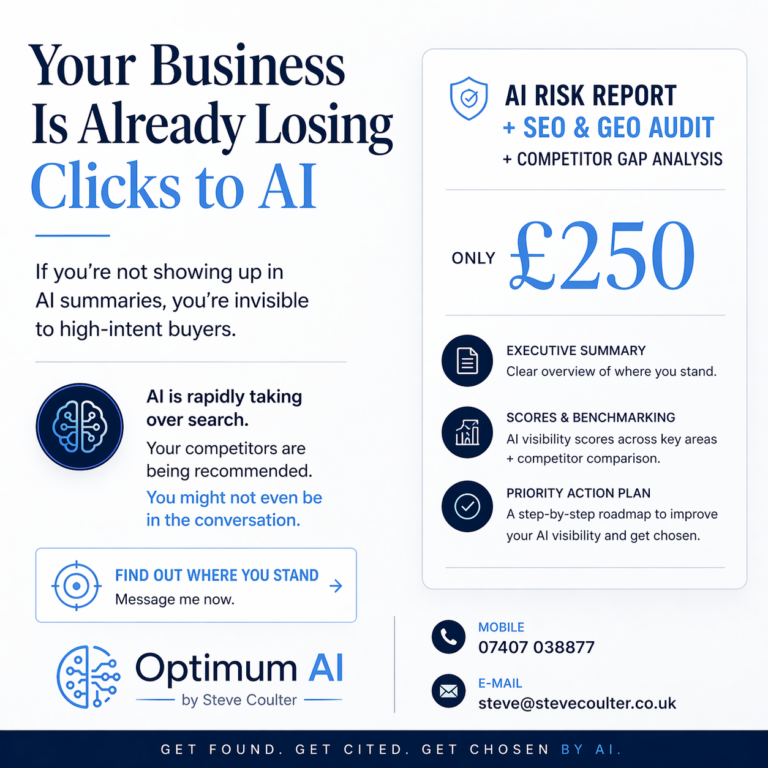
AI Risk Review Who Gets Seen

AI: Visibility Intelligence & Risk Report Offer

SEARCH HAS CHANGED. MOST BUSINESS WEBSITES HAVE NOT.

AI systems are now deciding which businesses get seen, recommended and trusted. Yet across industry including; estate agency, publishing and motor retail, OPTIMUM has uncovered the same problems:

Poor SEO. Non-existent AI optimisation. Weak entity signals. Template websites built for a search landscape that no longer exists.

Businesses are losing clicks, leads and authority without even realising it.

OPTIMUM identifies the hidden gaps damaging visibility in Google AI Overviews, ChatGPT, Gemini and AI-driven search.

We help businesses:
• Reduce dependence on portals and third-party platforms
• Strengthen AI discoverability and local authority
• Close keyword and entity gaps competitors are missing
• Capture high-intent traffic before disruptors do

This is not traditional SEO.

This is digital resilience for the AI discovery era.

The ‘OPTIMUM – AI Visibility and Risk Report’ is £500 RRP but currently just £250 which is incredible value for the detailed information surfaced which often uncovers hundreds of thousands of pounds of gross profit missed.

Please contact me for more information.

OPTIMUM
AI Visibility Intelligence for Businesses That Intend to Lead.