From Your Correspondent: Google Might Be About To Widen The Pool

For over a decade, SEO has operated within a fixed constraint: Google’s deep learning ranking systems only evaluate the top 20–30 candidate pages because running neural networks on more results is too expensive. That number wasn’t chosen for quality reasons. It was set by hardware budgets and memory costs. Court testimony from Google’s VP of Search confirmed it, and now Google Research has published the algorithm that could remove the constraint. TurboQuant compresses vector representations by 4x whilst maintaining retrieval quality, making it economically viable to evaluate far larger candidate sets. When the ranking window widens, the rules change. Sites with strong content and structured data get a fair hearing against established players with dominant backlink profiles. The moat around incumbent rankings is about to shrink.

Google has historically ranked pages using a two-stage process that evaluates tens of thousands of candidates before applying deep learning (RankBrain, BERT) to just 20–30 finalists. This narrow window exists because running neural ranking on more pages is too expensive in compute and memory. That constraint was confirmed under oath by Google’s VP of Search, Pandu Nayak, during the DOJ antitrust trial.

Now the hardware economics are shifting. Google has published TurboQuant, a vector compression technique that reduces memory requirements by 4x whilst keeping retrieval quality high. CEO Sundar Pichai has acknowledged severe supply constraints on memory and foundry capacity, but TurboQuant addresses exactly that bottleneck by making retrieval indexing “virtually free” and reducing memory load per vector dramatically.

If deployed, TurboQuant lets Google evaluate a much larger candidate set before final ranking without adding hardware cost. The 20–30 page window was never a design decision. It was a budget ceiling. When the ceiling lifts, the entire competitive surface changes.

Why widening the search pool is good news

A wider candidate set levels the playing field. Under the current constraint, strong content on smaller or newer sites often never reaches the deep learning ranking layer because it gets culled in early retrieval stages dominated by classical signals like domain authority and link equity. The top 20–30 slots tend to go to established players with robust backlink profiles, not necessarily the pages with the best answers.

When Google can afford to evaluate 100 or 200 candidates instead of 20, retrieval-ready content gets a fair hearing. Pages with clear, citable claims, strong entity associations and semantic coherence can enter the ranking window even without legacy domain authority. Sites that have invested in content quality and structured information rather than link-building arms races get a shot they didn’t have before. The moat around incumbent positions shrinks.

For SMEs, local businesses and specialist publishers without big backlink budgets, this matters. If your page is genuinely retrieval-friendly (meaning AI systems can extract, verify and cite it), you’re now competing on content merit in a larger pool rather than being filtered out before ranking even starts. The game shifts from “can I outrank these 20 entrenched sites” to “can I be one of the 100 or 200 pages Google considers worth evaluating”. That’s a much more achievable threshold for quality content.

In practical terms for your consultancy clients: automotive retailers and estate agents with well-structured, citation-ready content (clean JSON-LD, strong NAP consistency, clear expertise signals) will have a better chance of appearing in AI-mediated results and wider ranking windows than they do now, where they’re often squeezed out by aggregator sites with stronger link profiles.

The shift favours signal over legacy authority.

DIGITAL MARKETING: The Evolution Of Search

Search has evolved beyond rankings and keywords. In the age of AI-driven discovery, brands and businesses no longer compete solely for clicks, they compete for inclusion, understanding and endorsement.

Modern SEO, AEO and GEO now centre on four critical stages of visibility and influence.


1. Discovery – are you visible in the first place?

Before a search engine or AI assistant can recommend your business, it must know you exist.

Technical SEO, structured data, entity optimisation and semantic relevance all matter here. Search engines and generative AI systems require clear, accessible, machine-readable information to surface brands within responses and recommendations.

If your content cannot be crawled, indexed or understood, your expertise never enters the conversation.

“Visibility is no longer about ranking on page one. It is about being present wherever AI systems gather knowledge.”

2. Credibility – are you the option they trust?

AI platforms do not simply retrieve information; they evaluate it.

When multiple businesses cover the same topic, systems increasingly favour brands that demonstrate authority, consistency and expertise. Strong reviews, authoritative backlinks, accurate citations, topical depth and a recognisable digital footprint all contribute to trust signals.

This is where GEO and AEO become essential. The objective is not merely to appear, but to become the source algorithms feel confident using.

“The brands that win attention tomorrow will be those machines perceive as dependable today.”


3. Understanding – is your brand narrative clear?

AI systems now interpret and summarise businesses on behalf of users. Often, your company is being described before a visitor reaches your site.

That makes clarity vital.

If your messaging is inconsistent or poorly structured, AI-generated summaries may misrepresent your services, audience or expertise. A confused narrative weakens positioning and reduces relevance in recommendation systems.

“Effective optimisation now means shaping how machines understand your business – not just how humans read it.”


4. Influence – are you driving decisions?

The final stage is where visibility becomes commercial value.

The real winners in modern search are not the brands that simply appear in results, but the ones actively recommended when users ask for the best solution, provider or product.

AI search is rapidly becoming a recommendation engine. Businesses must optimise not only for traffic, but for preference and authority.

The future of digital marketing belongs to brands that are consistently surfaced, trusted, understood and recommended across every layer of search and AI discovery.

“Because modern optimisation is no longer just about being found – It is about becoming the answer.”

To learn more about my AI and SEO optimisation product OPTIMUM please contact me.

AI Risk Review Who Gets Seen

AI: Visibility Intelligence & Risk Report Offer

SEARCH HAS CHANGED. MOST BUSINESS WEBSITES HAVE NOT.

AI systems are now deciding which businesses get seen, recommended and trusted. Yet across industry including; estate agency, publishing and motor retail, OPTIMUM has uncovered the same problems:

Poor SEO. Non-existent AI optimisation. Weak entity signals. Template websites built for a search landscape that no longer exists.

Businesses are losing clicks, leads and authority without even realising it.

OPTIMUM identifies the hidden gaps damaging visibility in Google AI Overviews, ChatGPT, Gemini and AI-driven search.

We help businesses:
• Reduce dependence on portals and third-party platforms
• Strengthen AI discoverability and local authority
• Close keyword and entity gaps competitors are missing
• Capture high-intent traffic before disruptors do

This is not traditional SEO.

This is digital resilience for the AI discovery era.

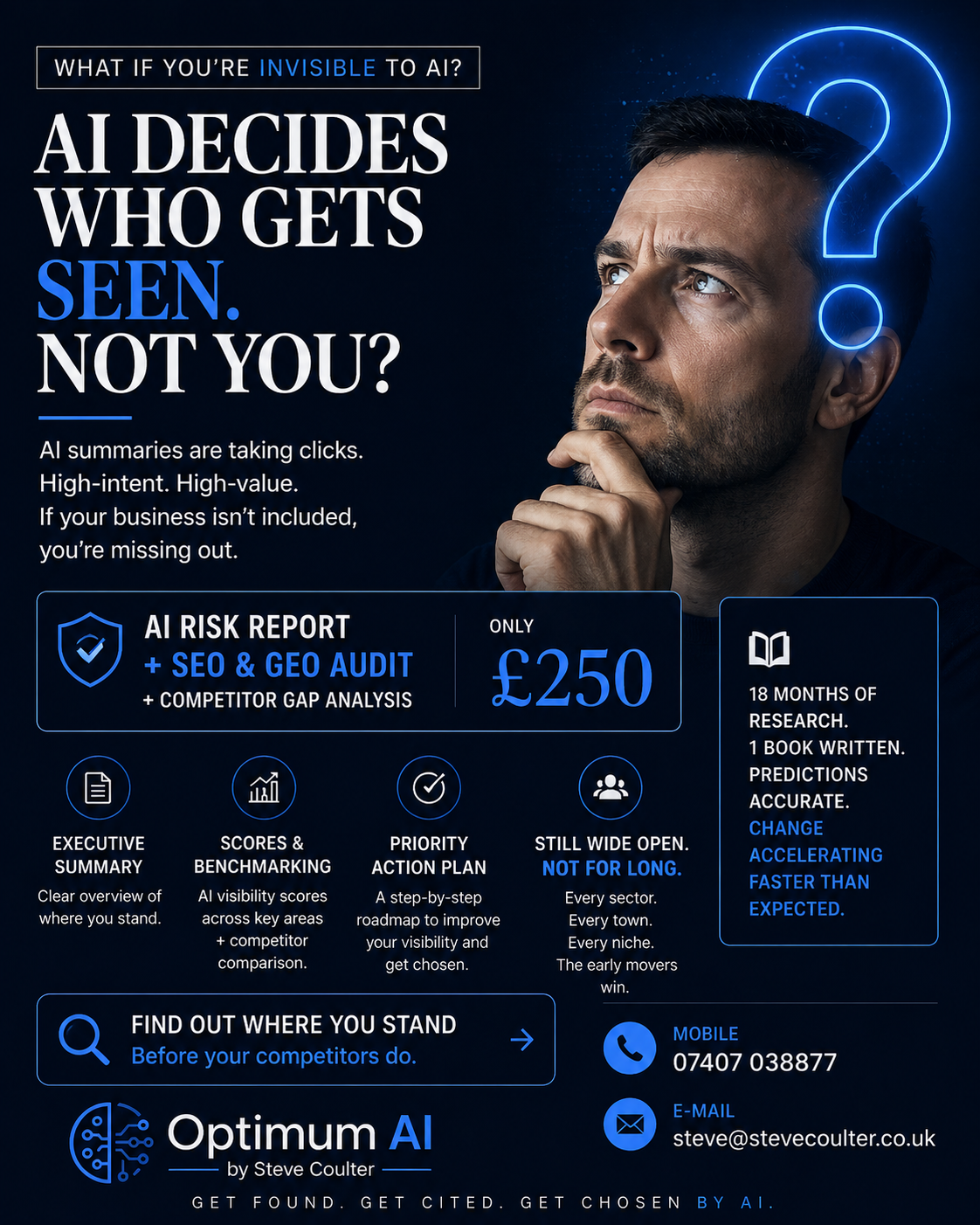
The ‘OPTIMUM – AI Visibility and Risk Report’ is £500 RRP but currently just £250 which is incredible value for the detailed information surfaced which often uncovers hundreds of thousands of pounds of gross profit missed.

Please contact me for more information.

OPTIMUM
AI Visibility Intelligence for Businesses That Intend to Lead.

CONSULTANCY: AI Risk Report. How Ready Is Your Business?

AI Risk Review Who Gets Seen

The Businesses Winning in AI Search Aren’t Always the Ones Ranking First

There’s a quiet shift happening in search.

Not an update. Not a tweak. A change in how decisions are made.

Users are no longer scanning pages of results. They’re asking questions and getting answers. Directly. Instantly. Often without clicking at all.

And those answers come from AI.

Which raises a simple question.

If AI is choosing who to recommend… is it choosing you?


The Problem Most Businesses Haven’t Spotted Yet

You can still rank well.

You can still invest in SEO.

You can still appear on page one.

And still lose the click.

Because AI summaries are now taking a growing share of search traffic. They sit above traditional results. They filter choices. They present a shortlist.

If you’re not included in that shortlist, you’re not part of the decision.

That’s the gap.


This Is Not SEO. It’s Something Else

For the past eighteen months I’ve been focused on Generative Engine Optimisation.

Not as an extension of SEO. As a separate discipline.

The premise is straightforward.

Search engines rank.
AI systems select.

Selection is based on different signals. Structure. Clarity. Authority. Consistency. Trust.

Get those wrong and you disappear from AI results, even if your rankings look fine.

What’s notable now is not just that this shift is happening.

It’s the speed.

If anything, the pace has accelerated faster than expected.


Why This Matters Now

AI traffic behaves differently.

It’s not casual browsing. It’s decision-led.

  • Higher intent
  • Better engagement
  • Stronger conversion

Fewer clicks, perhaps. But better ones.

Which means the businesses being cited by AI are not just getting traffic. They’re getting the right traffic.

And at the moment, in most sectors, the field is still open.


Introducing the AI Risk Report and SEO + GEO Audit

This is not another generic audit.

It’s a clear, structured view of how your business performs in both traditional search and AI-driven visibility.

What you get:

  • Executive summary
    A straight answer on where you stand
  • Scored audit
    Key areas rated out of ten so you can see strengths and weaknesses quickly
  • Competitor gap analysis
    Who is being selected instead of you, and why
  • Priority action plan
    What to fix first, in order of impact

All for a fixed fee of £250.

No padding. No filler. Just clarity.


What Happens Next

If you want to act on it, I work with you and your team to implement the changes.

Not theory. Not slides. Actual updates to your site, content and signals that improve your likelihood of being included and cited.

Done properly, this compounds.


The Window Is Still Open

This is the part most people underestimate.

We are early.

Which means in many markets there is no clear leader yet in AI search.

No entrenched winners. No closed lists.

Just a short window where the businesses that move first can define their position.

That window will not stay open.


A Simple Question

If someone asks AI for the best provider in your space tomorrow…

Does your business appear?

If you’re not sure, that’s the place to start.


Short Q and A

What is an AI Risk Report?
A review of whether your business is visible, cited or ignored in AI-generated search results, and what is affecting that position.

How is this different from SEO?
SEO focuses on rankings. GEO focuses on being selected and cited by AI systems before a user clicks.

Can I pay to be included in AI summaries?
No. Inclusion is based on relevance, authority and how clearly your content can be interpreted.

Why am I losing traffic if my rankings are stable?
Because AI is answering queries directly and reducing the need for users to click through.

How quickly can results improve?
Some changes can have an immediate effect. Others, particularly authority signals, build over time.


Find Out Where You Stand

If you want a clear view of your position and what to do about it:

Call: 07407 038877
Email: steve@stevecoulter.co.uk

Or message directly.


Optimum AI by Steve Coulter
Get found. Get cited. Get chosen by AI.

AI Search Summaries? [ANYTOWN] Is Wide Open

Most UK businesses are still years behind in local SEO, let alone Generative Engine Optimisation (GEO) essential for AI Summary citation which leaves a clear opening for those willing to act now. If you want to become the go-to authority in your town before the competition catches up, this will show you where the real advantage lies and how to take it.


Local SEO and GEO AI in the UK Is Still Wide Open – If You Know What You’re Doing

Spend any time looking at local search results across UK towns and cities and a pattern quickly emerges. Most businesses are visible, but very few are actually competitive in a meaningful way. There is a clear gap between what companies think counts as “local SEO” and what genuinely drives visibility in modern search, especially as AI-led results and answer engines become more prominent.

For many firms, local SEO still means a basic website, a handful of service pages, and a Google Business Profile with a few reviews. That approach might have worked five years ago, but it falls short today. Search systems are now far better at identifying authority, relevance, and real-world signals. They are not just ranking pages. They are deciding which businesses are trustworthy enough to surface, summarise, and cite.

This is where the gap begins.

The Reality Behind “Local Visibility”

What most businesses have is a presence. What very few have is a structured, location-aware digital footprint that reinforces itself across multiple signals.

An effective local strategy today looks more like building a network than a single website. It includes properly developed location or postcode pages, internal linking that reflects real service areas, consistent and growing review signals, and content that demonstrates actual involvement in the local community. It also means being recognisable as an entity, not just a business name on a page.

Much of the current conversation around GEO and AI-driven search is ahead of what the average UK business is doing. While marketers discuss citations, entity relationships, and answer engine optimisation, many local firms are still relying on templates and generic copy. That mismatch creates opportunity.

Why One Business Can Pull Ahead

In smaller and mid-sized UK markets, competition is often thinner than expected. Not because there are fewer businesses, but because so few execute well digitally.

When one company invests properly in its local presence, it can quickly separate itself. A site that covers key boroughs or service areas in depth, backed by strong reviews, relevant content, and clear internal structure, can outperform competitors that have been established for years.

This creates a first serious mover advantage. The business that positions itself as the most useful and locally relevant source tends to become the one search systems rely on. Once that trust is established, it compounds.

Where the Opportunity Is Strongest

The biggest gains tend to sit in service-led sectors where intent is both local and urgent. Trades, legal services, healthcare, home improvement, events, and specialist professional services all fall into this category.

These are areas where people want quick answers and reassurance. They are not browsing casually. They are choosing who to trust.

Smaller towns are particularly interesting. Many have limited digital competition, weaker local media ecosystems, and fewer high-quality backlinks or mentions. That leaves a wide opening for any business willing to invest in doing things properly.

The Limits of “Dominance”

It is important not to oversimplify. This is not just about publishing more content or building more pages.

Google Business Profile strength still matters. So does proximity, brand recognition, links, and real-world reputation. A technically strong site without supporting signals will struggle to fully dominate.

There is also a timing element. What looks like easy ground today is unlikely to stay that way. As more agencies and businesses catch up, the gap will narrow. Over the next one to two years, we can expect a more competitive and structured local landscape.

What Actually Wins

The businesses that succeed will not just be “optimised”. They will be the ones that are clearly the best answer for their area.

That usually comes down to a combination of:

  • Strong, logical location architecture across the site

  • Content that is genuinely useful and locally grounded

  • Consistent, high-quality reviews and supporting media signals

  • Real-world authority that search systems can confidently reference

In simple terms, it is about becoming the most credible local source in your niche.

Right now, much of the UK market is still underdeveloped in this respect. For businesses that recognise the shift and act early, the upside is significant. The window is open, but it will not stay that way forever.

DIGITAL MARKETING: Legacy Business and Mistaken Identity.

This week by utilising my analysis tool, OPTIMUM v2.2, in my role as a business consultant I can share three real-world cases where the digital tool revealed what conventional Search Engine Optimisation (SEO) audits simply miss – from a digital disruptor poised to overtake an established rival, to a business losing ground in AI Summaries because of another company’s bad reviews. If you think your Google SERPS and review ratings tell the full story, read on.

Was it Sir Richard Branson who said, “Train good managers well and pay them enough so they won’t want to leave“? Sound advice, as it turns out.

When senior managers and directors walk out of a legacy business that has only dipped its toes into the digital world, then immediately set up a rival operation that is leaner, more digitally confident, and energised by the founders’ drive, they do not simply become competitors. They become disruptors, and potentially an existential threat.

This week I ran OPTIMUM v2.2 across two businesses in entirely different sectors. In both cases, the data points in the same direction: the newcomer is on course to overwhelm the incumbent within six to twelve months in all areas of the business.

One of the new entrants scores particularly well across digital marketing, SEO and Generative Engine Optimisation (GEO) which in layman’s terms means AI Summary inclusion. The only reason it sits behind the legacy player in any notional local league table is that its five-star reviews are too recent to have yet shifted the algorithm’s overall rating. That will change in a few months to compound their initial success.

Another case threw up something altogether more abstract. A well-regarded Midlands business, with years of strong Google reviews and solid standing across industry portals, returned an unexpectedly low trust score. The reason? Another firm operating in the same region has a remarkably similar name and a TrustPilot rating of just 1.2 out of 5. The AI systems are conflating the two, and my client is being dragged down by a reputational deficit that has nothing to do with him.

The fix is straightforward in principle: create a TrustPilot profile using the exact business name, address and contact details, build up a body of genuine five-star reviews, and re-run the assessment in a few months. It is a concrete, actionable win that would not have surfaced without running the OPTIMUM Ecosystem tool.

On a broader point: when I run typical local searches, the first few pages of results are dominated by larger players with serious SEO investment or the budget to buy their way to the top. That is not a battle most SMEs can realistically win on Google.

AI Summaries are a different matter. At present, the only route to inclusion in those summaries is through genuine GEO optimisation of your website. There is no shortcut and no media buy. My view is that, right now, every town and city represents an open opportunity for a switched-on business to own the AI Summary space for its sector or niche. Not only can that battle be won, but the businesses that establish authority early will carry that advantage forward. The AI systems will keep referencing those early signals as they generate future responses, and that compounding effect is only going to grow.

That combination of proprietary diagnostic data and hard-won experience is precisely what makes the difference between an interesting report and a result. The tool sees what the algorithms see; the consultancy knows what to do next. If you would like to find out what OPTIMUM v2.2 reveals about your business, your competitors, or your AI Summary visibility, I would be happy to talk.

ESTATE AGENCY: Wake Up, You Have Website Paralysis

There is a clear and consistent issue across local estate agent websites. They are not built to generate business. They are built to exist.

Most agents rely heavily on portals like Rightmove and Zoopla for leads, treating their own website as a secondary asset. That creates a risk. If portal costs rise or performance drops, many firms have no reliable, owned source of enquiries. The automotive sector has already felt this pressure with Autotrader. Estate agency is heading in the same direction.

At the same time, most websites are under-optimised.

Common problems include thin location pages, duplicated property content, weak internal linking and outdated metadata. More importantly, there is little alignment with how people actually search. Buyers and sellers are asking detailed, intent-driven questions, yet very few agent websites provide meaningful answers.

This is where the real gap sits.

Content is often shallow and self-focused rather than useful. There is little coverage of the full customer journey, from early research through to decision. As a result, agents miss out on valuable organic traffic and fail to build authority in their local market.

Generative search adds another layer. Most sites are not structured in a way that AI systems can easily understand or trust. Without depth, clarity and consistency, they are unlikely to appear in AI-driven results.

Keyword gap analysis typically reveals hundreds of missed opportunities across local, long-tail and high-intent searches. Opportunity gap analysis then shows which of these are actually worth pursuing based on competition and conversion potential.

The bigger issue is strategic. Most estate agent websites are not designed as end to end marketing systems. They attract limited traffic, offer little engagement and convert poorly.

A more effective approach combines technical SEO, structured content, GEO readiness and clear conversion pathways. This turns a website from a passive brochure into an active source of instructions.

The opportunity is significant. Agents who invest in their own digital presence can reduce reliance on portals, improve margins and build a more stable pipeline of leads.

Right now, most are not doing this.

That is where the advantage lies.

To establish where you are today and understand where you could be tomorrow contact me and we can run an OPTIMUM V2 Ecosystem report.

AUTOMOTIVE: How AI Is Changing the Rules of Search

If your dealership website is seeing fewer visitors than it was a year ago, you’re not imagining it. Some of that declining traffic is a direct result of how artificial intelligence (AI) is reshaping the way people search online and the rules are changing faster than most dealers realise.


Over the last 18 months as a research project I’ve been studying the effect of AI technology on Internet search. New agency disciplines like Generative Engine Optimisation (GEO) Conversational Search (CAI) and Answer Optimisation (AO) all drive AI Search Summary results including the citation links.

The fact is – Customers are increasingly getting the answers they need in the AI Summary at the top of the search results (SERPS) without ever clicking through to your website. That’s not a temporary blip, it’s a structural shift in how search works. There’s every chance you are burning your Pay Per Click (PPC) budget.

Here’s another steer – don’t chase every new AI tool that lands in your inbox, an endless wave of shiny new products promising to revolutionise your digital presence. Instead go back to basics.

Review what you already have, identify the gaps, and fix your foundations first.

UK dealers are being targeted by an ever-growing number of AI marketing vendors, many of whom are selling solutions to problems dealers haven’t fully understood yet – I wrote an article called The Comprehension Gap. Understanding the landscape clearly is the essential first step. Some solutions don’t even need AI to resolve them.

The Language You Need to Know

To make sense of what’s happening, it helps to get comfortable with a handful of key terms that are increasingly shaping how dealers think about their digital presence.

SEO (Search Engine Optimisation) is the practice most dealers are already familiar with – building website content that ranks well in Google keyword searches and earns free, organic traffic. It remains important, but it’s no longer the whole picture. In fact Semrush, a leading analytics provider, recently  quoted a 1/3 drop off in search appearances for popular search terms because of ‘position zero’ AI summaries. Those enquiries are going to the forward thinking supplier who, ahead of the game in the world of GEO, is already being cited in AI search and AI App results – and will benefit from early adopter status forever.

Position Zero refers to the featured AI generated snippet that appears at the very top of Google results, providing a direct answer to a search query without the user needing to click any link. Appearing here means visibility without traffic, which is precisely the problem.

LLMs (Large Language Models) – as explained by Prof. Hannah Fry on the BBC this week – are the AI tools driven by state of the art electronic chips that are increasingly influencing how people search and make decisions. These include Google Gemini, ChatGPT, Claude, and Perplexity, platforms that millions of UK consumers now turn to for recommendations, comparisons, and buying guidance.

Schema Markup (sometimes called Website Schema) is structured data added to a website’s backend that consistently labels content, vehicles, reviews, services – so that search engines can properly understand it. It helps generate richer search results and improves click-through rates. Many dealer websites in the UK lack this entirely.

GEO (Generative Engine Optimisation) is perhaps the most important new concept for dealers to grasp. Where SEO is about ranking in traditional search, GEO is about structuring and creating content so it can be easily understood, cited, and summarised by AI tools. Think of it as SEO for the AI era. Unlike traditional SEO, which tends to return the same results for the same keyword, GEO is highly personalised, the same query from two different buyers can produce completely different AI-generated answers, pulling from reviews, forums, and third-party sources alongside your own website.

Prompt Visibility refers to how frequently and prominently your dealership, brand, or specific information appears in AI-generated responses. If an AI tool is recommending dealerships near a customer, does your name come up – and in what context?

Agentic AI is the next frontier. Unlike AI tools that simply provide information, Agentic AI can independently plan, make decisions, and execute multi-step tasks. In a retail automotive context, this means AI that could guide a buyer through the entire purchase journey, from initial research to booking a test drive, with minimal human involvement. This is not science fiction; early versions of this capability already exist. LLMs were initially created to drive Chatbot conversations.

Hallucinations are incorrect results appearing in AI search summaries that could affect a contact or even a loss of reputation. AI is in the ‘Model T Ford’ era, it is not always correct and you need to be testing search terms for accuracy as part of your reputation management.

What This Means for U.K. Dealers

The practical implications are significant. Every positive customer review matters more than ever, because AI tools draw on that content when forming recommendations. An authentic dealer with consistently strong, genuine reviews is far more likely to appear in AI-generated responses than one whose online reputation is thin or inconsistent.

Critically, responses to reviews also need to feel human and genuine – AI can detect overly automated or templated replies, and this affects how credibly your dealership is represented. You cannot rely on AI in most cases ChatGPT writing your content – it’s great for writer’s block, but rewrite ideas in your personal tone.

Your website content needs to answer real questions clearly and directly. Generic manufacturer copy doesn’t help AI understand what makes your dealership distinct. Pages that explain finance options, compare models, or provide genuinely useful local information are the kind of content that both search engines and AI tools favour.

From a technical perspective, your website needs to be accessible to AI crawlers in the first place. A significant number of dealer sites inadvertently block tools like ChatGPT and Google’s AI systems through robots.txt settings or security configurations – meaning those tools simply cannot recommend them, regardless of how good their stock or pricing is. Does your supplier understand llms.txt and is this included in your website back end? These are now questions you need answers to.

The fundamentals; fast loading websites, clean data, honest content, and a credible presence across all digital platforms haven’t changed. What’s changed is how much they matter, and what gets built on top of them.


Steve Coulter is a four decades Sales and Marketing expert with a career in the Automotive Industry and involved in state of the art Digital Marketing since 1999.

AUTOMOTIVE: Porsche Profits Apply The Big Stoppers

Porsche, once the golden child of German engineering and luxury performance, has hit an unexpected crisis in 2025. After years of record profits and unmatched prestige, the carmaker has reported a devastating fall in earnings, with operating profit plunging by more than 99 percent. The decline raises urgent questions about Porsche’s electric strategy, global sales slump, and future in an increasingly uncertain automotive market.

There was a time when the air in Zuffenhausen smelled of success and the confidence of endless growth. Porsche was the brand that never stumbled, the company that made perfection seem routine. Yet this year the balance sheets told a very different story.

For the first time in living memory, Porsche has posted a loss. Not a minor dip or a brief misfire, but a full-blown financial skid. In the third quarter of 2025, the company recorded an operational loss of nearly one billion euros. Across the first nine months of the year, profits collapsed from around four billion to just forty million. The figures landed like a crash through the guardrail at La Source.

The roots of Porsche’s decline lie in its costly electric gamble. Determined to lead the luxury EV revolution, the company poured billions into its own battery programme and an ambitious range of electric cars. The goal was clear: by 2030, eighty percent of new Porsches would run silently rather than roar. The market, however, had other ideas.

Buyers loved the Taycan’s design and speed, but hesitated at the price and limited range. High costs and lukewarm demand forced Porsche to retreat. The battery division was scrapped, new electric SUVs cancelled, and the firm took a three billion euro write-down. The pivot back to hybrids and combustion engines restored a little sanity, but the damage was done. Investors saw indecision. Customers saw confusion.

External pressures made things worse. In America, new tariffs on European luxury cars have already cost Porsche hundreds of millions of euros. Prices have risen, and demand has fallen. Across the Pacific, China’s once-booming market for Western prestige cars has cooled sharply. Sales dropped by more than twenty-five percent as domestic electric brands took centre stage.

Europe offered no comfort either. Economic fatigue and tighter emissions laws have hit the high-end market. Even the 911, the timeless heartbeat of Porsche, faces an uncertain future in a world determined to phase out petrol. Volkswagen Group, Porsche’s parent company, has reported its own steep drop in profit, much of it linked to this turmoil in Zuffenhausen.

The response has been fast and severe. Around four thousand jobs have already gone, and restructuring costs have topped three billion euros. Meetings that once celebrated lap times now focus on cost savings. Michael Leiters, Porsche’s new chief executive and a former McLaren man, has inherited the unenviable task of restoring confidence while steering a bruised and bewildered company back to growth.

Behind the scenes, engineers are refocusing. Porsche will rely on its most loyal strengths: craftsmanship, performance, and the feel of quality that no algorithm can reproduce. Future cars will blend petrol and electric power rather than replace one with the other. The idea is to rebuild gradually, balancing innovation with identity.

For decades, Porsche was defined by certainty. Every car, from the 911 Turbo to the Macan, carried the same message of precision and purpose. But the modern world is no longer so simple. Customers expect luxury, performance and sustainability in a single package. Governments demand cleaner cars. Markets demand profit. Somewhere in that storm, Porsche lost its footing.

Yet history suggests the brand knows how to recover. In the early Eighties, Porsche faced a similar reckoning. Sales were weak, costs were high, and purists feared the end of the 911. The company survived by listening to its engineers rather than its accountants. It rediscovered its essence. That may be the lesson Zuffenhausen needs again today.

If Porsche can blend its heritage with a clearer, more measured path to electrification, it could regain its balance. The 911 remains a global icon, and the Taycan, for all its struggles, proved that electric Porsches can still thrill. What the brand needs now is consistency and patience. The next great Porsche story will not be written in spreadsheets but in steering feel, design integrity and engineering bravery.

For now, though, Porsche’s halo has dimmed. The numbers are harsh, the markets unforgiving, and the pressure immense. Yet if any marque can turn a loss into a lesson, it is the one that made imperfection an art form.

What Porsche Could Do Next?

– Refocus the product line: Build hybrids and performance models that maintain the emotional core of the brand while easing customers toward electric power.
– Control production costs: Simplify supply chains, delay unnecessary launches, and invest only in platforms that deliver profit and flexibility.
– Strengthen brand storytelling: Reignite the emotional link between car and driver through heritage design cues and motorsport engagement.
– Win back key markets: Adjust pricing and marketing strategies in the United States and China to match shifting buyer sentiment.
– Prepare for the long term: Develop a steady, sustainable EV roadmap that doesn’t gamble the company’s identity on unproven demand.

If Porsche manages to balance its heart with its head, it will emerge stronger. The figures may be grim today, but the brand’s legacy of resilience remains intact. The brand is used to the smell of victory.

AI: Five Ways for SMEs to Protect Sales Leads and Marketing Efficiency in the Age of AI

The rise of artificial intelligence and AI Search Summaries (Resulting in answers from Zero Clicks) is changing the way people find and choose businesses online. For SME owners, this shift means the traditional paths to generating sales leads and website traffic are under significant pressure. AI-driven search tools often provide direct answers without needing users to click through to websites. This can reduce the number of leads and enquiries your business may get from online marketing. But there are clear steps small businesses can take this week to adapt and safeguard their sales efforts.

Here’s five immediate moves you can make THIS WEEK. 


1. Optimise for AI-Driven Search

Simply relying on old-fashioned search engine optimisation is no longer enough. Generative AI and tools like Google’s AI Overviews pick and summarise information directly from websites. It pays to adapt your content and code with clear, authoritative answers to common questions your customers ask. Using structured data on your site helps AI systems extract your business information accurately, increasing the chance your company will be referenced and recommended even without a traditional link click.

2. Broaden Your Lead Generation Channels

With fewer website visits from AI summaries, it is wise to build leads through multiple channels. Boost your presence on LinkedIn, local business directories, review platforms, and relevant industry forums. Keeping these online profiles up to date ensures your company can be found through AI recommendations in different digital spaces, capturing customers who no longer start with a Google search alone.

3. Strengthen Trust and Credibility Signals

AI tools favour sources that demonstrate expertise and trustworthiness. Ensure your website clearly shows accreditations, client testimonials, and case studies. Keep your legal pages, such as privacy and terms, current and transparent – these may be automated using AI tools. These elements help build the confidence AI systems and your customers need to choose your business over others.

4. Focus on Direct Nurture and Retargeting

Since organic site traffic might drop, it is important to maintain contact with existing and potential customers through email newsletters, retargeting adverts, and downloadable resources. Collecting first-party data – for example, through newsletter sign-ups – with clear consent – means you can continue marketing directly to interested leads, even as search behaviours evolve. Building your own customer database and reviews away from major retail platforms like Autotrader and Right Move is vital.

5. Review Your Analytics and Tracking

AI search changes and stricter privacy rules may reduce the accuracy of traditional website analytics. Take a detailed look at your tracking and attribution methods. Consider tools that track referrals from AI platforms, branded searches, and mentions. Adjusting your measurement models allows better insight into where leads come from and how AI impacts your digital visibility. Also check typical searches on the major AI LLM apps like ChatGPT and Perplexity to see if you are included in citations – if not who is? What information is being picked up and can you emulate this?

***

AI technologies are here to stay, but with the right approach, SMEs can continue to thrive. Taking these practical steps this week helps protect your sales pipeline and marketing success in a rapidly changing digital landscape.

***

Too busy, or this is outside your level of expertise? Contact Me today for a conversation about how my agency might assist. 

DIGITAL MARKETING: AFFORDABLE AI & SEO HEALTH CHECK

Is your business visible when it matters most?

With Google’s AI summaries now dominating search results, the digital landscape has shifted dramatically – and quickly.

What worked last March might be costing you customers today.

As an SME owner or director, you’re juggling countless priorities. But here’s the reality: whilst you’ve been focused on running your business, the way customers discover and evaluate companies has fundamentally changed. Google’s AI now determines which businesses get featured in those crucial summary boxes that appear before traditional search results.

The question isn’t whether you need a digital presence – it’s whether your current one is working.

Many SME owners assume their website and social media are “sorted” because they exist. But an empirical analysis often reveals:

• Your ideal customers can’t find you when they’re actively searching

• Competitors with weaker offerings are appearing ahead of you

• Your digital messaging doesn’t reflect your actual business strengths

• You’re missing opportunities in channels where your customers actually spend time

This isn’t about expensive overhauls or complex tech solutions. It’s about getting an objective, data-driven assessment of where you stand and what simple changes could make the biggest impact.

The businesses thriving right now aren’t necessarily the biggest – they’re the ones that understand their digital footprint and have aligned it with how customers actually behave online.

If you’ve been putting off that digital review because it feels overwhelming or expensive, consider this: the cost of not knowing where you stand is likely far higher than finding out.

The bonus is that my service is not only invaluable, but very affordable – I’ve started and run SME sized businesses so I understand cost control and value.

Don’t let your competitors steal tomorrow’s customers whilst you’re serving today’s.

Message me to get the ball rolling. 

DIGITAL MARKETING: Be Super Effective With Top Keywords

Unlocking Growth: The Ultimate Guide to Digital Marketing Services for Businesses

In today’s fast-paced online world, digital marketing is the cornerstone of business growth. Whether you’re a startup, a local business in Littlehampton, or an established B2B company, the right digital marketing strategy can transform your brand’s reach, generate quality leads, and drive measurable results. But with so many options: SEO, content marketing, social media marketing, PPC, and more how do you know which digital marketing services are right for your business?

This guide explores the best digital marketing agency solutions for small businesses and established firms alike, and helps you discover effective, affordable strategies tailored to your goals.

Why Digital Marketing Matters for Your Business

Digital marketing is more than just a buzzword. It’s a collection of powerful tools and strategies that allow businesses to connect with their target audience online. From effective SEO techniques for small businesses to advanced PPC management for startups, digital marketing services are essential for anyone looking to compete and thrive in the digital age.

Key Benefits:
– Increased Visibility: Online marketing ensures your business is found by customers searching for your products or services.
– Targeted Reach: Digital marketing allows you to focus on specific demographics, locations, and interests.
– Measurable Results: With analytics, you can track every click, lead, and sale to maximise ROI.

Choosing the Best Digital Marketing Agency for Small Business

Selecting the right digital marketing agency is crucial. The best agencies offer a blend of creativity, technical expertise, and a deep understanding of your industry. When searching for a digital marketing agency near me or digital marketing services near me, look for providers with proven experience, transparent pricing, and a portfolio of successful campaigns.

What to Look For:
– Industry Experience: Agencies that specialise in your sector (e.g., content marketing agency for B2B companies) understand your unique challenges.
– Customised Strategies: Avoid one-size-fits-all solutions. The best agencies are business enthusiasts that tailor their approach to your business goals.
– Comprehensive Services: From SEO to email marketing, choose an agency offering a full suite of services.

Building an Effective Digital Marketing Strategy

A successful digital marketing strategy is the foundation of online growth. But how do you create a digital marketing strategy that delivers results?

Steps to Success:
1. Define Your Goals: Are you looking to increase website traffic, generate leads, or boost sales?
2. Know Your Audience: Use data to understand your customers’ needs and online behaviour.
3. Choose the Right Channels: Focus on platforms where your audience spends time: be it Google, Facebook, LinkedIn, or email.
4. Measure and Optimise: Track key metrics and adjust your strategy for continuous improvement.

Essential Digital Marketing Services for Businesses

1. SEO (Search Engine Optimisation) Effective SEO techniques for small businesses are vital for ranking higher in Google search results. This includes keyword research, on-page optimisation, link building, and local SEO strategies.

2. Content Marketing
Content marketing agency services help you create valuable blog posts, videos, and guides that attract and engage your audience. High-quality content boosts your authority and drives organic traffic.

3. Social Media Marketing
Top social media marketing strategies for businesses focus on building relationships, growing your following, and driving engagement on platforms like Facebook, Instagram, and LinkedIn.

4. PPC (Pay-Per-Click) Management
Affordable PPC management for startups ensures you get the most from your advertising budget. Google Ads and social media ads can drive targeted traffic and quick results.

5. Email Marketing
Email marketing best practices for businesses include personalised campaigns, automation, and segmentation to nurture leads and retain customers.

6. Lead Generation Services
Lead generation services for your industry use a mix of online advertising, landing pages, and content offers to capture high-quality leads.

Online Advertising Solutions for Local Businesses

For local businesses, online advertising is a game-changer. Whether you’re a restaurant, retailer, or service provider, digital marketing services near me can help you reach customers in your area. Google My Business, local SEO, and targeted ads ensure your business appears when people search for services like yours.

How to Get Started with Digital Marketing

If you’re new to online marketing, start by assessing your current digital presence. Are you ranking for important keywords like digital marketing, SEO, or internet marketing? Do you have active social media profiles? Is your website optimised for mobile users?

Next, set clear objectives and consider partnering with a digital marketing agency that understands your market. Look for agencies that offer:
– Transparent reporting
– Proven results in your industry
– Flexible, scalable service packages

Measuring Success: Analytics and Optimisation

One of the biggest advantages of digital marketing is the ability to track and measure everything. Use tools like Google Analytics to monitor website traffic, conversion rates, and customer behaviour. Regularly review your campaigns and adjust your digital marketing strategy to improve performance.

Why Choose a Full-Service Digital Marketing Agency like SCC?

A full-service digital marketing agency offers everything you need under one roof, from SEO and content marketing to PPC, social media, and email marketing. This integrated approach ensures consistency, maximises your budget, and delivers better results.

Conclusion: Take Your Business to the Next Level

Digital marketing is the key to unlocking your business’s potential in the online world. By investing in the right digital marketing services, you can increase your visibility, attract more customers, and achieve sustainable growth. Whether you need a content marketing agency for B2B companies, affordable PPC management for startups, or online advertising solutions for local businesses, the right partner can make all the difference.

Ready to take the next step? Start by reaching out to SCC, the best digital marketing agency for SME & MME sized businesses, and discover how a customised digital marketing strategy can help you achieve your goals.

Contact me:

Tel: +44(0)7407 038877
Email: steve@stevecoulter.co.uk

DIGITAL MARKETING: US Real Estate & U.K. Estate Agency Improvement Packages

US Real Estate & U.K. Estate Agency Digital Presence Transformation

Transform Your Real Estate Agency Business Online: My Expert Digital Enhancement Package ‘Business Boost’

Is your real estate agency website and digital marketing underperforming? Are potential clients choosing your competitors?

My Audit-Fix-Maximise program delivers immediate improvements and generates more qualified leads and closed deals.

What You’ll Get:
– Comprehensive website and Google Business Profile audit
– Search Engine Optimised content creation tailored to real estate audiences
– Strategic digital marketing alignments with Google’s critical EEAT and YMYL guidelines
– Technical optimisations to improve your visibility in both traditional and AI-powered search

Why Act Now?
In today’s challenging market, your competitors are already enhancing their digital presence. Every day without optimisation means missed opportunities and lost revenue. My proven system has helped real estate professionals increase website traffic and build trust by lifting the Google Review Score from 4.2 to 4.7

Choose Your Performance Level:
Whether you need fundamental improvements or comprehensive digital transformation, we offer customised packages designed specifically for real estate professionals looking to dominate their local market.

Affordable digital transformation packages from only £150 – £400 to set up the programme for success. Contact me to discuss your business, objectives and goals for the programme.

Contact me today.

Call: +44(0)7407 038877 (+WhatsApp)
Email: steve@stevecoulter.co.uk

SCC – Simple – Creative – Cost Effective

DIGITAL MARKETING: Business Boost Digital Transformation Offer

Your Expert SEO Content Creation Partner

Driving Results: Vast Knowledge 35+ Years of Sales & Marketing Experience

I craft content that ranks, converts, and complies with strict Google EEAT & YMYL guidelines. Specialised in automotive and finance industries with regulatory knowledge. I will learn the key topics in your industry and understand your competition to partner with you.

What You Get:
– Search Engine Optimised website copy that robots love and humans actually want to read
– Ready-to-publish website & blog content (delivered in MS Word)
– Vital HTML text upgrades to Meta Description, Title, H1 H2 & H3 Titles
– AI search optimised Schema Markup available on upgrade
– Strategic content planning to boost domain authority
– Google Business Page Review and Improvements

Available via WhatsApp to seamlessly integrate with your team.

These digital transformation starter packages deliver immediate improvement from only £150-£400

Ask about my FREE 15 Chapter 126 page Book ‘The Definitive Guide To Digital Transformation For Legacy Businesses’. Available with this offer.

Contact me today.

Tel: +44(0)7407 038877
Email: steve@stevecoulter.co.uk

SCC – Simple Creative & Cost Effective

DIGITAL TRANSFORMATION: My Foreword To ‘The Definitive Guide…’

Congratulations on discovering “The Definitive Guide to Digital Transformation for Legacy Businesses.”

How did this guide come about? As an avid user of AI applications, whilst exploring potential opportunities, I analysed my CV through a prompt seeking areas of expertise where I might find employment or commissions. Based on previous projects and successes, Digital Transformation consistently emerged as the top result. Further investigation revealed that this outcome was driven by my work in change management when implementing the BS5750/ISO9002 Quality Standard in businesses between 1995 and 2005, combined with organic digital marketing skills and knowledge developed thereafter.

The renowned physicist Richard Feynman once remarked, “You are only an expert on a subject when you can teach it to others.” With this in mind, I began researching the areas where my knowledge was lacking. This led to brainstorming chapters which, as they expanded, required further research. You now hold the result of that journey.

Certainly, anyone with an interest in digital transformation could undertake similar research, but it is time-consuming. I believe most business owners can generate more revenue by running their businesses rather than learning about Technology Horizon Scanning. Additionally, many online resources on this subject are of a research or academic nature, so I have written this guide in a non-academic style. The transformation process is divided into specific chapters, each with subheadings and a conclusion. I am developing an online version with tools and management consulting checklists. Within each chapter, you will find pearls of profit wisdom that entrepreneurs and business people will recognise and may wish to act upon. I have never attended a training course that has not yielded at least tenfold returns upon returning to business. With this in mind, despite exceeding 100 pages, I encourage you to print the document (or individual chapters) and highlight pertinent areas requiring work or research. Do make notes in the margins!

Why is this guide free? My intention is to evangelise on the subject because digital transformation is critical to the future existence of every business. I wrote this document with legacy businesses and those affected by Google’s stringent YMYL SEO rules specifically in mind. If you do not maximise your opportunities or defend your business against industry disruptors, it simply will not survive.

Compliance is also vital in YMYL disciplines and needs to be incorporated alongside contemporary issues such as accessibility and sustainability. You need digitally skilled staff and, upon completion, a system to future-proof your business. All of this is included.

As a consultant, I am available for contact. I would also appreciate your feedback from your own digital transformation endeavours, which I will incorporate into future editions.

Wishing you a successful digital transformation.

Please contact me for your FREE copy of The Definitive Guide To Digital Transformation For Legacy Businesses. The bundle includes a 15 chapter 123 page comprehensive process and also a one page 5 stage process for SME sized businesses with limited time and funds. The larger document may be used for reference.